Wine in the Hands of the Elderly: Why the Industry Isn't Changing
Priscilla Hennekam recently posted a reflection on LinkedIn that I recommend reading, "Rethinking the Impossible." It begins in the São Francisco Valley, in northeastern Brazil, between the eighth and ninth parallels south. The climate is tropical, semi-arid, with more than three thousand hours of sunshine a year.
No one changed the climate of that valley. They changed the question. They stopped asking themselves how to copy Bordeaux and started asking what could be done with what they had before them. Hennekam draws a simple idea from this: we continually confuse what has never been done with what cannot be done. We become, she writes, prisoners of what has come before. And when we say "it's impossible," we're often saying something much more modest: I still can't imagine how. Her proposal is to replace the "why can't it be done?" with another question: if it were possible, what would have to change?
I tried to pass it on to our sector.
For years, we've talked about nothing but change. Markets in upheaval, consumers no longer the same as before, models that need to be rethought. Then I look at the state of things, and I write about it often, and I see a world that seems unchangeable. Locked in the idea that there is no alternative to the status quo and that the only strategy is to hope everything goes back to the way it was before.
Yet, if you look more closely, solutions are already on the table.
People want to have fun, and I don't know many products that fit as well as wine at a party. People want experiences outside of mass, standardized tourism, and wine tourism is exactly that. There's a desire for biodiversity, and we have an impressively diverse wine offering. And today, the moment of consumption matters more than the product itself, and that's a good thing because wine, in its myriad varieties, has the right bottle for every occasion.
The ingredients are there, and there are more than we imagine. So why does putting them together in a perfect recipe seem so difficult? Indeed, so impossible?
A direct and merciless answer comes to mind. I know that, without going into detail, it might sound excessive. I'll leave it as it is, because sugarcoating it would only make it innocuous.
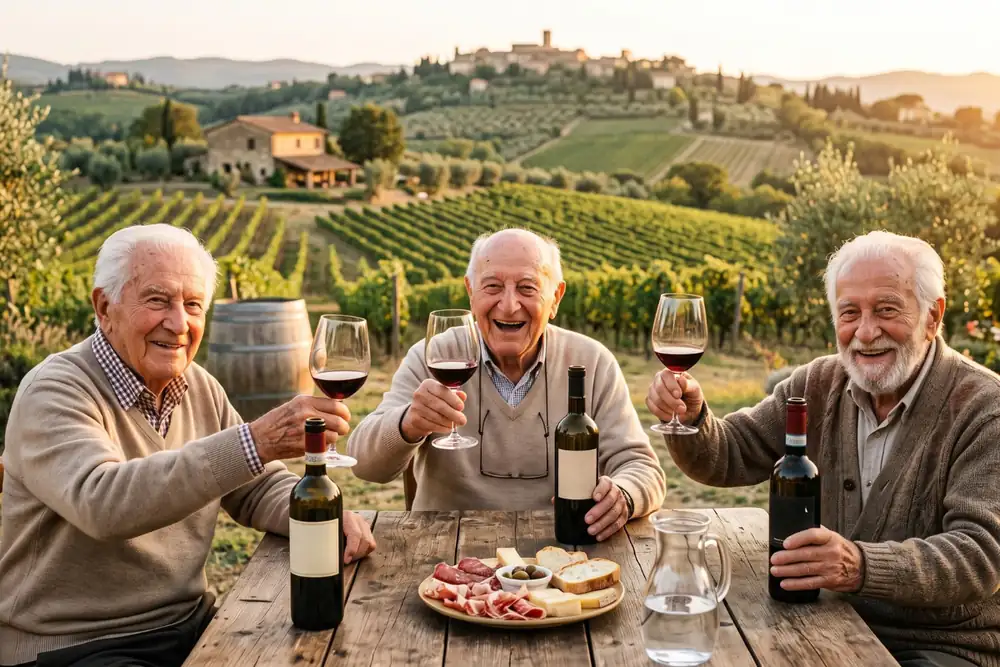
The wine is in the hands of the old. The usual old men. Old men who have no intention of leaving the field to others.
Mind you, I'm not saying wine is a product for old people. That's bullshit. I'm saying it's a product in the hands of old people, and that's a whole other story.
And it's not just a generational transition issue within companies. It affects the entire supply chain: consortia, organizations, the media, and wine critics. I'm the first to have to take this into account, given that I've been doing this job for quite some time.
And unfortunately, and this is the most serious aspect, it's not just an age problem. It even affects young people, and this is what worries me most. To enter the world of wine and be accepted, they have to disguise themselves as old people. They learn the language, the rituals, the prudence. And after a while, they can't shed those clothes.
If this diagnosis is true, try to imagine how willing a sector like this is to transform the supposedly impossible into something possible.
Put this way, one might bluntly conclude that it's enough to wait for one generation to exit the scene. That's not the case. That generation has already genetically contaminated the next. Replacement, by itself, won't change anything.
So what to do? First, say it. Denounce it, bring it to light clearly, without fear. Because the impossible becomes possible only if we start from an awareness of reality. Without that, the impossible turns into abstraction, into science fiction. And science fiction is a perfect excuse for not changing anything.
Hennekam invites us to distinguish real constraints from assumptions we've stopped questioning. That wine must remain in the hands of those who have held it for forty years isn't a real constraint. It's an assumption. The most convenient one for those who uphold it.
Key points
- The wine sector does not change because control has remained in the hands of the same generation for decades.
- Even young people entering the world of wine end up adopting the language and habits of those who are already there.
- The solutions already exist: wine tourism, biodiversity, experiences and moments of consumption beyond just the product.
- Generational change alone leaves intact the mentality that has already infected the younger generation.
- Openly acknowledging the problem is the first step in turning the impossible into the possible.