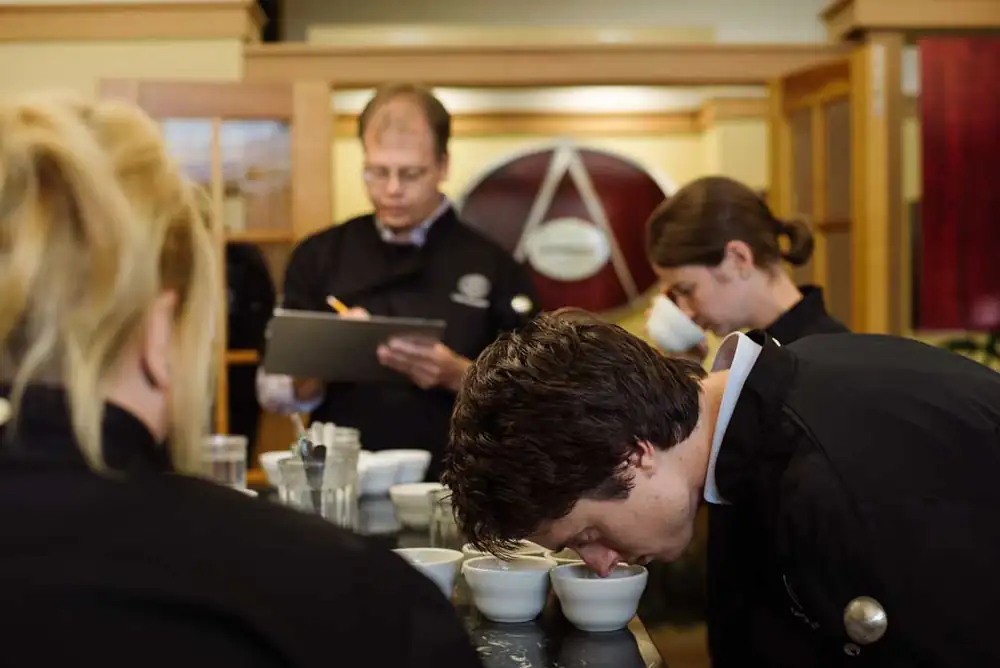
Why coffee tasting needs the human sense of smell and taste
No machine can match the olfactory bulbs or taste cells of people, and coffee evaluation still depends on trained tasters.
Artificial noses and other chemical evaluation machines can be useful in certain circumstances, but so far their ability to capture the sensory qualities of coffee is quite limited. That's why tasting is done with several professionals at once. Each taster contributes their repertoire of flavors and aromas: some distinguish spices better, others sweet or salty nuances. Learning from each other and knowing how to describe, question, and discover flavors improves the tasting experience, and people can continue expanding their sensory knowledge throughout their lives.
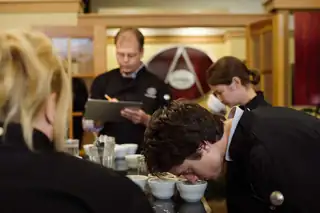
In the trade, cupping is the sensory evaluation done before buying coffee. The lots are about 38,000 pounds per container, roughly twice the weight of a school bus. The buyer receives a 1- to 2-pound sample of green coffee and roasts 100 grams in a small benchtop roaster, deliberately insufficient roasting to more easily detect flaws or defects.
Faults, such as fermentation, phenols, dirt, or excessive acidity, render coffee unsuitable for purchase. These defects are subtle nuances that a buyer may accept if they appear in small quantities. The taster typically samples five to nine cups prepared by direct brewing: they smell the grounds, taste the samples quickly, and spit them into a container. The cups are also evaluated for consistency and may be re-tasted once cooled. If they are free of defects and impurities, the coffee is suitable for purchase.
When the entire shipment arrives at the roaster, another sample is taken and the process is repeated to verify that it meets the batch specifications. The post-purchase cupping, conducted after brewing the coffee in a commercial coffee machine, has a different purpose: to determine how the coffee should be used, on its own or in a blend, and at what roast level: light, medium, or dark. The percentage of each coffee in the blend defines the recipe.
Blending coffees is one of the most important skills for a professional. It allows for creating new flavors, controlling costs, compensating for a shortage of a particular coffee, or replacing one with a problematic blend. The coffee's intensity also depends on the ratio of water to ground coffee. Mocha Java is considered to be the first coffee blend ever created.
Wine tasters need training to evaluate, describe, score, and remember the performance of each sample. It's not a part-time job: it demands constant dedication and continuous learning, a task that is both rewarding and necessary.