The recipe for cacio e pepe? No, caci e pepe, Marco Gallotta tells us
Three ingredients, and only three: cheese, pepper, and pasta, and you have the most minimalist dish in Roman cuisine, born from the assembly of provisions that shepherds from the Pontine Marshes carried in their saddlebags during the transhumance. Easier said than done, in reality.
Cacio e pepe, along with its cousins carbonara, gricia, and amatriciana, is one of today's most debated traditional dishes, among the most philosophized about: there's the pecorino-only camp, the one that mixes it with parmesan (never admit it in front of a Roman), the one that favors creamy sauce on the side, and the one that favors sprinkling it with the sauce. And then there's the egg pasta camp, the spaghetti camp, and the short pasta camp. In short, if we were to draw cacio e pepe, it would be a complex tree diagram.
And we decided to bring some order (or not?) by asking Roman chef Marco Gallotta—the creator of the famous Primo al Pigneto and now culinary consultant at the revamped Osteria La Quercia—to tell us the ins and outs of his cacio e pepe. Which is cacio e pepi.
When asked, ironically, whether he identifies with the fundamentalist or the progressive cacio e pepe movement, Marco Gallotta responds with a frown: "Fundamentalist? I don't even like the word. Fundamentalism never gets you anywhere," he says, smiling. And he explains why.
Marco Gallotta loves tradition, of course. But it must be studied and, trying to understand the public's tastes, it must be balanced. "Domesticated," he says. "Try offering this dish to a Northerner: they'll definitely tell you it's savory." He calls his cacio e pepe "an evolution over time." And with a few small adjustments (not to mention careful attention to the ingredients) that he describes in meticulous detail, it becomes the queen of simplicity and balance.
"My cacio e pepe follows my personal history," he confesses. "As a chef and a food enthusiast, it's based on experimentation. Thirty years ago, it might have been a simple spaghetti sautéed with pecorino cheese and pepper. Over time, you've evolved, and partly out of curiosity and partly because you understand people's tastes, you understand that the traditional recipe must always be open-minded, while still maintaining a connection to its origins."
The search for balance
Osteria La Quercia's cacio e pepe has a plural in its name: it's called cacio e pepi. A plurality of ingredients, too, which the chef proudly shares with us.
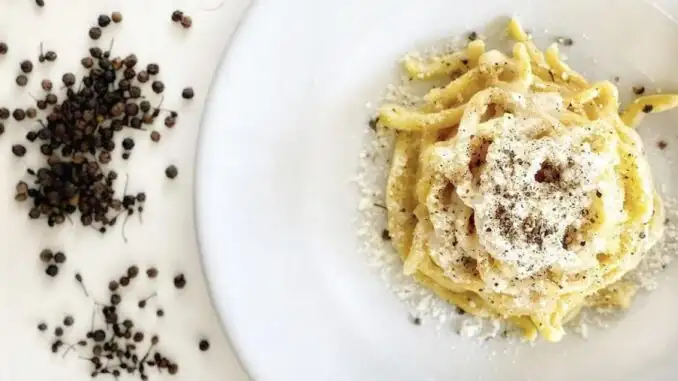
Where to find the balance? "Definitely in our work with pepper," Gallotta explains: a blend of Sarawak, Penja, and Madagascar peppers, in a ratio of 40:40:20, so that the intensity of the Penja is tempered by the Sarawak, a soft Malaysian pepper. The mix is then blended with Madagascar, a wild, highly aromatic pepper, which "lends hints of resin, berries, roots, and moss, and rounds out the blend." The combination of the peppers with the pecorino, whose spiciness is not exaggerated but enhanced, is probably the real secret he reveals to us. It's the chef's signature. "In my interpretation, it's all about balance."
It all starts right here, with the roasting of the peppers in the oven, which are then crushed rigorously in a marble mortar. And the blend is served. We move on to the research on the pecorino romano, which must be aged for at least 8-12 months. Gallotta uses 80% of it, because he mixes it with a sweeter pecorino: "But still pecorino," he is keen to point out. "Right now, I get my supplies from D'Ascenzo, a farm in Rieti run by a young breeder who produces small, aged sheep's milk cheeses. I blend the pecorino romano with 20-25% of this sweeter pecorino, which tames the saltiness."
And finally, the last ingredient: "Well, the only thing I'm a stickler for is pasta being al dente," he says. And who can blame him? "I generally love spaghetti, and I love durum wheat pasta. But I also appreciate tonnarello, which in a restaurant allows you to reduce the preparation time of the dish. Ultimately, the important thing is that the pasta has a certain bite."
The procedure
So, two to two and a half tablespoons of pecorino (domesticated), the blend of peppers, and hot water to make the creamy sauce while the pasta cooks. Marco Gallotta is one of those who sautés and then stirs the cacio e pepe (as he calls it) without ever exceeding 70°-80°C, "because cheese, as we know, splits beyond that threshold." In short, it's all a question of size. And experience, of course.
"Be careful," he warns, "for the emulsion you should use plain hot water, never salt water." Otherwise, all the research into flavor is useless.
The lesson, at this point, is that fundamentalism doesn't benefit anyone, especially those who try a dish. And that cacio e pepe is absolutely worth trying. At Osteria La Quercia, as soon as better times arrive. Or at home, thanks to Marco Gallotta's invaluable recipe and story.
La Quercia Osteria Monteforte. Piazza della Quercia 23, Rome. Tel. 06 68300932. Website. Facebook page.