Gong Oriental Attitude in Milan, review: the prestigious and ambitious Chinese restaurant
It seems like we haven't heard much about it recently, the city's buzz turning to newer, more pop-oriented Asian haute cuisine establishments—the kind that's trending today, faithful to its original cultural intentions but free from rigid territorial constraints and tired tradition/contamination dichotomies.
Its reputation as one of the city's most prestigious and authoritative Chinese restaurants remains intact. It is the legitimate offspring of the Italian-Chinese Liu dynasty, three brothers who, with two other establishments (BA and the Michelin-starred Iyo), control a significant portion of the city's high-end Asian gastronomy. Influences and intertwinings with other cultures, including Italian, of course, set the tone, so much so that Asia here isn't a dogma but an attitude (what out-of-touch boomer would still use the word fusion?). Gong, Oriental Attitude, it goes without saying. A state of mind, as a budding press office intern would suggest.
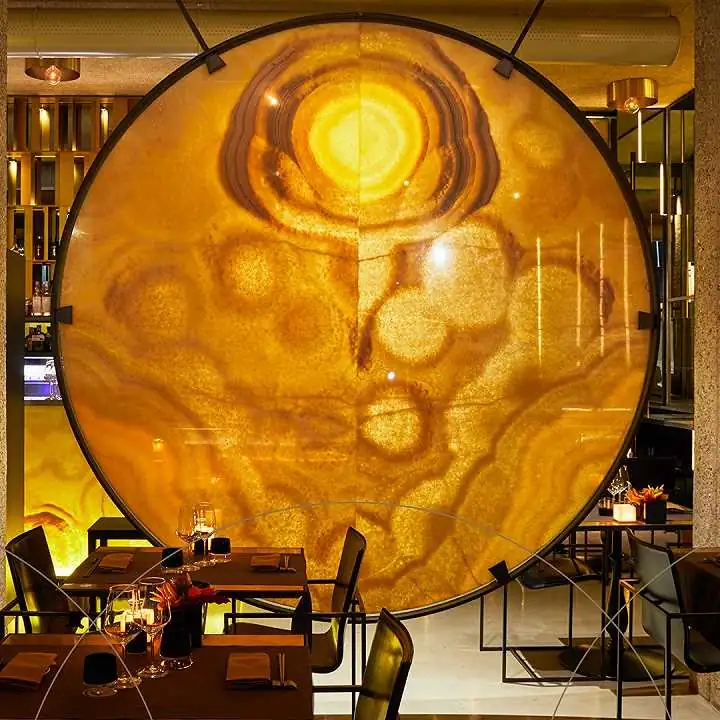
Cold and monumental, austere with sparse, refined touches, the space recalls the office of a high-ranking bureaucrat in some totalitarian regime. Refined and sophisticated, yet intimidating. The welcome is impeccable, yet stiff and cautious. The suffused atmosphere, uniformly yellow-ochre, overflows from the furnishings to permeate the air, as if everything were immersed in a chemical preservative solution. The large gold-colored gongs on the walls, far from evoking distant magic, do nothing to correct the general sense of disconnection with the environment. A stiff, dreamily disorienting atmosphere weighs on everything like an invisible drape of thick fabric fallen from above.
The service is friendly and impeccable, yet automatic. The fixed position of a waiter between two tables at the back of the room, one of which is ours, is an unfortunate and oppressive choice. The intervention of the sommelier, with his exuberant Venetian accent, briefly interrupts the mannerism. The more he goes on to recount the story of the suggested wine, a highly personal and excellent "Andata e ritorno" by the artisanal winemaker Ancarani from Romagna, the more he seems to find new details to enrich the story itself.
The beauty of Japanese soba noodles is that they're made from buckwheat, which lends them an unmistakable earthy, toasted hazelnut flavor. Mixing them with squid ink is a demeaning choice, resulting in them tasting neither of squid ink nor buckwheat. The shrimp bisque that accompanies them exudes only the bland saltiness of the seasonings, rather than the natural, smooth flavor of the sea.
In the dim sum (dumplings) with black cod on a cream of mullet bottarga, the herb-infused panko bread shows no signs of life, so much so that one doubts its existence. In the ones with wagyu beef, foie gras sauce, and truffle, the filling is divine and stuns the senses, but the pasta is mediocre, as in the other dim sum, in an involuntary diminuendo that causes the crystalline pasta of the spicy beef dumplings to yield and open at the first touch of the chopsticks.
The glazed eel with kabayaki sauce, foie gras, and Fuji apple in a beetroot osmosis, despite its grandiose composition, is reduced to a nori sandwich containing a creamy mess of indistinguishable, rather cloying textures and flavors. The crispy pork belly boasts perfect cooking and texture, but the miso-infused chestnut cream on top and the marinated cabbage garnish are muted by the overpowering mix of aromatic herbs that sweeps everything away in a sudden balsamic gust. Rosemary, perhaps? Fennel? Porchetta comes to mind.
So it is with regret that we must conclude that Gong offers cuisine that is ambitious and refined on paper, but in reality crude and only superficially cloaked in refinement, at the price of fine dining (between 85 and 130 euros for the tasting menus, between 20 and 30 euros for the à la carte dishes, to which you must add the inevitable 5 euro cover charge).
Opinion
A painful, glaring example of the disconnect between expectations and reality; between the theoretical conception of complex, high-sounding dishes and their outcome; between reputation and direct experience. The word "wishful thinking" is often imprecisely used as a synonym for ambitious. I think this is an opportunity to reclaim its proper meaning: unrealized ambition that remains a dead letter.
PRO
- Imaginative proposals, refined and quality ingredients.
AGAINST
- Apparently sophisticated cuisine, but messy and crude.
- The atmosphere is austere and unfriendly, despite its elegance.