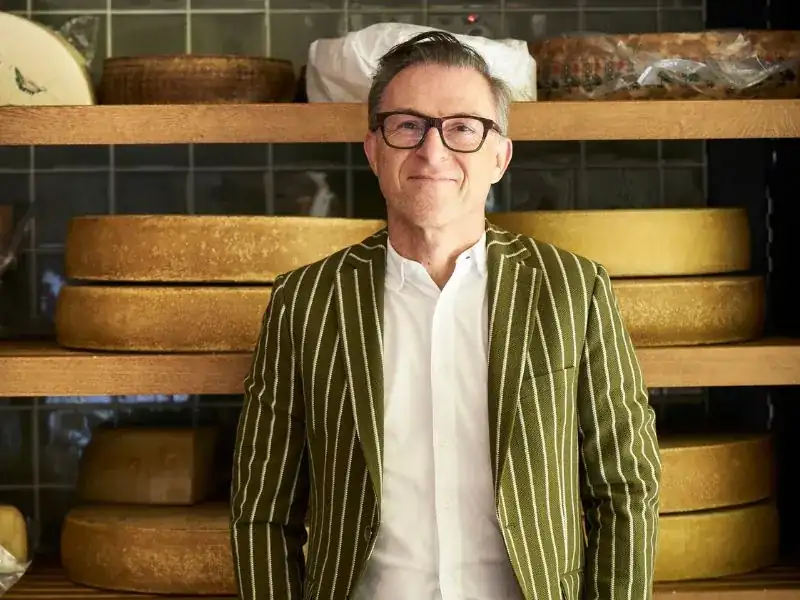
Jörg Reuter on delicatessen, producers & enjoyment
Interview with Jörg Reuter
Mr. Reuter, your shops are called "Goodness from the Simple." How simple can it be without sacrificing quality? For a long time, gourmet food primarily meant international delicacies – balsamic vinegar from Modena, French terrines, Spanish Serrano ham. We, on the other hand, were drawn to what's culturally exciting here in Germany: cheese, sausage, butter – of outstanding quality. So: goodness from the simple.
Is your shop a delicatessen nonetheless? We avoided that term at first. We didn't want to be a place where people only shop on Saturdays or look for gifts. Our goal was always: an everyday grocery store. If I have to explain it quickly, I'll of course say "delicatessen," but actually, we're a lovely place for good food.
Your product range is regionally focused – how do you find the producers? In the beginning, it was difficult; we ordered countless samples, and much of it was simply inedible. Today it's different: the producers find us. And there's a lot of word-of-mouth involved. If someone like Stefan from the Heggelbach estate says, "You have to meet the cheesemaker from Franconia; he has something special," then I go there.
So how do you choose what goes into your product range? First, we look at animal husbandry and origin. If that's a good fit, we taste it. I don't need 20 different types of Tyrolean bacon side by side – if one is convincing and the farm is a good match for us, then that's our product. A lot also comes about by chance, like the raw milk butter from Matthias in the Black Forest.
So you know all the producers personally? Almost all of them, anyway. We work on a handshake principle: either we've been there ourselves or someone we absolutely trust has. We now have around 150 suppliers – a business and organizational nightmare, but wonderful on a personal level.
How is it received by your customers? I find it fascinating how well the concept works in a city like Berlin. Essentially, our shop is a farm shop right in the heart of the metropolis. Many customers come not just to shop, but to take a short break, to smell, to taste, to chat. It's almost like a weekend getaway – just between the subway and the office. We offer a connection on a sensory, aesthetic, and also a human level.
You speak of "resonance." What does that mean? That shopping is an experience again. In the supermarket, you're anonymous; here, you take your time, try things, talk to us. Many people are once again comfortable discussing taste. I often observe that customers start discussing the finer points of cheese after trying the second one—wonderful.
And will there be an online option? We're currently working on curated boxes – cheese platters and bundles that can be delivered to homes anywhere in Germany. Our heart remains in the shop, of course. But this way, people outside Berlin can also experience a taste of "the good things in life."
You speak with such enthusiasm about cheese and butter – is enjoyment also a form of well-being for you? Yes, absolutely. We are currently experiencing a renaissance of authenticity. Butter, raw milk cheese, kefir – these are living foods, not industrial products. Enjoyment and health don't have to be mutually exclusive. When you eat well, you automatically eat better.