Mexicans create artificial stomach capable of processing fruit and sausages
The artificial stomach mimics the movements of the human organ and is capable of processing fruit or sausages, explained scientists Gabriel Ascanio Gasca and Alberto Caballero Ruiz, creators of the project.
“This is an artificial stomach with which we try to emulate the functioning of a human stomach. We have used it very successfully for food breakdown with sausage and melon, and it works exactly like the natural organ, with three and a half cycles per minute. Bile juices are added, and we see its ability to break down food,” Ascanio Gasca explained.
How does an artificial stomach work? A major breakthrough for science
Researchers at the Institute of Applied Sciences and Technology of UNAM explained that the device is not for use on humans, but it can be of great benefit to people by allowing them to check the dissolution of drugs, since according to the pharmacopoeia any medication should disintegrate in a maximum of 20 minutes, but the current equipment used for this purpose is quite rudimentary, as they are tanks with an agitator.
Gasca explained that digestion in the artificial stomach begins with chewing in the mouth, which reduces the size of the particles to be ingested, hydrates and lubricates the food, forming what is known as a bolus, a process that has been reviewed for some years by a group of specialists.
In real life, the organ contracts and relaxes the muscles, which allows it to transport chyme from one side to the other, and it does so mainly in its most well-known part, the distal region, which is attached to the pylorus, the valve that connects it to the small intestine, noted Ascanio Gasca, a member of the National Laboratory of Additive and Digital Manufacturing.
In nature, the esophagus transports the food bolus from the pharynx to the stomach, whose function is to control the flow, dose and prevent the flow from gastric acids, as well as store, mix and empty the bolus into the small intestine.
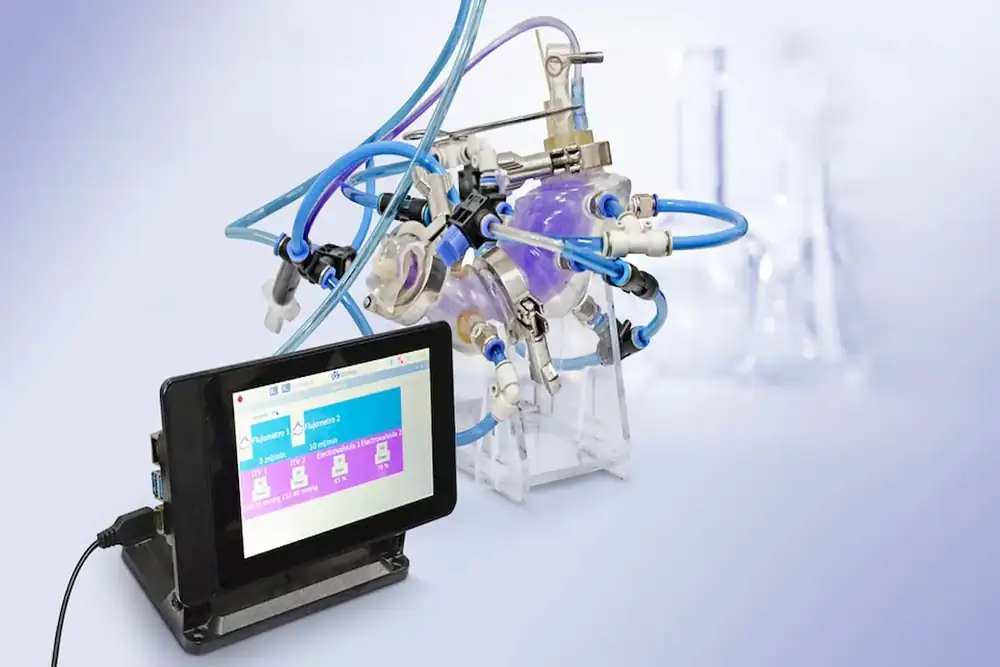
The device created at ICAT features soft membranes that replicate the gastric walls, which are subjected to pressure levels close to the ranges of the human organ.
“The stomach generates flows with pressures of 20 to 25 millimeters of mercury (very low), that is why we do not feel when digestion takes place; that has been the great challenge and we reproduce it very well,” emphasized Ascanio Gasca.
What does an artificial stomach look like?
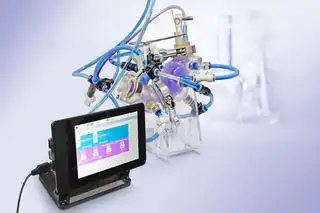
Its translucent appearance allows visualization of the degradation process of food or medicines, which is done chemically and mechanically.
By putting melon and sausage into the instrument to digest, the experts demonstrated that in this work it is important to reproduce the mechanical movements made by the stomach, as the food was dissolved better compared to conventional systems.
After achieving a successful result, both specialists are working on mechanically reproducing the next step in food digestion, which involves the functioning of the duodenum, where most nutrient assimilation takes place. The plan is to replicate this process and see how it works with nutritional supplements, for example.