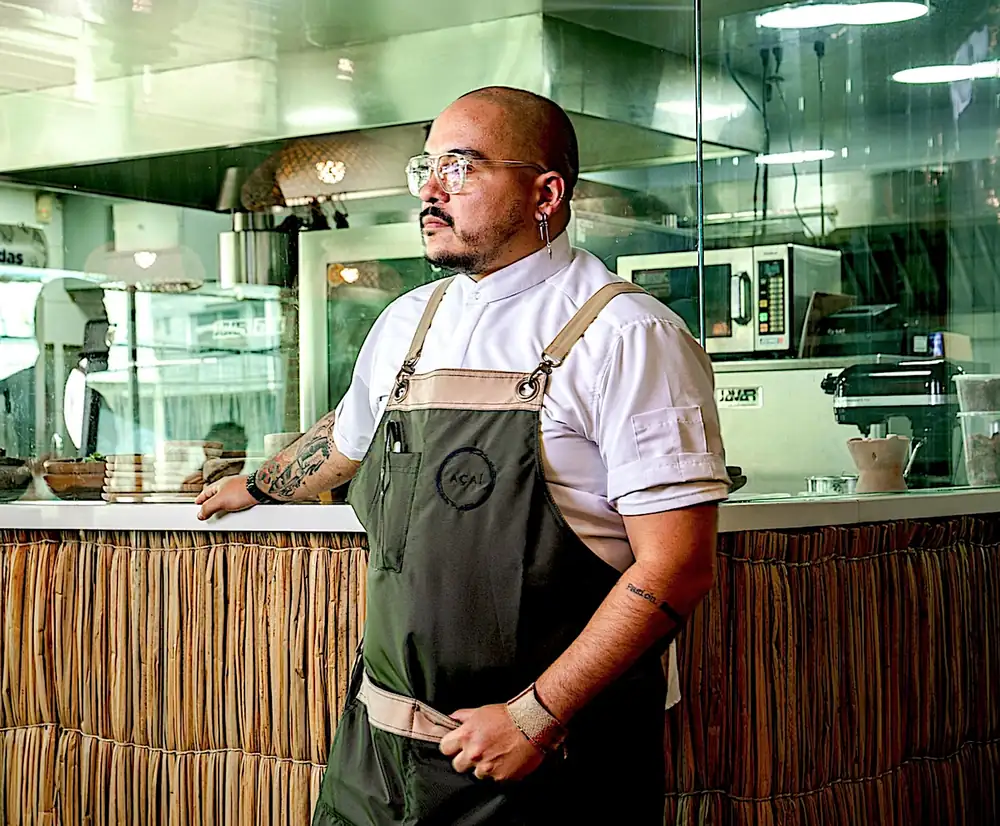
Andrews Arrieta shows his obsession with the Amazon in Açai
The shop is located on the first floor of a commercial building, in the capital's famous fishing business district, a few blocks from the Paloquemao Market Square and the Samper Mendoza night market, the country's epicenter for aromatic, medicinal and esoteric herbs.
At the start of the project, Andrews Arrieta only knew half a dozen products from the Amazon thanks to the two years he worked for Leonor Espinosa. For years, ingredients from the Amazon rainforest only appeared discreetly on the menus of restaurants like Espinosa's own, Mini-mál by Antonuela Ariza and Eduardo Martínez, and, many years later, the now-defunct Ocio by Álex Salgado. He also encountered them with Professor Ricardo Malagón at the National Learning Service (SENA), or at the intermittent La Chagra in Medellín—open, then closed, and recently reopened—owned by Juan Santiago Gallego, probably the Colombian chef with the Amazon most deeply in his blood.
This lack of knowledge was compounded by a loss of smell and taste due to health complications. Medicine and surgery resolved his gustatory and olfactory deficiencies, and the mysteries of life, thanks to a cup of coffee served by his wife while caring for their newborn daughter, gifted him with a new sensitivity that allowed him to detect flavors and aromas he had never before experienced in a simple, steaming cup of homemade coffee.
Discover the Amazon
He had a large quantity of pirarucu (arapaima, Arapaima gigas) in the company's warehouses and still hadn't tasted it. After that coffee epiphany, he spent days locked away with his team in the restaurant, tasting and smelling every fish and Amazonian product in the freezers, refrigerators, cupboards, and shelves. Once the task was complete, he found himself on a plane to Leticia—a city in southern Colombia, on the banks of the Amazon River, bordering Brazil and Peru—convinced that no matter how much he tasted in Bogotá, he couldn't talk about an Amazonian concept on his menu without knowing the territory and its producers. He remembered the words he had learned from Leonor Espinosa: "Never put something on your plate that you don't know, that you haven't researched, and that you haven't worked with."
“The Amazon drastically changed my life.” Arrieta feels this emphatically and with conviction, drawing on his accumulated knowledge, acquired through four years of travel to different regions of the Amazon to learn from various ethnic groups and indigenous communities. He's a chef who speaks with passion and gratitude, overwhelmed by the sheer volume of things he wants to share, thrilled by every unusual ingredient he offers you to taste—like the grated ishpingo seed (Ocotea quixos), with its cinnamon-like flavor—and brimming with a boundless energy that gradually subsides as he presents the Açai dishes. All that frenetic energy and explosive character, so typical of the Caribbean coast, is reflected in his creations, some wildly baroque and others brutally simple. But in each one, the Amazon and its food sovereignty are unmistakably present.
The Sixth Region. That's the name of their latest menu, designed as a tribute to one of the country's most neglected regions for decades. She can still recite by heart the list she learned in school: "Caribbean, Insular, Pacific, Andean, Orinoquía, and Amazon."
Amazonian deployment
His extensive menu showcases fish from South America's great rivers, such as yellow catfish, bocachico, piranha, tucunaré, arawana, pirarucu, and gamitana. Others come from the Pacific, like hake, sole, ray, and pufferfish. All are prepared using techniques Arrieta learned from various indigenous groups, such as smoking, curing, and pataraska (fish wrapped in leaves and grilled over charcoal). He also incorporates jungle rarities like the mojojoy (a type of ant) he keeps alive in a terrarium, different kinds of ants, potent fresh and pickled chili peppers, and other preparations derived from cassava, such as caguana, casabe, and tucupi, the Amazonian seasoning.
The lunch begins with the mojojoy—an Amazonian beetle larva that feeds on the Amazonian palm. It's presented stuffed with its own fat, mixed with pirarucu meat, and seasoned with Amazonian herbs like chicory (wild cilantro), turmeric, and purple basil. It's an interesting concoction, similar to a chorizo sausage, where the casing of a traditional sausage is the larva's skin. It's served on casabe—the Amazonian unleavened bread made from cassava flour—and accompanied by lemon ants (the lemon flavor is incredible) and aji ojo de pez, a round, intensely spicy pepper. Arrieta started by bringing 20 mojojoy larvae to Bogotá when Açai was just beginning. Now he sells 1,500 larvae every month.
The smoked ray croquette respects the concept of resourceful cooking, in this case using the ray that fishermen consumed for themselves and that had no market. It is presented breaded with cassava bread and filled with shredded smoked ray, dairy products from Caquetá, Paipa cheese, ishpingo grated fruit, and mushrooms.
Pirarucus can reach up to 2.5 meters in length, give or take a few centimeters. They come from Brazilian lagoons and mangroves and are farmed using natural feed, replicating the original environment of the Amazon River. This remarkable project, active for over 20 years, has successfully halted the endangered status of the world's largest river fish. Cured pirarucus is the first of many dishes prepared with this giant fish. Here, it's cured gravlax-style—with salt and sugar—and then smoked. On the plate, it's sliced, rolled, grilled, and stuffed with Colombian dates from Soatá (Boyacá Department) and plantain cream. A river delicacy that tastes like bacon to the naked eye. It's served with a sauce made from white tucupí, a preparation that differs from black tucupí because it's not cooked; it's simply cassava water mixed with Amazonian chili peppers and fermented.
Pacific hake ceviche –nothing to do with European hake– with mandarin lemon, Mayan pineapple –the white pineapple of the Amazon– cooked in its juice, palm heart apple –the lower part of the palm, which used to be discarded–, mayonnaise with catara –the indigenous vinegar–, camu camu –an Amazonian fruit with more vitamin C than the orange–, Montes de María sesame, and an achiote oil with fish eye chili and huacatay oil (Tagetes minuta).
Arrieta also displays knowledge of the crafts and tools made by different Indigenous communities, which he uses in plates, cups, fabrics, and stands. A steaming mini camareta from the Curripaco ethnic group of Guainía arrives at the table. The real one measures over two meters and is used by fishermen to slowly roast the leftover catch from the previous day, wrapped in leaves, while they head out to fish for the next day's catch at dawn. On our table rests the tacacho: a ball of yucca and coca leaf powder, filled with piranha encocado and Paipa cheese with Protected Designation of Origin, and breaded with casabe bread.
Another pirarucu arrives, cured with macambo seeds – Theobroma bicolor, from the cacao family, roasted, crunchy, and with its peculiar miniature brain shape – grapefruit, cupuaçu – another relative of Amazonian cacao, Theobroma grandiflorum –, aguaselva of cucumbers, peppers, tucupi, and catara on a creamy yucca base. A melting pot of bitter, sweet, sour, salty, and Amazonian umami.
The menu offers whole fish, as steaks, ribs, tails, and fillets. But there are also carnivorous options like beef skewers, street-style, with Amazonian chimichurri. I notice a monumental plate of braised pork on the next table while I sample a dish of slow-cooked, shredded lamb neck accompanied by hearts of palm from Putumayo.
A different, abundant and honest cuisine, a tribute to the worldview of the Amazon and its unknown ingredients.