
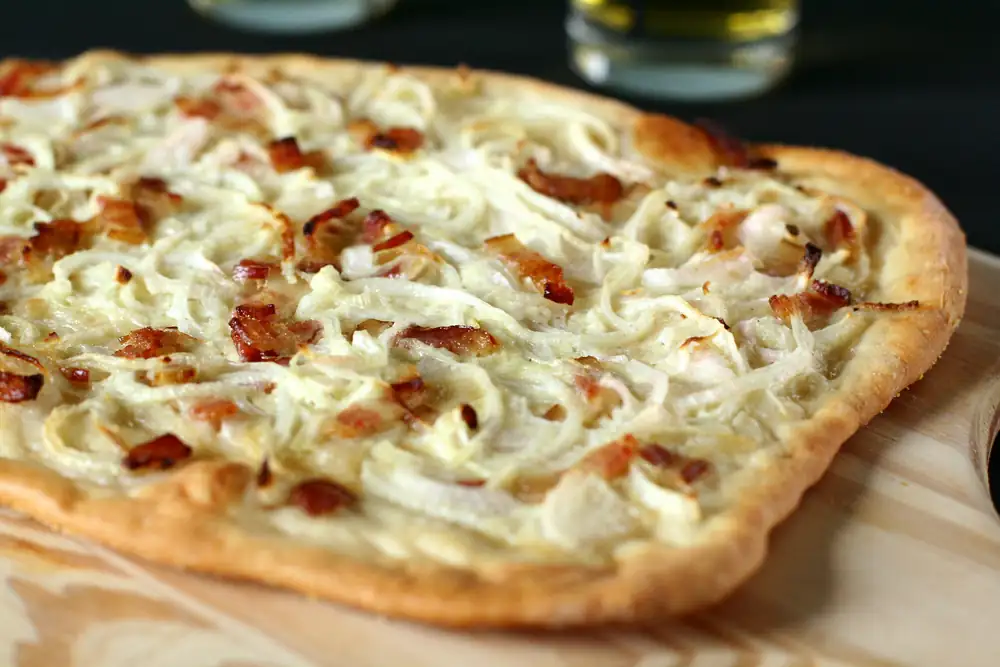
Flammekueche: the cult dish of the Franco-German border region
Flammekueche was originally a practical treat for farmers in the Kochersberg region: it was used to test the temperature of bread ovens.
The authentic version is made exclusively with local ingredients and in a wood-fired oven. There are only forty such restaurants in the world, most of them in Alsace.
Although local inns served it as early as the 19th century, flammekueche only really became popular in the 1960s, when pizzerias opened across Europe. The resemblance is deceptive, however: the pastry is paper-thin, often made without yeast, and the toppings are almost always based on traditional ingredients.
The secret to a good flammekueche is a sense of proportion. The dough should be rolled out until it is almost translucently thin, the cream should not soak through, and the bacon should be distributed in such a way that it reaches every bite. The really good places are not fancy restaurants, but simple, family taverns with wood-fired ovens and returning guests for generations.
Comfort food
Strasbourg, the capital of Alsace, is one of the region’s most popular destinations: the narrow streets of the Petite France district are lined with half-timbered houses, giving the city an almost stage-like atmosphere. However, when it comes to flammekueche, most locals say that the best versions are to be found in the countryside, not in the city. There are a few places in Strasbourg that are exceptions, including Le Tigre, which also operates a craft brewery.
The restaurant's menu features the classic tarte flambée with onion, cream and lardons, as well as dessert variations such as apple, cinnamon and calvados flambé. The traditional version here is baked twice – a rare departure from the traditional approach – and has a particularly rich, creamy texture.
Situated on the Alsatian Wine Route, Kaysersberg’s medieval atmosphere is a perfect match for one of the region’s most famous dishes. Known for its pastel-colored houses and half-timbered buildings, Flamme & Co. is also located in the town, which bases its concept on a modern reinterpretation of the traditional tarte flambée.
The restaurant was originally conceived by Olivier Nasti, the chef of the two-Michelin-starred La Table d'Olivier Nasti, and is now run by Yoan Jacquet and Pierre Moiso. In addition to classic Alsatian dishes, their six-course tasting menu offers creative interpretations such as flammekueche with salmon, dill, leek and lemon, rib-eye steak with sun-dried tomatoes and parmesan, or duck with pumpkin, celery and raspberry sauce. These complex flavor combinations are a far cry from the dish's traditional bacon-based world.
L'Aigle, located in the village of Pfulgriesheim in the Kochersberg region, is even closer to the traditional Alsatian world. The restaurant, which was converted from a 17th-century farmhouse, has been preparing traditional local dishes for the fifth generation, and tarte flambée is still the house specialty. The recipes have been passed down from generation to generation, and most of the ingredients still come from the immediate area.
The classic version here is made with rich cream, thicker bacon, sweet onions and a little Emmental cheese. The texture is both creamy and crunchy, and despite the thicker lardons and rich toppings, the dough still retains its crunchy texture.
In recent years, flammekueche has increasingly emerged from the world of rural inns: it is now being reimagined by modern bistros, craft breweries and fine dining chefs. But in Alsace, it remains much more than a simple dish — it remains one of the strongest gastronomic symbols of the region’s rural culture, family meals and agricultural traditions.