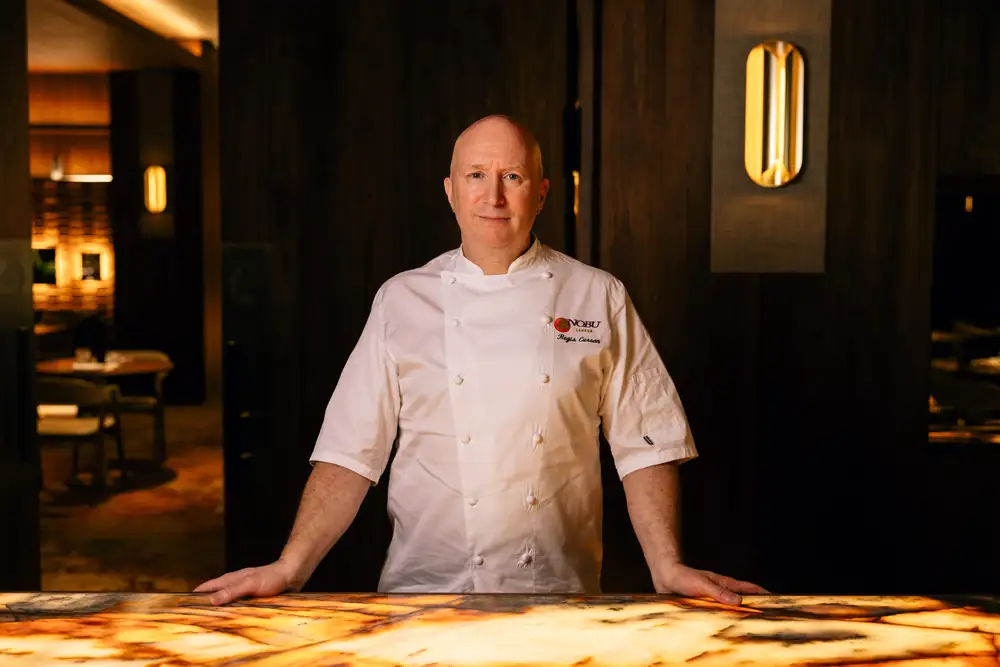
“I'm not a mad scientist, I just like to play with ingredients” – Regis Cursan, Nobu's international pastry chef, visited Budapest
At Nobu, desserts are as consciously constructed a part of the meal as an iconic sashimi or black cod with miso. As Corporate Pastry Chef at Nobu UK & Europe, Regis Cursan has spent over two decades working to ensure that the brand’s desserts are recognisable across all restaurants, while also allowing for local character and creative freedom.
Between August 6-8, guests in Budapest can experience a special chapter of this approach. During the limited offer Pastry & Cocktail by Regis Cursan, each dessert is accompanied by a cocktail specially composed for the occasion, so that dessert and drink blend into a dialogue.
But according to Regis Cursan, the foundation of any good dessert is surprisingly simple. “It all starts with the quality of the ingredients. We always look for the best possible ingredients, and we strive for minimalism in the presentation. At Nobu, we work with Japanese ingredients, but we build on French techniques and classic pastry foundations. This is the backbone of our identity.”
But Japanese and French traditions are just one layer. Nobu's desserts also reflect Latin American inspirations, constantly pushing his thinking in new directions.
“Peruvian flavors are always an exciting challenge for me. I also really like Mexican gastronomy. For example, tequila can be a great ingredient in desserts, as can cajeta, which is a caramel cream made from goat's milk and gives a completely different character to a dessert than traditional dulce de leche,” adds the pastry chef.
Inspiration often comes at a random moment.
The world's most famous pastry chefs often talk about research, technology, or laboratory precision. Regis Cursan's stories are perhaps much more human. One of his most famous desserts, for example, owes its existence to a simple evening outing.
“One night we were sitting by the campfire, we had a pineapple, and since the embers were still hot enough, we skewered it and roasted it. When I tasted it, I knew it would be a dessert. It later became one of my favorite desserts, which is made with a lightly smoked pineapple coulis. I have many similar stories. When I taste something that appeals to me, I almost automatically start thinking about how I could turn it into a dessert,” she shares.
However, he doesn't consider creativity to be some kind of special ability. "My team knows I'm not a mad scientist. I just like to play with ingredients. Sometimes there's no time to tell the story behind every idea, but I always try to convey the technique and the mindset, not just a recipe," he says.
The use of sugar is no longer a given.
While many people still associate the world of desserts with sweets, Regis Cursan says one of the biggest issues in confectionery is rethinking the use of sugar. “Sugar is perhaps our biggest challenge today. We need to find better alternatives. It doesn’t matter what sweetener we use. Honey gives a completely different character to a dessert than unrefined cane sugar, and we get a completely different result than with simple white sugar. Unrefined sugars carry flavor in themselves, not just sweetness,” he emphasizes.
That’s why he’s particularly interested in the way different cultures around the world use sugar. He talks about Japanese kokuto, the traditional black cane sugar from Okinawa that goes into the silky kuromitsu syrup, but he also mentions Peruvian chancaca, an unrefined sugar syrup made with spices and orange, with equal enthusiasm. “Each one tells a different story, not only sweetening, but also adding character. It’s these little differences that make confectionery so exciting,” he adds.
Unified philosophy and framework, spiced with local freedom
Nobu now operates dozens of restaurants around the world, which inevitably raises the question: how can you create a unified image while each restaurant appeals to its own audience? According to Regis Cursan, the key to this is not necessarily a strict set of rules.
“When I arrive at a restaurant, I don’t come to tell you what to do. I want to understand the place, the people and their thinking. My goal is to share my ideas, talk about Japanese ingredients, and show a direction in which we can develop together. This only works with mutual trust,” says the pastry chef, who also experiences this during his visit to Budapest.
“I had dinner here last night. Everything was prepared with extreme precision, the presentation was beautiful, and the team made a very good impression on me. We also talked about how much Hungarians love pastries. This is fantastic news for us, because we are coming to an environment where there is a real interest in desserts,” he says with a smile.
He and Nobu Budapest executive chef Gábor Schreiner have been working for the same brand for sixteen years now, and in recent years, their collaboration has grown even closer. “We all work for the same reason: to make the best food possible and have fun doing it. After all, what’s the point of this work if we don’t enjoy it?” he adds.
From Bordeaux to London
Regis Cursan grew up in Bordeaux, originally trained as a chef, but at a young age he realized that the world of pastry was much closer to him. He was captivated by the precision, creativity and, as he puts it, the “science” of pastry. After years in France, military service and some very unusual jobs, including demolition and recycling projects, he moved to the UK, where he later joined the Nobu team.
He has now been with the company for twenty-four years, constantly enriching the French techniques with new ingredients. “Our techniques are still fundamentally French, but we are constantly playing with flavors. For example, we were using yuzu long before it became fashionable worldwide. The same goes for miso or soy.”
This time he came to Budapest not only to create, but also to explore the city. “I’ve already received some tips from my colleagues. I know that Gerbeaud is a legendary place, I definitely want to visit it. I’m also curious about the history of Hungarian confectionery, because the sweets of every country reveal a lot about its culture,” Regis Cursan concludes.