This New Native Kitchen Is Stocked with Prickly Pear and Hominy
In a new cookbook, chef Freddie Bitsoie makes the case for evolving—not just preserving—Indigenous cooking traditions. I first got to know Diné (Navajo) chef Freddie Bitsoie through his writing back in 2017 when we’d both contributed essays to America: The Cookbook .
“Yeah, it’s true. I understand. But we’re trying to take photos for a book, so it needs some kind of garnish, and I think the blue and white have a great contrast.”
I called Bitsoie up earlier this month—he’s at home with his family in New Mexico—to talk to him about the book, his forward-thinking focus, and the proper contemporary garnish for a blue corn mush. Maybe because of what you say in the book, that your through line is techniques, not just components.
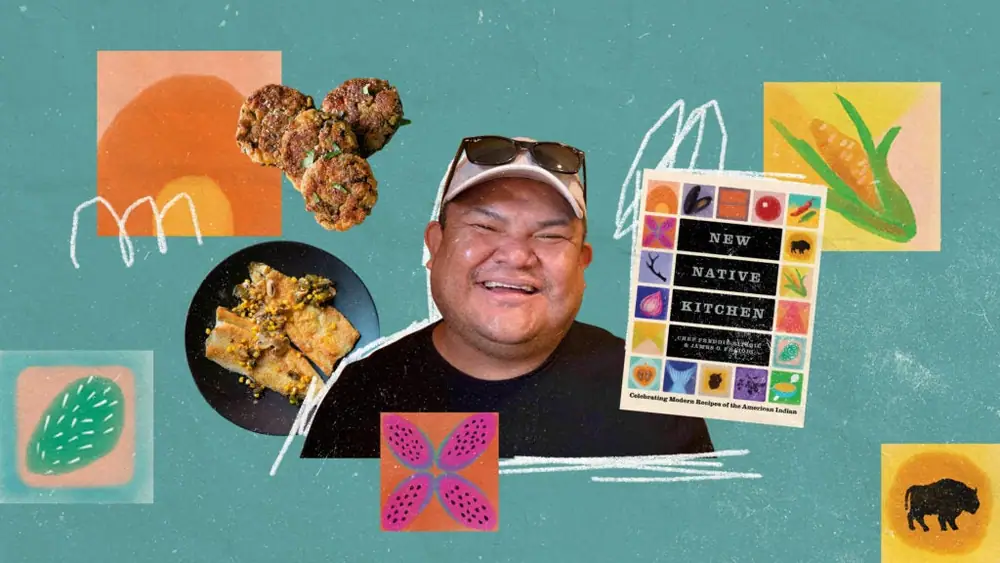
When we all get together, we don’t say, “Oh, where’s the salad?” It’s not an oogabooga-caveman kind of thing, you know, it’s just that mixing greens and then combining them in oil and acid was just was not a part of any type of repertoire of how people ate historically or prehistorically or even of late. We did the photos for the book at the Phoenix Indian School museum—they volunteered the kitchen for me to use since no one was using it during COVID.
I was getting ready to garnish the blue corn, and I was going to use queso fresco. She just coincidentally came out right when I was doing it, and she goes, “Ooh, blue corn.” Hopi people are known for their blue corn—in my opinion, more than the Navajo people. They make this blue corn piki bread —it’s paper-thin bread, and it’s rolled up like a burrito, and it’s a real crowd-pleaser—and they have all these different ways to prepare the blue corn.
She was watching me put the queso fresco on top of the blue corn mush, and she looked at me, and she goes, “What are you doing?” I explained, “I’m just adding some garnish.” And then she goes, “Freddie, if you put cheese on that blue corn, I will claim that you’re not Native American.” I go, “Yeah, it’s true. But we’re trying to take photos for a book, so it needs some kind of garnish, and I think the blue and white have a great contrast.” And she goes, “No, we just don’t put cheese in blue corn. And then she made a really good point: “Otherwise, you’re basically making a blue corn polenta .” And that’s where she got me.
Those stories and those recipes were based on a history of preparation with my grandmother. Witnessing it; my mother carrying on some certain dishes that my grandmother made; and her telling me stories from my grandfather, whom I’ve never met—but still this assumption that “Native” is evolving and changing. It’s great that you have other Native chefs who are talking about the past—and this is in no way insulting or trying to be mean or anything—I think sharing that type of savor and history is important as well.
But to use the example of preserving culture, what if you just break down the whole idea? Then you bring all this great flavor to it, so that everyone will enjoy and love it now.
And then you get this pretty bottle or pretty jar, and you boil that, you sanitize it. And then you pour the preserves in the jar, and then you close it, and you allow that steam to vacuum that lid, and then you wrap it in a pretty bow.
And so I really do think that talking about Native food and how it’s evolving culturally and moving forward is the premise and the thesis of the recipes in the book. I think that you telling that story is a very Native American way to describe that concept to me, right?
Per to It’s really funny you, as it gets me embarrassed, as I go to Native American events a lot, whether they’re Navajo or Hopi or wherever. It’s like, “Oh God, there he goes again.” And now, when I tell stories, it’s like, “Oh my God, I’m becoming those people.” THREE EXCITING RECIPES FROM NEW NATIVE KITCHEN : Cornmeal-Crusted Walleye with Roasted Corn and Green Chilies A light, summery take on a fish found in the waters of Michigan, Wisconsin, Minnesota, and North Dakota.
- Who: Native American