Vancouver entrepreneurs are dreaming up new ways to eat and drink
On a recent Friday morning, coffee and breakfast sandwiches were being served at the former home of a park caretaker at Kitsilano Beach — a space that, until that day, had been used for something entirely different.
“We had to move our restaurant container after discovering the original location would not have adequate access to safe, running water,”
The brick building had been transformed into the latest outpost of Batch, the Vancouver hospitality company known for turning outdoor spaces into unconventional places to eat and drink. By day, The Caretaker is a neighbourhood café; by evening, it’s a wine bar. For founder John Negrin, the café’s opening on Aug. 21 represents what can happen when an underused public space is given a new life.
But getting there took more than a good idea. Across Vancouver, entrepreneurs are turning shipping containers, garages, heritage homes and vacant public spaces into neighbourhood gathering places. Bringing those ideas to life, however, means navigating layers of zoning, permits, health and liquor rules — a process that can take several months or even years.
For some, that process has cost tens of thousands of dollars. Others have resorted to operating temporarily, risking fines or closure while awaiting approvals.
Vancouver says it has made progress cutting red tape. But with a civic election approaching, industry experts and candidates are questioning whether the city’s rules are keeping pace with demand for livelier neighbourhood hospitality.
“Vancouver is a young city with a framework for hospitality that comes from an entirely different time,” said Negrin. Batch opened its first location at the Plaza of Nations in summer 2022, operating in collaboration with the city and Vancouver park board.
Using temporary special-event liquor licences, Batch turned a vacant waterfront plaza into a spot for drinks, food and live music before moving toward a permanent model. Each of Batch’s three Vancouver locations took between one and two years to become fully licensed, Negrin said. The biggest challenge was dealing with multiple government departments at once.
“You’re dealing with the B.C. Liquor Board, you’re dealing with Vancouver Coastal Health, and then you’re dealing with the city’s business and planning departments.
You’re trying to align stars to get this activation done,” he said. “It’s a lot of work and information on how to do things scattered all over the place.” With a vision of his flagship restaurant operating out of a shipping container on the seawall plaza, Negrin said he was startled by how many approvals were required.
“We had to move our restaurant container after discovering the original location would not have adequate access to safe, running water,” he said, referring to health and sanitation regulations enforced by Vancouver Coastal Health. More complications arose at Batch’s Kitsilano concession location when it expanded into the adjacent space that had previously been the caretaker’s residence in the park.
But changing the residence’s use and expanding its patio to add more seating triggered another layer of regulatory approvals. “We had to get a full development permit,” Negrin said. “We applied for that permit last summer, and we’ve been waiting over a year.”
A missing middle
For Negrin, those timelines point to a bigger gap: clear paths exist for temporary events and permanent businesses, but not for something in between. The province acknowledges the gap.
B.C.’s Liquor and Cannabis Regulation Branch, which issues liquor licences, said in a statement that there is no interim licence for businesses that want to test a concept before committing to permanent premises, and that special-event permits aren’t meant for continuing commercial operations. It said it’s “continually looking at ways to modernize the regulatory system” for emerging business models. Negrin wants to see the city create a framework for three-month or seasonal pilots, giving entrepreneurs a chance to test an idea before taking on the cost and complexity of making it permanent.
“If you’re doing a large ticketed festival, you can kind of justify the cost,” Negrin said. “But if you’re doing something permanent, it’s going to be a huge endeavour because you may not fully know what it entails.” In Kitsilano, a married couple wanted to build a social enterprise for their neighbourhood — a spot to offer coffee, music, a place to gather. They’re finding out how hard it is to do that within the rules.
Postmedia News has agreed not to identify them due to their concerns that naming them could jeopardize the operation. Close to 500 customers passed through a pop-up café in the couple’s garage on July 11, drawn by coffee, a jazz trio in the backyard and local artists showing their work.
It was the second time the couple, who moved from London, England, last December, had opened their garage doors to reveal a café. The first time, they charged $4 a cup; the second time they took donations, giving all the proceeds to the artists and musicians who participated.
Since postings about it went online, dozens of baristas and 50 or so artists have asked to join the hospitality venture, they said. “The spirit of the café is to do something for the community — not to start a business,” said one of the owners. Hoping to continue operating, the couple contacted VCH to ask how the café can operate legally.
“We definitely need to inquire about food safety and make sure that we’re getting all the right licensing,” said one of the owners. “But it definitely seems prohibitive.” He was told the options were either a private, unpromoted gathering with no money changing hands or a fully ticketed commercial event.
Neither fit what they were doing. “This type of thing sits somewhere in between,” he said.
Cafes and restaurants aren’t allowed in most residential areas of Vancouver. The City of Vancouver said they can operate as home-based businesses, but provincial health rules have no home-kitchen exemption, so any operation preparing food for the public needs the same commercial food-safety permit as a restaurant.
VCH requires operators to submit floor plans and meet commercial standards — for things like dishwashing, handwashing and ventilation — that a home kitchen typically can’t meet. That gap is the problem, says the owner, who would like to be able to test the café idea close to home before taking on steep commercial rents.
“If you have a passion project that you think about turning into something full-time, and you’ve got to rent a space for $5,000 a month to do it, it’s just so hard to make that jump from zero to one,” he said. The couple hasn’t run an event since July.
Navigating the system as a newcomer
For another unlicensed operator, the problem is less the rules than how hard they are to find. The coffee stand owner, who asked not to be identified because she’s wary of drawing unwanted attention, moved last year to Vancouver from Hong Kong, where she sold beans and packaged coffee.
Now she runs a small stand inside an existing restaurant — an arrangement that came about after she helped the eatery’s owner when his espresso machine broke. The stand barely breaks even, but she hopes to eventually have a small commercial space of her own.
“I’m not aiming to gain a lot of money,” she said — just something small that she can operate independently. In Hong Kong, she said, licensing a business is largely done online, with a response within a week or two.
But in Vancouver she found the process scattered across departments, making it difficult for a newcomer to navigate the system. Information was buried across websites, she said.
The city confirmed that the process typically involves different agencies, adding that they “look for opportunities to streamline permitting and licensing processes and provide clearer, more co-ordinated guidance to applicants.” The coffee stand operator has looked at Vancouver, Burnaby and Richmond hospitality regulations, and found each has its own distinct rules, which is daunting for a newcomer learning an entirely new language and banking system, she said.
Licensing labyrinth
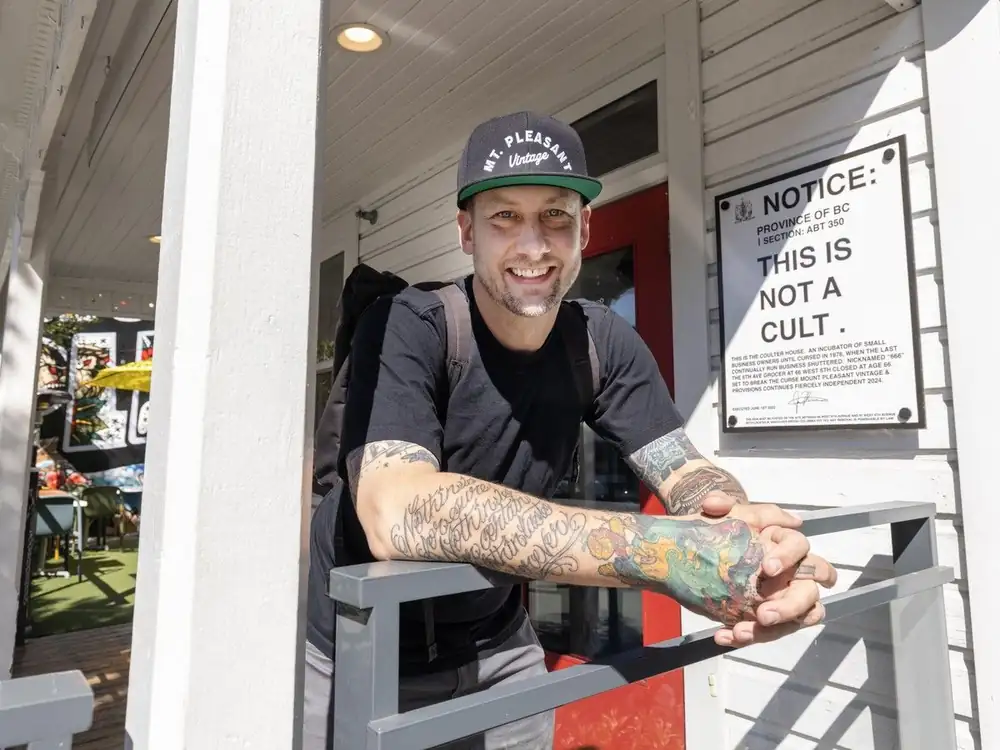
Cameron Bogue wanted to open the kind of bar where people could grab a drink, stand and mingle.
Getting permission to open one at his vintage-themed restaurant took 19 months and about $40,000. When Bogue opened Mount Pleasant Vintage & Provisions in 2022, he chose a food-primary licence because it was faster and cheaper to obtain than a liquor-primary licence, which requires city council approval and was granted to a limited number of bars.
But there was a catch: with a food-primary licence, customers have to remain seated while drinking. “We’re in a new age of socializing where people want to drink and mingle over late-night food in an open space, rather than a dark nightclub,” he said.
The city’s current liquor permitting system took shape after B.C. overhauled its liquor laws in 2002, replacing older categories with food-primary and liquor-primary licences. Vancouver built its own municipal approval process around those provincial rules.
But some of Vancouver’s red tape goes back even further. A 1989 city policy required liquor-licence applications near residential areas to go through a neighbourhood referendum, giving residents a say before any business could move forward.
Under the current ABC-majority council, led by Mayor Ken Sim, the city has been trying to make it easier for hospitality businesses to open. Three years ago, it created a hospitality working group to look at delays and rules around licensing, liquor and fire safety. The city has already made several changes.
Since December 2023, businesses have been able to apply for development permits and liquor licences at the same time. Council also made it easier for non-traditional businesses, such as retail shops, barbershops and spas, to get liquor licences.
It also allowed more businesses to apply for liquor primary licences by removing long-standing limits on new applications. The city said in a statement the median approval time for a new liquor-primary licence fell from 202 days in 2023 to 118 in 2025.
More work remains, it said, on speeding liquor licensing, expanding patios and simplifying rules for breweries. Bogue was among the first businesses to take part in a dual-licensing pilot that allowed restaurants to obtain a liquor-primary licence.
“It’s been a game-changer,” he said, describing lines outside on weekends. The approval process, however, took 19 months.
Bogue hired a consultant to help navigate the system, and costs continued to pile up while the business was just getting off the ground. “It was one of the darkest times of my life,” he said. The Liquor and Cannabis Regulation Branch said cases that take over a year are “very uncommon,” attributing longer waits to background checks, construction delays and local-government approval.
It added that provincial licence fees in B.C. are “well below $10,000″ — $950 for a food-primary, $4,400 for a liquor-primary. But Bogue’s new liquor-primary licence brought new limits: occupancy split among 95 people inside, 45 on the front patio and 45 on the back.
“We’ve had to hire security to cap the number of people on our back patio dance floor,” he said, adding he put chairs on the dance floor to discourage congregating. “We’ve gotten a ton of one-star reviews because of it.” A few weeks ago, Bogue opened a second location in Calgary, where he said he secured a liquor licence in six weeks for less than $10,000, with full occupancy and standing and mingling allowed.
The permitting process in Vancouver was more time-consuming and cost more to navigate. The main difference, he said, was that Calgary’s permitting departments worked together rather than making him navigate each step.
This week, he received Vancouver city council’s approval to raise his Mount Pleasant bar occupancy to 248 people. ‘Streamlining red tape will be really important’
Ian Tostenson, president of the B.C. Restaurant & Foodservices Association, and a member of the city’s hospitality working group, said Vancouver should make it easier for food and drink businesses to use neighbourhood spaces, as other global cities do.
He said that while public safety matters, the city should also look at whether some rules are actually needed or create more red tape. He pointed to one example: during the World Cup, Tostenson received a call about customers walking through the Fan Zone on Granville Street with beers in their hands.
The situation eventually involved a call from police. “(But) the city and council have made a lot of effort to streamline things,” Tostenson acknowledged.
He pointed to the city’s newly created business office, which works on hospitality issues and has been looking at where businesses get stuck in the permitting process and how to fix those delays. He called it “a good first attempt” but said many entrepreneurs don’t have the money to wait through long delays or deal with complicated processes when they apply for licensing.
“Streamlining the red tape even more will be really important,” he said. With the municipal election looming, several council candidates are making red tape a campaign issue. Rebecca Bligh, an incumbent councillor with Vote Vancouver, has promised to “fix” the system so “small businesses can move forward without years of red tape.”
OneCity mayoral candidate William Azaroff said his party has an economic plan that would make it easier for residents to operate small businesses in their residential neighbourhoods, including cafes, bike repair shops, corner stores and home-based businesses. “Vancouver is known to be one of the most difficult cities to open something cool in,” Bogue said. “But there is so much opportunity here, if we were allowed.”
- Who: Vancouver · Vancouver Coastal Health
- Money: $320,000 · $4 · $5,000 · $40,000.