Mouthwatering Chicken Akni Recipe (chicken Pulao)
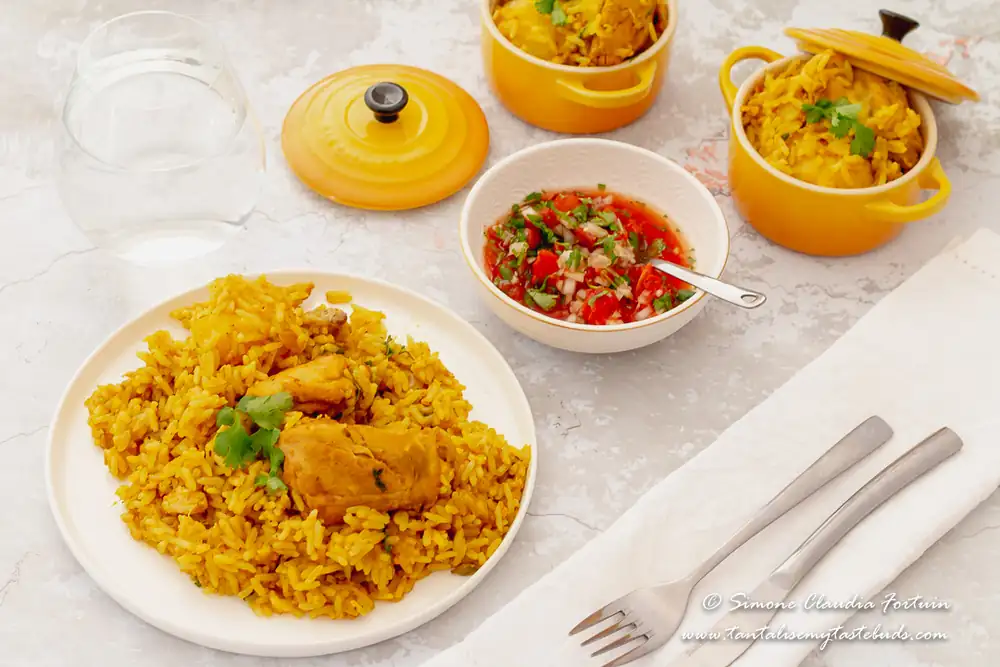
Cape Malay Chicken Akni is simple comfort food of lightly spiced and fragrant perfectly cooked fluffy rice with chicken, potatoes and herbs. No matter the season, whenever I go back home to Cape Town my soul yearns for the food of my childhood.
- 570 grams long grain basmati rice (approximately 750 ml or 3 cups)
- 60 ml vegetable oil (approximately 1/4 cup)
- 5 pieces stick cinnamon
- 10 cloves
- 10 allspice
- 10 cardamom pods
- 250 gram onions, finely diced (approximately 2 small onions or 1 large)
- 115 grams tomatoes, chopped or grated (approximately 1 medium tomato)
- 20 grams crushed garlic (or garlic paste)
- 20 grams grated ginger (or ginger paste)
- 2 green chillies, sliced
- 5 ml fine dried curry leaf powder (approximately 1 teaspoon)
- 7.5 ml cumin powder (approximately 1 1/2 teaspoons)
- 7.5 ml coriander powder (approximately 1 1/2 teaspoons)
- 5 ml turmeric powder (approximately 1 teaspoon)
- 12.5 ml curry powder (approximately 2 1/2 tablespoons )
- 20 ml salt (approximately 4 teaspoons to start)
- 1 kg chicken pieces
- 400 gram potatoes, peeled and cubed (approximately 4 medium sized potatoes)
- 75 ml finely chopped fresh coriander or parsley (approximately 5 tablespoons )
- 40 grams butter (approximately 3 tablespoons)
- Rinse the basmati rice until the water runs clear.
- Soak the rice in lukewarm to hot water for at least 30 minutes before cooking. This ensures that the rice will absorb the water and cook evenly.
- Put at least 2 liters of water into a pot and bring to a boil over high heat, then add the rice. Let the water boil again then turn down the heat to medium-high and cook for /-10 minutes or until the rice is parboiled but not soft and still has a bite.
- Rinse and strain the rice and put it aside, because this is one of the very last ingredients that will be added to the pot later.
- In a large heavy duty pot or dutch oven add oil, cinnamon sticks, cloves, allspice, cardamom pods, cloves, onions, tomato, and saute on low to medium heat for 10 - 15 minutes until golden brown.
- Add garlic, ginger, chillies, curry leaf powder, curry, coriander and cumin powders and allow this to simmer for 5 minutes.
- Add 125 ml boiling water to prevent the spices burning or sticking to the pan and allow to simmer for 5 minutes on low heat.
- Add the chicken pieces, cubed potatoes and salt and add another 125 ml boiling water then cook on high for 15 minutes.
- Turn the heat to medium-low and simmer for a further 20-30 mins on low to medium heat. Be sure to keep checking and stirring the pot every 10-15 mins to prevent the pot from burning.
- Check that the potatoes are chicken are cooked through then add the rice and give everything a really good stir to allow all the spices and flavours to combine with the rice.
- Add the butter and coriander or parsley over the top of the rice and do not stir again. Cover the rice with a piece of parchment paper and close the pot with a tight fitting lid.
- Cook on medium for 5 minutes then turn off the heat completely. Allow this to steam for 10-15 minutes from the residual heat. The rice should be moist and fully cooked but not wet.
- Lastly, give the pot a good mix and your chicken akni is ready.
- Serve with tomato and onion quick pickle sambal.
Katriena usually cooks either Chicken Akni or Lamb Akni or Sugar Bean bredie for my first meal. She learned to make it from watching my mother, and as with many of my mother’s recipes, Katriena is the keeper of the secrets of her every day cooking.
When I came to Dubai more than a decade ago, my colleagues wanted me to cook something for them that reminded me of home for our Saturday lunch at the site office. The first thing that came to mind was my mother’s Chicken Akni, because it would be tasty and substantial enough to feed six hungry men.
Imagine my surprise when the meal was followed by compliments like ‘that biryani was so tasty’ or ‘I like your biryani much better than what we get from the restaurants’. I had to explain the difference between a biryani and an akni recipe as we know it in Cape Malay households.
While both are rice based dishes with protein like chicken, meat or seafood and spices as well as herbs and optional vegetables, they differed in preparation and cooking style. While Akni was often included in a Sunday lunch during the cooler months, my mother reserved making Biryani for feast days like Eid. The Cape Malay biryani making process has many steps and in her opinion was too time consuming for a regular Sunday lunch.
- Marinating the protein – meat or chicken is usually marinated in a mix of spices and yogurt or buttermilk for biryani, but can be cooked without prior marination in akni. For the best result the biryani marination occurs overnight in the fridge.
- Addition of lentils – for texture and to increase the protein, lentils are added to biryani but not akni.
- Addition of saffron – bloomed saffron water is added over the top of the final layer of rice in biryani before the final steaming, but not to akni.
- Layering of ingredients – for biryani it starts starting at the bottom with a thin layer of rice then fried potato, then marinated cooked protein with gravy followed by rice and fried onions. For akni the curry base with protein and potatoes is cooked first, then the rice is added and cooked or steamed in the curry sauce until the rice is fluffy and no water remains.
- Addition of vegetables – fried onions are added to the top of the biryani whilst peas or peas and carrots may be added to akni before the final steam.
- Amazing fluffy Chicken Akni starts with the rice. The best rice to use for akni is long grain Basmati or Jasmine rice. Make sure that you don’t use sticky Jasmine rice as that could be a disaster of mushy proportions.
- The rice must be soaked for at least 30 minutes in lookwarm water before cooking. This ensures that the rice absorbs the water and cooks evenly without breaking.
- Stir the pot carefully and not vigorously, preferably with a big roasting fork or chopsticks that won’t break or mash the rice. Using a heavy spoon will result in the chicken and potatoes to break up and lose form due to the amount of moisture present in the pot. This does not make for a good look.
- Continuously check your pot to avoid burning, especially if you’re using an enamelled cast iron pot that retains heat.
- Be sure to add the boiling water sparingly. It helps with the steaming of the chicken and potatoes but you don’t want to add too much as it will be too wet. The liquid allows all the flavour from the spices to release and also, the Chicken akni will not be dry but moist.
- If the pot seems a bit too dry for your liking, just add water a little at a time, but not too much because then the akni will have a somewhat watery finish.
- Always add the butter and chopped coriander last as a finishing touch and garnish.
- Add frozen peas or peas and carrots before the final steam so that they are still bright and just tender.
- Chicken Akni is best served with what we in Cape Town like to call “uiwe en tamatie slaai”. It is a lightly pickled salad using with chopped tomatoes, chopped onions, chillies, vinegar and sugar.
- This is a family meal and meant to stretch. If you prefer less rice use only 2 1/2 cups and reduce the water accordingly.
- Ginger and garlic paste can be used.
- Crushed dried chillies can used instead of fresh chilies. If you like it spicy add chili powder as well.
- Any long grain rice can be used, though basmati and jasmine rice (not sticky rice) are preferred.
- If you do not have parchment paper, foil and cling wrap or a clean tea towel can also be used. Just placing the lid on the pot is also okay too as long as it fits tightly.
Disclaimer: Nutritional information for the recipe is an approximation and varies according to the ingredients and products used. If you liked the recipe above please consider rating the recipe and leaving a comment below.
Also keep in touch on Facebook, Twitter, Pinterest and Instagram for more updates. Don’t forget to share the recipe with your family and friends and #tantalisemytastebuds if you share one of my recipes that you made on Instagram!
Want more?