Fatty, Moist, and Perfectly Crisp When Grilled, No Wonder Eel Is a Big Deal In This Adriatic Town
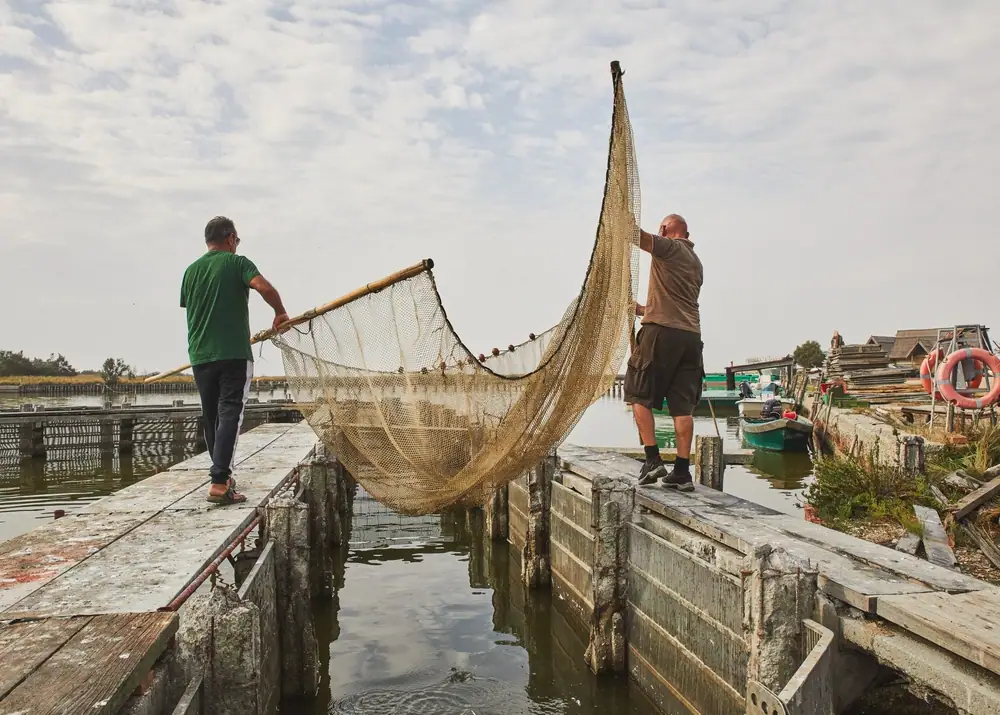
Local fishermen Carletto and Giancarlo reset a net before pulling up eels from the trap.
“Cooking here is habitual, nothing inventive, we don’t change anything,”
Simon Bajada Up until the 1950s, there were no roads to Comacchio—the sleepy fishing outpost was only accessible by water—so it’s understandable that the Italian town and its people still have an air of superstition when it comes to outsiders. It hasn’t progressed like the more touristy destinations nearby dotting the Adriatic coast (Venice is a two-hour drive north), but travelers prepared to forego some modern luxuries will be rewarded with a trip back in time. With its many bridges and canals, Comacchio recalls a mini Venice (not far north along the Adriatic coast).
Simon Bajada Like the curious creature that put it on the map, Comacchio can be tricky to capture. Situated at a delta where several waterways meet the sea, the wetland-rich landscape is reminiscent of a scene out of True Detective —while the inner town could pass for Venice in miniature, with its picturesque network of canals and arched brick bridges. A classic not to be messed with: the grilled eel and polenta at the Sagra dell’Anguilla (eel festival).
Next, fried school prawns and whitebait act as show openers to the star dish: grilled eel on humble polenta. None of this fritto misto gets a drop of lemon juice (my request for the citrus was denied); the savor is so superior, locals consider it somewhat of an insult to attempt to embellish it further. Early in the morning, a local checks his nets in front of his home for any eel or fish he may have trapped overnight.
Simon Bajada In Comacchio, eels once translated into big business, and excessive stock prompted the development of preservation methods (still used today) to maximize returns. Roasted then cooled, the pieces are placed in a simple brine of vinegar, water, and bay, before being sealed in cans with the original 1950s packaging worthy of design awards.
During the Sagra dell’Anguilla (the annual Eel Festival that kicks off in late September), stalls pop up along the canals selling local delicacies and every restaurant has a special set menu. At the outskirts of Comacchio, fences made of reeds act as traps to catch fish and eel out on the Po Delta.
The stone building is one of the old warehouses where stock was cooked and preserved. Simon Bajada At Il Bettolino Di Foce , a destination eatery that stands at the end of a dusty car park under a vast open sky, I meet chefs Mirella and Fillipo.
The flat surroundings, a stretch of ramshackle fishing huts and old stone factories where fishermen once lived for weeks at a time, add to the ambience and reflect the locals’ straight-forward approach to preparing their treasured ingredient. “The rich meat needs nothing,” states Fillipo. Served with polenta, a counterpoint to the fatty protein, and it’s immediately obvious why the combination has never changed.
Used to preserve the eel, it’s in addition featured in the Bec d’Asan—a stew of tomato, onions, garlic, and eel that translates to “donkey’s beak,” an Italian expression for a simple, fast process with great results. Mirella, who has cooked up and down the Adriatic Riviera since the 1980s, holds back on the vinegar when making the dish, but Fillipo, going off the techniques and recipes passed down from his grandmother (herself a locally renowned home cook), insists the stew gets generous splashes of the stuff. And when we start eating it’s clearly warranted; the vinegar permeates the oily flesh and balances out the flavor.
Simon Bajada Like most things in Comacchio, residents don’t feel the need to add flourishes or tweak traditional recipes.