12 Kitchen Items You Should Never Buy From Thrift Stores
In the grand scheme of things, kitchen utensils and spatulas generally aren't that expensive, and you can find them at most stores and online retailers. Although it might be tempting to add "just one more" scraper spatula to your cart, we recommend skipping it.
However, before you fall in love with one of these thrifted knives, you'll want to make sure to test that it's not dull (if your thrift store even allows you to do that). Dull knives are dangerous, since they do not cut food effectively and can easily slip. If you buy a used knife, take it home, and use it without making sure it's properly sharpened, you will risk hurting yourself and wrecking what would have been a beautiful steak (or whatever you're cooking). Knife sharpening is easy enough to do, but it necessitates that you have a knife sharpener or a whetstone, or can take it to someone who can professionally sharpen it for you. This costs money and time, and in the end, may make the low purchase cost of the knife unappealing. It would be much easier (and would save you the headache) to buy a pre-sharpened, ready-to-go knife in the first place.
Salt and pepper mills may seem straightforward and like a safe bet, as there isn't anything added to them besides salt or pepper, but let us ask you this: When was the last time you cleaned your pepper or salt grinder? That alone should give you pause, especially when you consider all of the splashing and cross-contamination that occurs when you leave them next to your stove. While we would like to believe that the folks thrifting these items would be diligent about cleaning them, that just isn't the case.
Stand mixer
Any bread-making enthusiast knows the importance of a stand mixer. Gone are the days of kneading dough for what feels like hours, as all you need to do is pop the ingredients into the stand mixer bowl and use the right attachment. The last thing you want is for your stand mixer to die the second you give it a task, which is why we'd recommend buying one of these machines new or certified refurbished (KitchenAid offers this) rather than from a thrift store. For one, there are parts inside of a stand mixer that you cannot see and adequately assess the status of when you buy it from a thrift store. And if you do want to buy one at the secondhand store, you have to look out for signs of damage like rust, cracks, leaky oil or lubricant, and more. Plus, if you buy your item at a thrift store, you may not be getting all of the attachments you need to use it to your ful
Plastic food storage containers
If you're like us, you know that there is no upper limit to the amount of food storage containers you can have. You might buy a set, but lose the lids for a few, crack the bases of others, or just hand them off to people when they ask for leftovers at Thanksgiving. And you would think that a thrift store would be a great place to score some cheap extras for yourself. However, when it comes to plastic, that is hardly the case. Many have argued that you should ditch plastic food storage containers altogether because they can easily scratch, dent, and harbor bacteria. They can smell like food after washing, and oily foods can break down the plastics, potentially releasing chemicals into your food (though more research is needed to calculate the full risk of plastics in the food supply). Even if you aren't as concerned with the health risks of used plastic storage cont
Cutting boards
Have you ever chopped something on a plastic cutting board, only to look at it and think, "Man, I need to throw that thing away?" Take it as your sign to send the discolored and/or scraped cutting board to the trash and not the thrift store. And, if one of these used cutting boards does find its way into your local Goodwill aisle, heed our advice and leave it out of your cart. Some people have argued that we should get rid of plastic cutting boards as a whole, as the repeated chopping can release plastics into food. However, sanitation (or lack thereof) is a more pertinent concern with thrifted cutting boards. This kitchen essential needs to be properly sanitized and cleaned regularly, because the grooves can be a hotbed for bacteria and food-borne illness. Your board and knife can be causing your food to go bad faster, and it's impossible to know what exa
Coffee machines
Smith Collection/gado/Getty Images For many, the coffee or espresso machine is the one item in the kitchen that is used daily. The trusty appliance is there for all of our morning brews and leisurely sipped lattes, and it even helps craft the perfect espresso shot for an espresso martini. It's not a cheap machine, so it makes sense to want to thrift one and save yourself some money. However, this one is worth skipping for two reasons: It's impossible to know how well the last owner of your machine cleaned it, and there are a lot of parts that can easily break or become damaged that you won't be able to tell from a basic, in-store once-over. This includes built-in grinders, heaters, water tanks, wiring, and more. If any part of this machine fails or is broken, the coffee won't brew as intended, which means you'll be back at square one. Coffee machines are notorious for needing regular cle
Non-stick pans
If you cook for yourself often, you likely go through non-stick pans like wildfire. Scratches, burnt-on food, and residue can all cause your non-stick pan to become, well, non-non-stick. That damaged coating is arguably why most people drop these pans off at thrift stores in the first place. They might be perfectly "good" pans in that they cook your food and aren't visibly warped, but you will come to regret your thrift store purchase when you come to flip your pancake or move something around in it, only to find the food stuck to the bottom. You can't let some other home cook's trash become your "treasure." We would recommend avoiding non-stick pans altogether, however, if you find one that you really love while perusing the Goodwill aisles, be sure to give it a once-over for any potential damage. Scratches on the pan's surface are a clear sign that the coating
Appliances with a plug
How you feel about thrift shopping may correlate to how you feel about taking risks. If you don't adequately test an appliance with a plug before adding it to your thrift store cart, you run the risk of buying something that doesn't work. On a $5 mini blender or $10 rice cooker, this might be trivial, but if you are blindly trusting that a $300 refrigerator works, well, the odds might not be in your favor. Some thrift stores offer plugs near the appliance section so you can test your item before adding it to your cart, and others will offer opportunities to return the appliance back to the store within a certain period of time. However, these test and return options do not alleviate all the risks of thrifting a plug-in appliance. For example, while a microwave might power on when you plug it in, the plate inside of it may not spin, some of the buttons may be broken
Vintage serveware
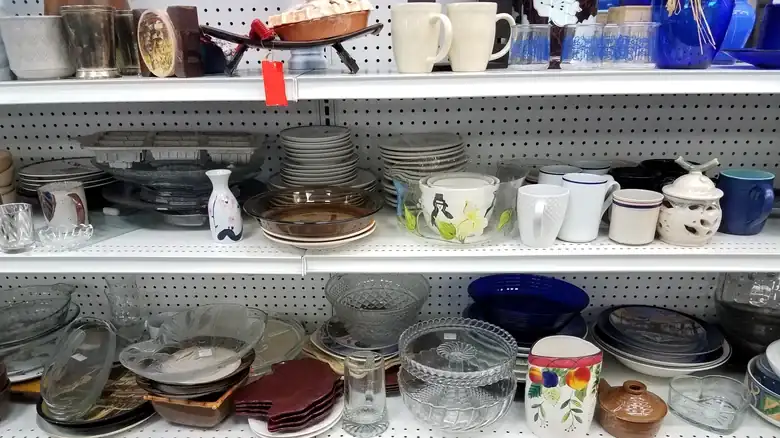
We'd be remiss not to mention vintage serve-ware, including porcelain and china, as they're common finds at thrift stores. You may be able to find some high-end pieces if you know what to look for. However, if you are thrifting pre-1971 pieces, you also risk lead exposure. Prior to this time, there was very little regulation over the use of lead and cadmium, another heavy metal, in dinnerware. While lead gave the serve-ware of the era a beautiful finish, it also came with negative health effects, including impaired fetal development, memory, and kidney function. It can be hard to determine which dishes contain lead and cadmium, as this isn't disclosed on the products themselves. However, knowing what items are at risk can be helpful. Pay attention to vintage crystal, dinnerware, and metal pieces (including metal ice cube trays). Glazed terracotta, hand-painted or a
Rusted cast irons
We love a challenge. However, we also understand the mantra of "work smarter, not harder." Unfortunately, rusted or unloved cast iron pans are something we consider to be the latter, rather than the former. Although they may look rugged, cast iron requires dutiful and intentional cleaning and re-seasoning to remain in good working order. Rust is not a death sentence for cast iron, as there are ways to remove it, but we would not recommend getting a cast iron pan that is already rusted, because you have to do a lot of work before you can even cook with it. From soaking it in vinegar and water to scrubbing away the rust (often multiple times, depending on the severity), cleaning, re-seasoning, and cooking, you could be spending hours on getting this pan ready for your next recipe. And when you can buy a new Lodge cast iron skillet for under $30, or even spring
Older copper cookware
If you are painfully aware of the price of high-end cookware, seeing a copper pan at a thrift store will make you feel like you just won the thrift store lottery. It's the cookware that Martha Stewart swears by, and it's beloved by cooks because of its ability to heat up quickly and retain its temperature for long periods of time. Secondhand stores are the best place to buy it because single pans can cost more than $100, but it's important to remember that not all vintage copper cookware is valuable. The copper cookware needs to be lined with tin, stainless steel, or some other non-reactive metal so that it can be safe to use, as ingesting copper can make you sick. So if you can pick up the pan and see the copper layer poking through, or the finish looks dull and patchy, it could be a sign that the pan is not safe to use. Furthermore, if you notice verdigris, patc
Wooden or plastic utensils
A home cook will likely use some sort of utensil every time they cook, whether that's a wooden spoon, silicone spatula, or metal whisk. These small items are generally priced less than other kitchen essentials (like pans), and they're an especially popular choice at thrift stores for folks who love collecting kitchen gadgets and tools. We mean, has anyone ever complained about owning too many spatulas? However, the harsh reality is that just because you can buy utensils — specifically used utensils — from the thrift store doesn't mean you should. Like cutting boards, they can release plastics into your food as they wear down, and this wear is what introduces more surface area for bacteria to hold out. Stainless steel, bamboo, and wood utensils are generally safer to thrift than plastics because they don't wear as easily, but who wants to buy a used spoon t
Dull kitchen knives
Kitchen knives are an essential that aren't cheap. While there are some Japanese chef knives available on Amazon for under $50, the vast majority of high-quality knives are priced upwards of $100 — potentially even more. So, it would make sense to peruse the aisle at your local secondhand shop to try and find a good deal. However, before you fall in love with one of these thrifted knives, you'll want to make sure to test that it's not dull (if your thrift store even allows you to do that). Dull knives are dangerous, since they do not cut food effectively and can easily slip. If you buy a used knife, take it home, and use it without making sure it's properly sharpened, you will risk hurting yourself and wrecking what would have been a beautiful steak (or whatever you're cooking). Knife sharpening is easy enough to do, but it necessitates that you have a knife sh
Spice grinders and garlic presses
It might seem odd to group salt and pepper grinders and garlic presses on this list, but once you think about it, these two kitchen gadgets face very a similar problem: They have a lot of nooks and crannies, and they can be really hard to clean well. We can't tell you how much time we've spent picking tiny pieces of garlic out of a garlic press (often with a toothpick) because the scrub-brush-and-dishwasher combo wasn't enough. It's reasonable to expect that the person who tossed their garlic press in the "donate" pile may not have been as attentive to cleaning theirs. Salt and pepper mills may seem straightforward and like a safe bet, as there isn't anything added to them besides salt or pepper, but let us ask you this: When was the last time you cleaned your pepper or salt grinder? That alone should give you pause, especially when you consider all of the s