Flourless and Yeast-Free Bread: A Nutritionist's Recipe That You Won't Be Ashamed to Eat in the Evening
Bread is a food that's often eliminated from the diet when people decide to lose weight or switch to a "healthy diet." A particular battle often begins with the evening meal. The first thing that comes to mind for those trying to lose weight is not eating after 6:00 PM.
Why is flourless bread not necessarily about restrictions?
The absence of flour and yeast doesn't automatically make a product healthy or low-calorie. It all depends on the ingredients. This type of bread can emphasize eggs, seeds, nuts, and dietary fiber, resulting in a more filling option with a good amount of protein and fat.
The main advantage of homemade bread is that you control its ingredients. But don't be afraid of regular bread: it's important to learn how to read product labels and incorporate them into your diet.
Is it possible to eat bread in the evening?
Yes, you can. The body doesn't automatically convert bread after 6:00 PM into fat.
Weight is primarily influenced by overall energy balance, diet, and lifestyle. But evening meals often hide another pitfall: if you've eaten too little during the day, your body will try to compensate in the evening.
To avoid evening binges, it's important not to deny yourself bread during the day, but to incorporate it into a complete meal: add a source of protein, vegetables, and a serving that fits your diet.
What will replace flour and yeast?
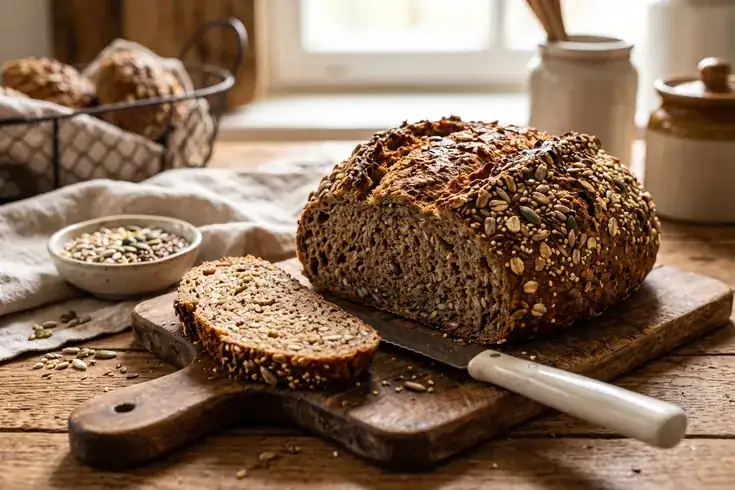
Alternatively, you can make bread made with eggs, seeds, and psyllium, or take a trip back to the Paleolithic era and make bread made with seeds and nuts.
Eggs provide protein and help form the bread's structure after heating. Flax, pumpkin, and sesame seeds add fat and dietary fiber, creating a more interesting texture.
Psyllium is a source of soluble dietary fiber. When exposed to water, it swells and forms a gel, helping to bind ingredients and retain moisture. This helps keep bread from crumbling, even without flour or yeast.
Nuts are a source of vegetable protein, unsaturated fats, dietary fiber, vitamins and minerals.
Ingredients:
eggs - 3 pcs. psyllium - 2 tbsp. flax seeds - 2 tbsp. pumpkin seeds - 2 tbsp. sesame seeds - 1 tbsp. water - 120 ml. salt - 1/2 tsp. baking powder - 1 tsp. olive oil - 1 tsp. optional - dried herbs, paprika, garlic or other spices.
Preparation:
Lightly grind the flax seeds. You don't have to turn them into flour—breaking the shell is enough.
In a bowl, whisk the eggs with water and salt. Add the psyllium husk, flax seeds, pumpkin seeds, sesame seeds, and baking powder. Stir and let the mixture sit for 5-10 minutes. The psyllium husk will absorb the water, and the mixture will thicken noticeably.
Transfer the mixture to a small pan lined with baking paper. You can add a few more seeds on top.
Bake at 180 degrees Celsius for approximately 35-45 minutes. The exact time will depend on the size of the pan and the oven.
Let the finished bread cool completely. This is important: after cooling, the structure will become firmer, making the bread easier to slice.
Ingredients:
Sunflower seeds - 100 g. Sesame seeds - 100 g. Pumpkin seeds - 100 g. Walnuts - 200 g. Eggs - 5 pcs. Salt - 1/2 tsp.
Preparation:
Grind the walnuts. Don't turn them into flour—small pieces are enough.
Add sunflower seeds, pumpkin seeds, sesame seeds, eggs, and salt. Mix until smooth and thick.
Transfer the mixture to a small baking dish lined with baking paper or to individual ceramic cocotte dishes.
Cover the pan with a lid or foil and bake at 180 degrees Celsius for 20 minutes. Then remove the lid or foil and bake for another 30 minutes.
Let the finished bread cool slightly, then cut.
How to make bread even more filling?
This bread doesn't have to be eaten on its own. In the evening, it can be paired with protein and vegetables.
For example, add fish, poultry, eggs, meat, cottage cheese, or another familiar protein source. Pair this with a vegetable salad or baked vegetables.
Then a piece of bread becomes not a separate “forbidden product”, but part of a normal meal.
Ultimately, good bread doesn't have to be "unhealthy" or "dietary." And you certainly shouldn't feel ashamed of eating it in the evening.
It's much more important to eat a balanced diet throughout the day, and bread plays a sensible role in it. This homemade version is an easy way to add protein, fiber, and seeds to your diet while still enjoying a familiar product without flour or yeast.