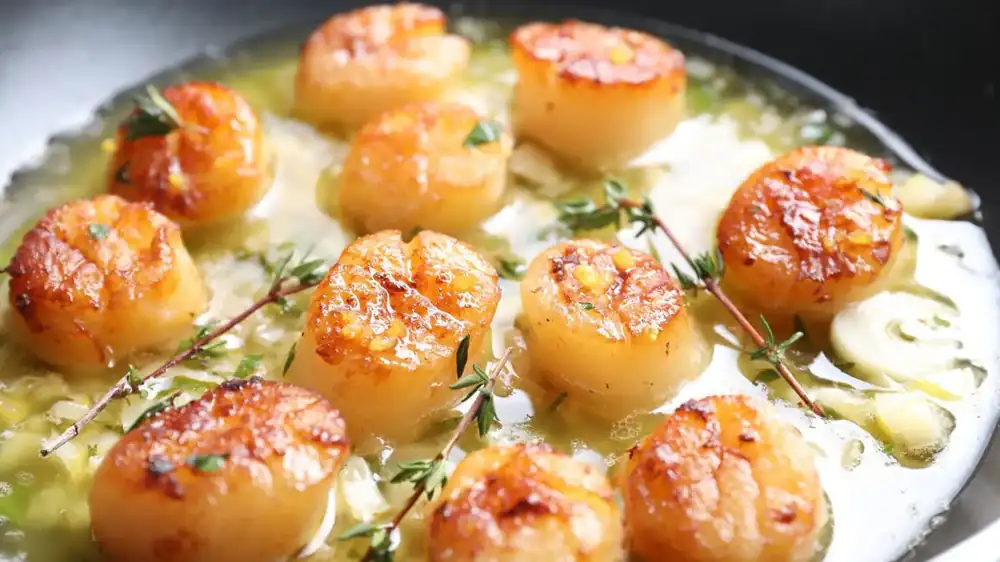
Neither butter nor olive oil: this ingredient allows the scallops to sear and gives them a beautiful golden crust
Cooking scallops is a crucial step in bringing out the best in this delicate product. The goal is to create a beautiful golden crust without burning the flesh inside. To achieve this subtle balance, we'll reveal which fat is particularly effective. This will literally transform your next cooking experience!
In cooking, adding fat during cooking prevents food from sticking to the surface and ensures better heat distribution. It also enhances flavors and, in some cases, even promotes a deliciously browned color.
Cooking scallops requires a delicate approach. It's crucial to choose the right fat. The challenge lies in achieving an immediate sear, allowing a beautiful golden crust to form quickly. For this, clarified butter is the ideal fat.
More resistant than regular butter, clarified butter doesn't burn easily. It nonetheless imparts a unique flavor that pairs perfectly with the subtle briny taste of scallops. Olive oil, when used for cooking, risks masking some of the seafood's flavor due to its strong aroma.
A fat with remarkable qualities
Clarified butter, known as ghee particularly in Indian cuisine, is prized for its cooking properties. Indeed, stripped of many heat-sensitive compounds, this nearly pure fat has a very high smoke point (between 200°C and 250°C).
This means that clarified butter can be heated to very high temperatures without burning. Regular butter, on the other hand, is limited to 130-150°C. Once these temperatures are reached, the proteins (casein) and milk sugar (lactose) turn black and bitter. They also release toxic compounds that should not be ingested.
Olive oil, which is more stable (smoke point around 200°C), can be used, but its sometimes very strong flavor tends to mask that of the scallop. Clarified butter is milder, giving the cooked product subtle nutty notes.
Clarified butter can obviously be bought in stores (organic supermarkets, large retailers, etc.). However, it is possible to make it at home with regular unsalted butter. To do this, cut a 250g block into uniform cubes.
Melt the butter in a small, heavy-bottomed saucepan over very low heat. Do not stir. Gradually, the butter will separate into three distinct layers:
- The proteins in whey form a white layer on the surface.
- The pure fat, appearing as a golden-yellow liquid, remains in the center.
- Lactose and residual water settle at the bottom.
First, the surface film must be very gently removed. This skimming can be done with a spoon. Then, simply pour the pure fat very gently (so as not to mix the layers again) into a suitable container. Using a cheesecloth (or a coffee filter) will produce perfectly clarified butter.
This clarified butter can be stored for several months at room temperature (away from light). Stored in the refrigerator, it goes rancid even less quickly and can be used for up to a year.