What Does It Mean to Eat a Flower?
Flowers have as much savor and nutritional value as a lot of things that we put in salads.
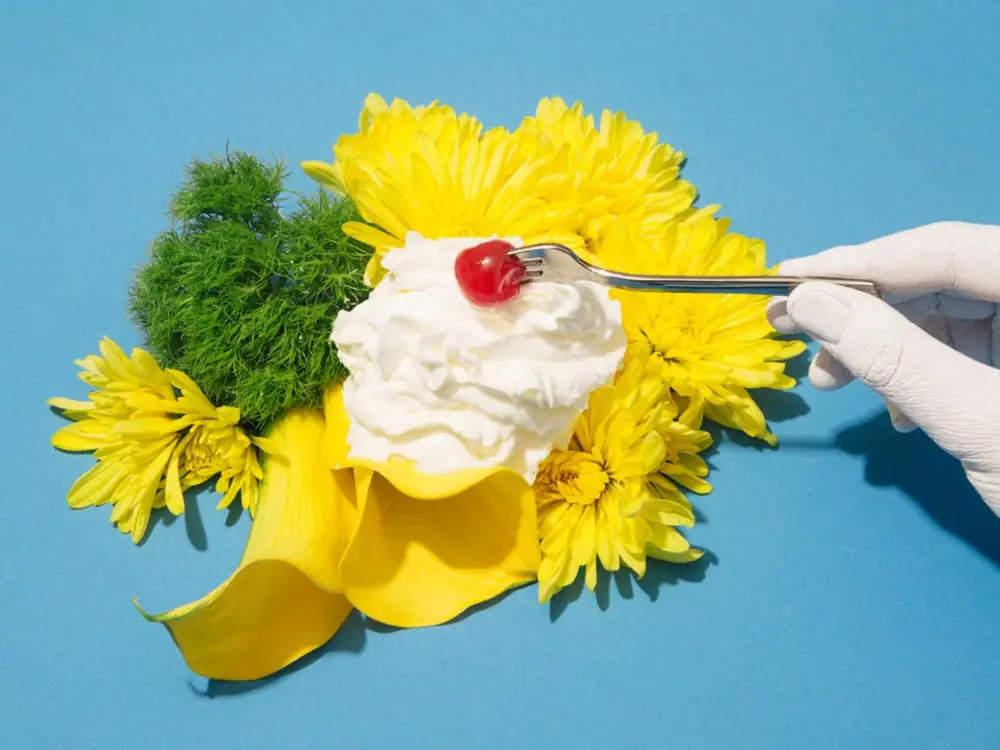
“It was a bizarre, disturbing sight: somehow the flower being crammed into her mouth was like a living creature,”
So why do we think of them as such a symbol of vanity and superficiality? On the cover of The Moon Juice Cookbook , a book by the enigmatic wellness fairy Amanda Chantal Bacon, a single spoonful of yogurt floats in midair while an invisible hand delivers, in the style of Salt Bae, a sprinkling of powder that cascades onto the semi-viscid surface. This might all seem like superficial adornment, born of a culture of excess and performance, but people have been eating flowers for as long as we’ve been eating plants of any kind.
Like all edible plants, they provide some sustenance, but historically, the reasons for eating flowers often had more to do with cultural needs than bodily ones. We see a few fresh pansies strewn across a salad, and it’s hard to see anything other than a decoration.
Flowers had medicinal uses (rose petals for vitamin C, honeysuckle to soothe the throat). Religious ones (the Egyptians considered the lotus the sacred flower of the Nile and ate it raw, boiled, baked into bread, and dipped in honey). Despite this long and storied history, and despite the fact that they are, nutritionally, not that different from lots of herbs we eat regularly, flowers tend to occupy a space in our imaginations that we associate with vanity and hedonistic desires.
We see a few fresh pansies strewn across a salad, and it’s hard to see anything other than a decoration. In the summer, I eat the flowers from my garden, snacking on chive blossoms and basil flowers while I weed. I have a friend who forages in the woods of New England for a living, and in the summer she likes to make large “wild” salad bowls for lunch, packed with every native green sprig she can find—dressed with olive oil and lemon juice.
Flowers are mild in savor and nutritional value, yet they’re high in emotional resonance. A 2005 study conducted by researchers Jeannette Haviland-Jones and Terry McGuire found that when participants were presented with flowers, they always, in every case, responded with a Duchenne smile (aka a “true smile” that involves the mouth, cheeks, and eyes).
Flowers have certain traits that are universally pleasing—they’re colorful, they smell nice, and they tend to have some type of symmetry. But despite the many practical reasons to eat flowers (nutritional, environmental, medicinal), we tend to greet flower-eating with a mild sense of judgment—as if people who eat flowers are somehow cheating their way to happiness, just as they might by taking drugs or buying a $12 Moon Juice.
When his men partake in the local custom (it is only polite, after all), they fall into a blissful forgetfulness and have to be forced back to work. In Alfred Lord Tennyson’s poem The Lotus-eaters, he rewrites this encounter in his own 19th-century verse, calling the natives “mild-eyed” and “melancholy” as they bear branches “laden with flower and fruit” that made the sailors forsake their homes and descend into a particularly apathetic form of madness.
In the case of the famous 20th-century Japanese story “The Flower Eating Crone,” eating flowers has an illicit impulsiveness to it. “It was a bizarre, disturbing sight: somehow the flower being crammed into her mouth was like a living creature,” the narrator describes, appalled and yet ever so slightly enticed by the rude gesture. We’re not supposed to value beauty above all else, especially not in such a practical realm as the kitchen.
Yet we so often consume things that have little nutritional value (like herbs or spices) without giving it a second thought. We’re not supposed to value beauty above all else, especially not in such a practical realm as the kitchen.
Yet we so often consume things that have little nutritional value (like herbs or spices) without giving it a second thought.
- Who: Amanda Chantal Bacon · Salt Bae
- Money: $12