Taurasi and Barolo: why prices tell different stories about markets
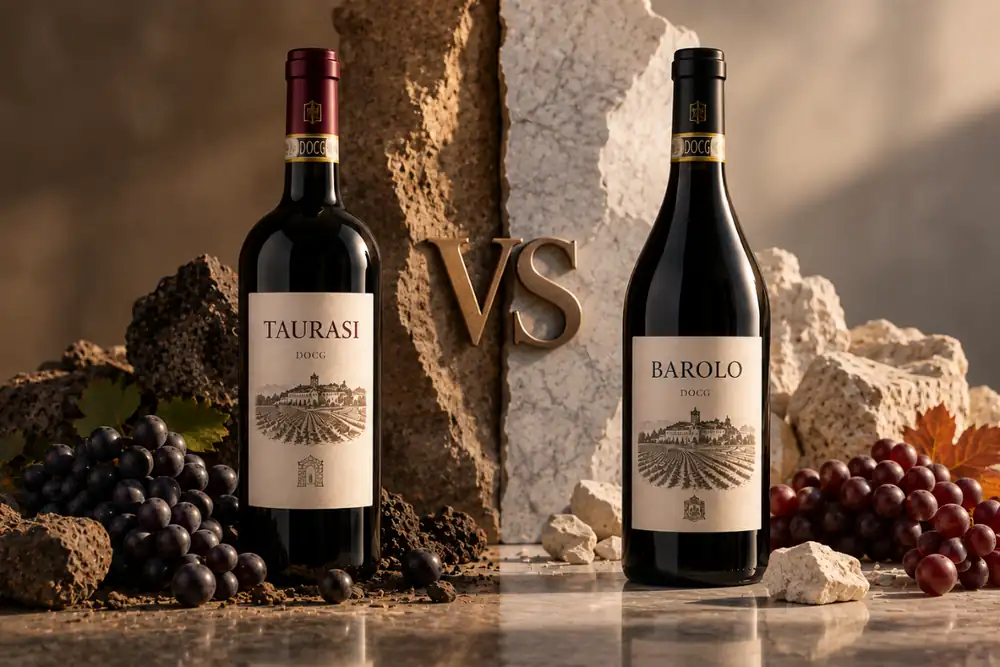
Comparing Taurasi and Barolo highlights how the commercial value of a denomination depends on factors beyond quality. Average prices, online availability, distribution, reputation, and market continuity reveal two very different positionings.
In wine, quality tends to be viewed as a variable that the market, sooner or later, rewards. Data shows that this isn't always the case. Commercial reputation also depends on distribution and the consistency with which a denomination is presented to operators and consumers.
María Laura Ortiz addresses this issue in the article "Barolo and Taurasi: Same Language, Different Accent," published on Wine-Searcher. The platform's international database lists 14,477 Barolos and only 731 Taurasi wines. The global average price is $136 and $71, respectively. In the United States, it rises to $179 for Barolo and $105 for Taurasi.
Online offers do not correspond to actual sales. Even the tasting of eight wines presented in the article doesn't allow for a general assessment of the quality of the two appellations. However, the numbers reveal two very different positionings. Barolo offers a wide selection, spread across various price ranges, while Taurasi maintains a more limited presence, concentrated primarily between $25 and $75.
The theme draws on a reflection developed by Fabio Piccoli in the recent Wine Meridian editorial "Value Doesn't Grow Alone." Growth in value doesn't automatically involve all quality products. It rewards those supported by precise positioning and an appropriate strategy.
Barolo has built these conditions over time. The 181 additional geographical indications allow for the identification of the different production areas and have provided the market with shared criteria for distinguishing wines. The MGAs do not represent a qualitative classification, but they facilitate the work of critics, restaurants, and distributors. Added to this is a consolidated international presence, which has fostered a diverse demand even in the higher price ranges.
Taurasi possesses equally significant production characteristics. The denomination encompasses 17 municipalities, and the production regulations require at least three years of aging, four for the Riserva, as specified by the Consorzio Tutela Vini d'Irpinia. Aglianico also offers wines capable of long-term aging. These factors, however, do not automatically guarantee fame and commercial availability.
A denomination that's less widely distributed has a harder time appearing on restaurant menus and in importers' selections. It has fewer opportunities to be tasted, reviewed, and repurchased. Reduced availability limits demand and makes it more difficult to build a stable premium segment. Taurasi's lower price, therefore, doesn't indicate a lower quality. Rather, it signals a narrower market.
Calling it the "Barolo of the South" doesn't help change this situation. The label uses Piedmontese fame to explain a wine that needs to be positioned independently. It would be more useful to more precisely communicate the differences within Irpinia and ensure a more consistent presence in strategic markets. Offering mature vintages could also concretely demonstrate the appellation's capacity for evolution.
Ortiz's comparison doesn't establish which of the two wines is superior. Instead, it shows how difficult it is to transform quality into value when distribution, awareness, and demand are lacking. The average price depends not only on the wine produced, but on the position a denomination has managed to establish in the market. For Taurasi, the priority isn't once again proving its ageability. It's ensuring this quality becomes known to a wider audience.
Key points
- Average prices: Barolo $136 globally and $179 in the US; Taurasi $71 and $105.
- Online availability: Wine-Searcher records 14,477 listings for Barolo versus 731 for Taurasi.
- Distribution: A broader commercial presence facilitates catering, importers, tastings, reviews, and repurchases.
- Positioning: The 181 Barolo MGAs help the market distinguish production areas and build awareness.
- Taurasi: quality and growth potential require greater awareness, distribution continuity, and independent positioning.