Oysters, the culinary treasure of Magdalena Bay
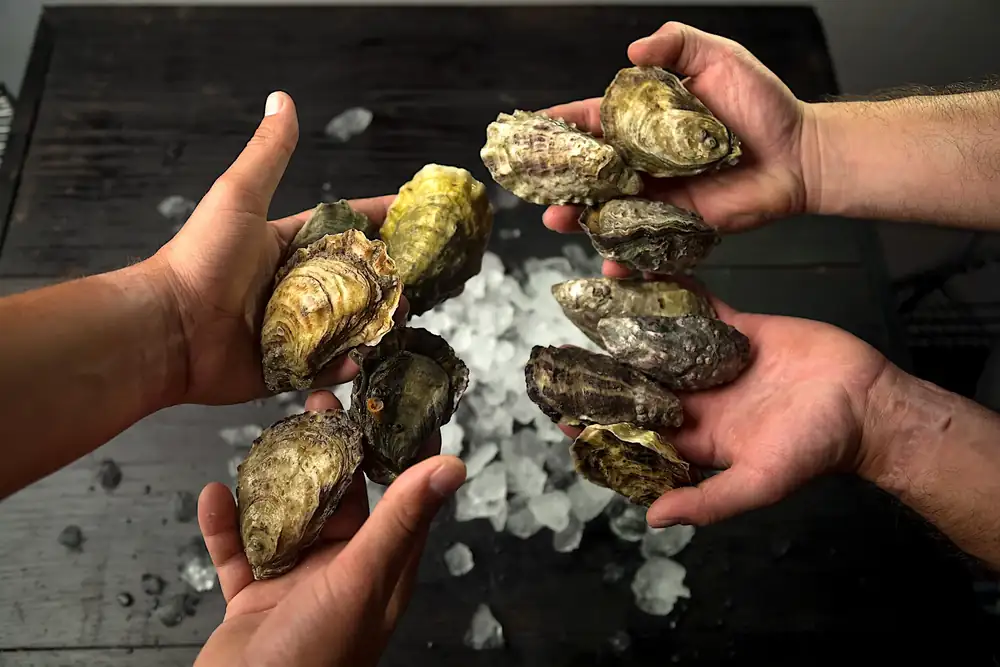
Two buckets overflowing with ice. The first brimming with oysters of various sizes, the other with a liter of beer (a large bottle of beer) beached in the cold. That was the welcome to the parade of shellfish that followed. But the culprit for this review was one in particular.
"Where did this beauty come from?" I asked aloud. By the grace of Poseidon, Alan Espinoza, one of the partners of Oyster House and founder of the Mexican Association of Oyster Farmers and of Bendito Mar, the company that made that moment of marine pleasure possible, happened to be passing by.
Alan grew up on Natividad Island in Baja California Sur, where his father was a fisherman. Sea cucumber, abalone, sea urchin, and macroalgae were his main source of income, but overexploitation led him to seek more sustainable and profitable products. “That’s how we came to Magdalena Bay, and eight years ago we founded Bendito Mar, which started as a family cooperative and gradually grew as we partnered with people from the community.”
Oyster paradise
This reserve nestled in the Pacific is, according to Espinoza, a paradise for mollusks. “Magdalena Bay is a complex of bays and estuaries. We farm in Banderitas and San Buto. The area is surrounded by mangroves that provide nutrients, prevent soil erosion, and protect against hurricanes.” Being far from cities and industries, its waters are free of pollution. COFEPRIS (the Federal Commission for Protection against Sanitary Risks) and the Ministry of Health certify that the water meets sanitary standards.
Alan explains the process: “We have Japanese oyster Crassostrea gigas (now Magallana gigas), the most cultivated worldwide. Also catarina clam and scallop.”
“Oysters take an average of 12 months to grow. They arrive at the farm as seed that we buy from certified laboratories. We plant them in different cultivation systems, then go through the pre-fattening stage, followed by the fattening stage, and finally the harvest. Catarina clams reach their ideal size in 10 months, and scallops in two years. Then we bring them to our processing plant in La Paz, sort them by size, clean them, brush them, pack them, and distribute them to Baja California Sur as well as other states, including Oaxaca, Mexico City, Baja California, and Quintana Roo.”
They have established an efficient distribution system: airplanes, coolers, vans. In a matter of hours, the clams arrive fresh to dozens of restaurants, including those that bear the #FISM Fishing Industry Seafood Mexico seal, which emerged as a guarantee of quality and now endorses the restaurant group conceived by Luis Baquedano.
A house for oysters
Luis is from Mexico City. “I started in aquaculture five years ago, processing and packing fish from a farm in La Paz. A year and a half later, I met Alan, who was looking for a processing plant. I’ve always loved oysters; it’s a product I adore, so it made sense to partner with him and fully immerse myself in oyster farming.”
His entrepreneurial spirit led him to consider how to complete the production chain by having his own points of sale. “We started with this small restaurant, the Oyster House in La Paz, where the oyster, prepared in all its forms, is the most important product on the menu. We really enjoyed the experience, so when the opportunity arose to open in Mexico City, we didn't hesitate.”
That's how Barra California Sur was born in the once-popular Santa María la River neighborhood. The place soon became a favorite among foodies. "It was a success very quickly and relatively easily. There weren't any seafood restaurants in the area; it's a simple place, the dishes aren't complicated at all, and people liked it," Baquedano says.
Then came a boom that Luis recalls with excitement: “In that quest to reach the end consumer with our product and original message, we opened eight restaurants at once. Masaryk, Roma, Roma Norte, Juárez, Condesa—exponential growth. That's when we realized how difficult it was. We closed several. We kept six: Oyster House in La Paz and Los Cabos, Oyster Shuck in Ensenada and Barra, California Sur, Taller de Ostiones, and La Concha de Atlixco in Mexico City.”
Luis explains that the importance of restaurants lies not only in sales. “In our establishments, we can talk with diners, see their expressions when they taste an oyster that was in the sea 36 hours earlier. We know which ones they enjoy most, from which bay, what size, and that way we can make the necessary adjustments to create a product that suits the market's tastes. For us, it's also important to cultivate an oyster culture, to help people overcome their fear of them.”
Alan and Luis's most recent project is a non-profit organization. “AMEXO is the Mexican Association of Oyster Farmers. It was founded to support small producers. We help them implement better practices through courses and training. We provide them with access to and contact with new markets and new buyers, and in this way,” Alan explains, “we cover all aspects of the industry we're in.”
Sustainable crops
They define Bendito Mar as a regenerative aquaculture project, and this vision of integrating communities and other oyster farmers is part of it. Alan explains it very clearly: “We’re not just looking for immediate economic gain; we want something sustainable in every sense.”
“The Catarina clam and the scallop are endangered due to overexploitation and climate change, so we cultivate them, but we only harvest 80%; the other 20% is kept to regenerate damaged beds. We have jobs with above-average pay for the region. This allows our employees to improve their quality of life, and this, combined with the very high quality of the product, is what makes us very proud.”
The next step for Alan and Luis is what they call oyster tourism, which begins with the restructuring of an entire village. “A few years ago, we contacted Susana López of RED Arquitectos. She specializes in sustainable design and development and has also managed to capture the identity of Baja California Sur very well in her architecture. We finally went together to San Buto, where we sought to begin the development of the community, since we focused all our efforts on the marine infrastructure and now it's time to do the same on land.”
“There are no playgrounds for children, no sports fields, and no school where they can take English classes, arts and crafts, or other arts and crafts courses; so we're looking to create a community center in partnership with RED Arquitectos. We also want to create the first hub with a pilot house built from pulverized seashells, designed to be as sustainable as possible, with solar panels and a hurricane-resistant structure, because hurricanes in the area can rip off sheet metal roofs. Luis, who has had the opportunity to travel to many places, shared this vision with me,” Alan says, acknowledging his partner and friend.
Luis speaks of his dream: “The idea is an oyster farming village that represents the people, that gives them identity, pride, and of course, income. A place with good food and a good relationship with the sea and the environment, like in other parts of the world. We would like to make San Buto an oyster farming village that makes our country proud. So that when people think of quality oysters, they think of France, Japan, Holland, but also of Mexico, Baja California Sur, and especially San Buto—why not?”
Photographs provided by Bendito Mar.