In pursuit of pastrami
The Origin and Cultural Impact of Pastrami
Pastrami originated in Romania, Eastern Europe. Today, it is usually made from beef brisket, which is cured, partially dried, seasoned, and smoked to preserve it. The word “pastra” itself comes from the Romanian verb “păstra,” which means “to preserve” – a reference to preservation methods before the advent of refrigeration.
When pastrami arrived in the United States in the second half of the 19th century, it was brought mainly by Jewish immigrants from Romania and other Eastern European countries. Many of these immigrants, seeking a new life, settled in New York City, where they opened their own businesses, including butcher shops and delicatessens. In the early days, beef brisket was cheaper and more readily available in the United States, so pastrami, originally made from goat and mutton, was made with beef instead. When refrigeration became possible, a milder version of pastrami developed, which was cured in a weaker brine.
Delis were originally gathering places for Eastern European Jewish communities, where people could preserve their culinary traditions while adapting to American life. Pastrami quickly became popular in these stores because it was made from cheap ingredients, had a long shelf life, and was easy to slice into a good sandwich. One of the first famous delis in New York City was Katz's Delicatessen, which opened in 1888 and still serves one of the city's most famous pastrami sandwiches.
As delis became more popular, pastrami was discovered not only by the Jewish community but also by the wider public. By the mid-20th century, delis had become American gastronomic institutions, and the pastrami sandwich had become one of their most well-known dishes.
Although it may seem like a humble sandwich ingredient, pastrami has quite a lot of cultural significance – it has become a symbol of the meeting of nations and cultures, connecting the past with the present.
What goes into pastrami?
Pastrami, as we know it today, is now almost always made from beef brisket. The meat is cured in brine, then traditionally seasoned with black pepper and coriander. It is then smoked to add flavor, and finally braised to achieve its characteristically tender texture.
Although pastrami is similar to corned beef, a type of salted beef, they are different in the way they are prepared and processed. Both are cured in brine, but pastrami is coated with a spice mixture that gives it a dark crust, while corned beef is not given such a spicy coating.
Pickling, smoking and cooking methods
Pickling is one of the most basic ways to preserve food and meat. For the best pastrami, the meat should be marinated for at least seven days to properly absorb the brine, soften, and develop a nice color.
Smoking is done at a low temperature and slowly to preserve the meat's texture and give it a deeper flavor. During the smoking process, the collagen in the meat breaks down, resulting in extra juiciness and tenderness. In the final cooking phase, the pastrami is braised, which makes it even more tender and juicy, creating its characteristic texture. Although making the perfect pastrami is a time-consuming process, the result is worth all the effort.
How to consume it?
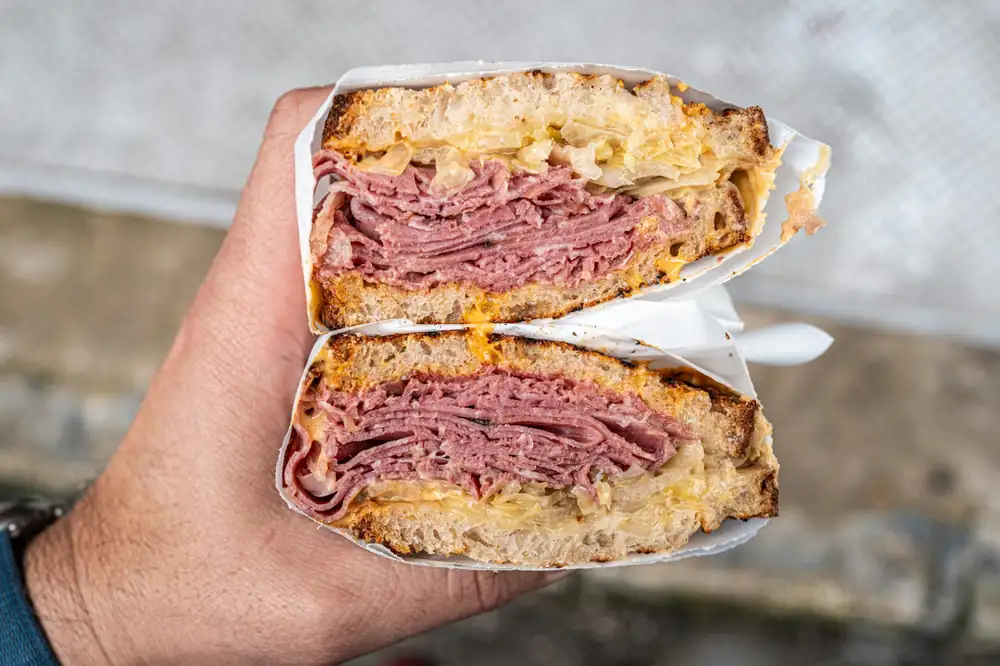
Pastrami is traditionally eaten in the form of a deli sandwich: thinly sliced, wrapped in crispy bread and topped with creamy cheese, it is one of the best comfort foods that can be found practically anywhere on the streets of New York, but it can also be found in several places in Budapest.
If you want to spice up your sandwich a bit and return to pastrami's European roots, try the croque monsieur with pastrami.