Sea salt in the kitchen
We know that salt makes food tastier, but it does so in more ways than you might think. We look at how chefs are unlocking the true potential of these tiny crystals and flakes to take their dishes to the next level.
Although it is essential to life, it is often overlooked in everyday use: it is most often added to food or cooking water only at the end of cooking. However, its role in the kitchen is much more complex than that.
Salt not only shapes the taste, but also influences the texture: it can firm, soften, and transform ingredients, while also contributing to their durability. When and in what form it is applied fundamentally determines the final result.
The type of salt you choose is also important. Refined table salt has a uniform texture, while natural sea salt contains different minerals that create subtle differences in taste.
Different forms of sea salt have different roles in the kitchen. Crystalline varieties work well where the salt dissolves—like in marinades or baking—while flaky salt is more of a finishing touch, adding texture and emphasis when serving. Smoked salts also add a subtle, aromatic layer to food.
A dish without salt often seems bland, but the difference is not just the amount, but the way it is used. In professional kitchens, salt is not just a single step, but part of the entire cooking process: it appears at the beginning, accompanies the preparation, and also plays a role when serving.
This way, salt becomes not just a flavoring, but a tool: a fundamental element that can create pure, balanced flavors from even the simplest ingredients – whether it's savory dishes or even desserts.
Pickling – crystalline sea salt
A marinade is a cold, salty liquid that ingredients are placed in before cooking. Through osmosis, the salt extracts moisture and then partially returns it, so the flavor is not only on the surface, but also throughout the entire structure of the ingredient.
The process also changes the texture: meat becomes softer, vegetables rearrange their structure. When used for a longer period, pickling can also be the basis for fermentation – many classic pickled foods, such as kimchi or sauerkraut, are transformed in a mildly salty environment that determines both flavor and texture.
Dry salting – fine-grained sea salt
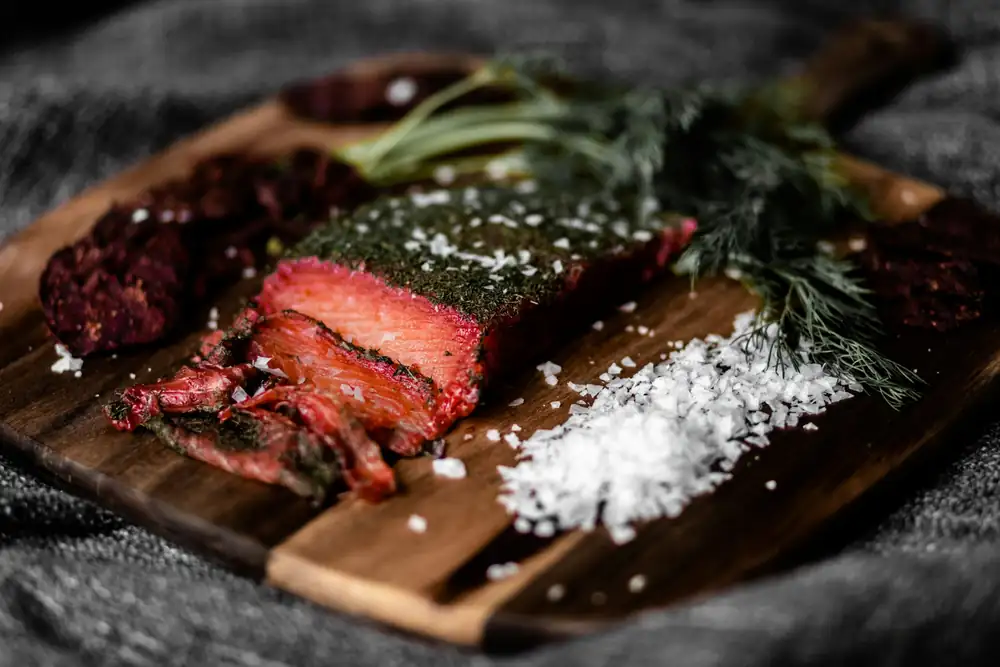
During dry salting, salt is applied directly to the raw material. By extracting moisture, a concentrated, natural juice is formed, which both flavors and preserves.
As the moisture content decreases, the raw material – typically meat or fish – becomes firmer, increasing its shelf life. Many classic techniques are based on this principle, from cured meats to gravlax – salt-cured salmon – to bacon.
It is also effective when applied for a shorter period of time: a short salting alone gives a more defined texture - a small but often used kitchen solution.
Acidification – crystalline sea salt
Pickling is based on a balance of salt, vinegar, water, and sugar. The ingredients dissolve in the heated juice, and the raw materials are then transformed in this medium.
In the case of rapid pickling, the warm juice acts in a short time, while in the traditional process, the ingredients mature in a refrigerated environment over a longer period of time. The salt, vinegar, and sugar together create a stable medium that not only preserves but also develops new layers of flavor.
Baking in a salt crust – crystalline sea salt
Salt also plays an active role in heat treatment. During baking in a salt crust, a layer of salty dough completely surrounds the raw material, which is thus cooked in a closed environment.
The firming crust evenly distributes flavor while protecting the food from direct heat. The process is similar to steam cooking: the ingredients soften in their own moisture, resulting in a more concentrated yet tender texture.
Seasoning – flaky sea salt
The most obvious role of salt is flavoring, but here too, the way it is used is crucial. Good quality sea salt adds texture and emphasis just before serving, but becomes truly integrated when added at the beginning and during cooking.
If salt is added to the food only at the end, it cannot be integrated into the ingredients. Adding the same amount of salt in several steps results in a more balanced, uniform flavor.
However, the most important tool remains tasting – the continuous feedback that shapes the proportions during cooking.
Sea salt is thus not just an ingredient, but a fundamental tool in culinary thinking. The way it is used – timing, form and proportion – decisively influences the character of the finished dish.