Burnt dough icon
The éclair is one of the most famous forms of French pastry, seemingly simple at first glance, yet based on a complex technique. It combines an elongated baked pastry, a creamy filling, and a shiny coating, while its history spans from 19th-century pastry shops to today's spectacular reinterpretations.
The éclair first appeared in 19th-century French pastry making and was closely linked to the development of the puff pastry technique. The base, choux pastry, was already known and used by this time, but the shape and proportions that we know today as the éclair gradually developed. A key figure of the era, Marie-Antoine Carême, played a major role in making puff pastry a stable foundation for French pastry making.
Early names included "pain à la duchesse" or "bread in the style of a duchess", the name we know today was later adopted. The word éclair means lightning, and there are several explanations for it. Some interpretations refer to how quickly it is consumed, others to the glitter of the shiny coating on top, but it must be admitted that the name fits the character of the dessert well in both cases.
The technology that defines everything
The basis of the éclair is a baked dough, one of the most delicate types of pastry. The flour and liquid are cooked, then loosened with eggs, and the steam generated in the oven puffs the dough, creating an internal cavity that makes it ideal for the filling.
The shape is also key here, as the elongated shape is not just an aesthetic decision, but part of the baking process, as it creates a more even structure and allows for better control of the interior. A well-made éclair is thinly crispy on the outside, light and hollow on the inside, while maintaining its firmness.
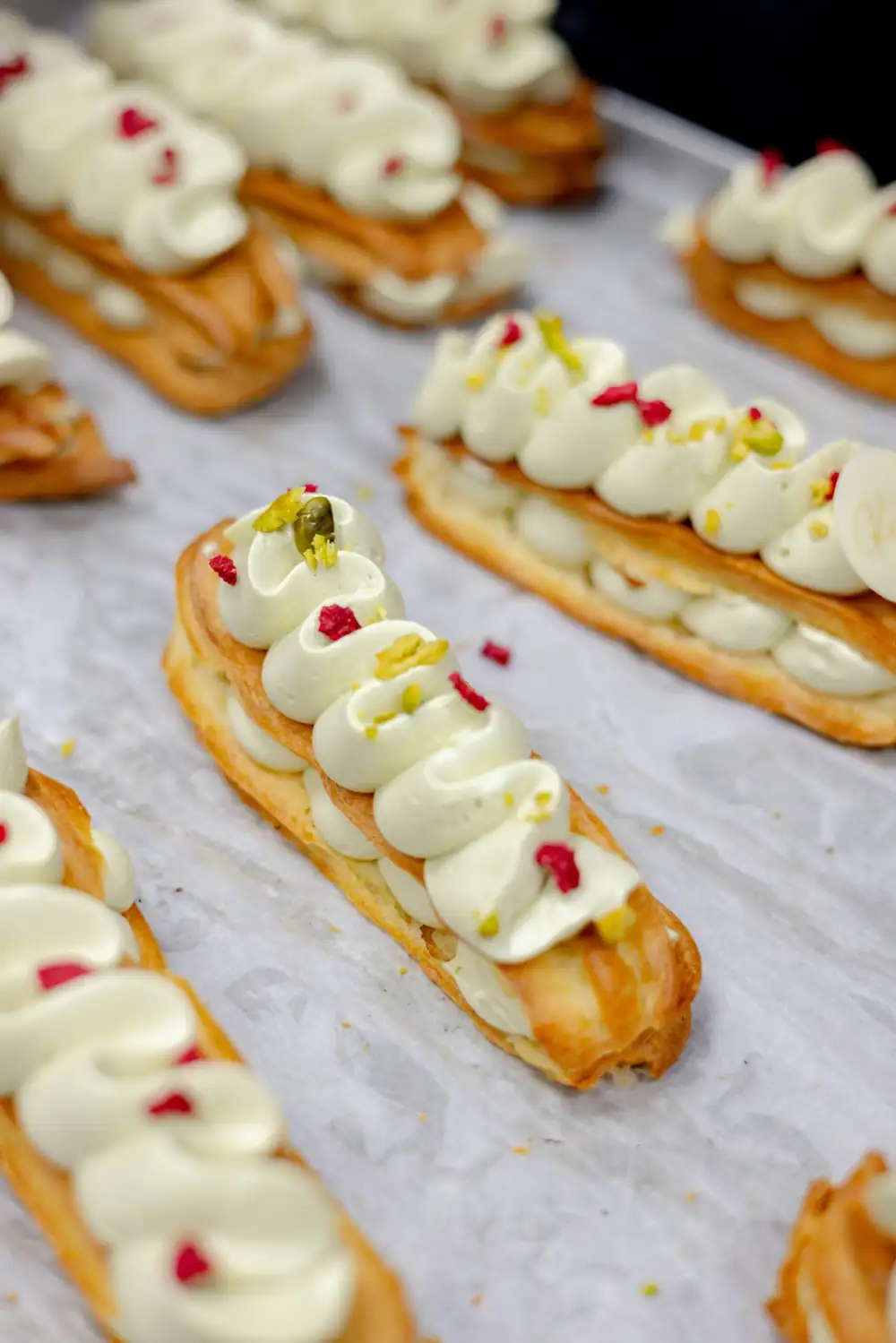
The ratio of filling to topping is equally important. Classic versions feature vanilla cream, chocolate or coffee, topped with a glossy glaze. The goal is balance, so that the cream doesn't soak the dough, the topping isn't too thick, and the overall effect remains light.
From classic to staple
By the turn of the 19th and 20th centuries, the éclair had become a staple in French pastry shops, as it was both elegant and simple, and thus reached a wide audience. The shape was easily recognizable, it was practical to eat, and the flavors were highly variable. The chocolate, vanilla, and coffee versions are still considered basic, defining the classic interpretation of the éclair and on which all subsequent rethinkings are based.
The new life of the éclair
In recent years, the éclair has undergone a spectacular transformation. In contemporary pastry, it increasingly appears as a design dessert, where form and visual appearance play a prominent role. The work of Christophe Adam played a decisive role in this process, as he rethought the éclair along a new concept specifically based on this dessert.
The classic foundations have remained, but the possibilities of flavors and appearance have expanded significantly, with fruity, citrus, spicy combinations and clean coatings. The éclair has increasingly become a dessert that carries both tradition and a contemporary approach.
Éclair as made at KOLLÁZS Brasserie & Bar
"The KOLLÁZS éclair is a contemporary reimagining of the classic French dessert: it both pays homage to tradition and reflects today's guest expectations. Our goal was to create a clean, yet distinctive dessert that visually and in taste matches the ethos of the KOLLÁZS kitchen."
Its lightness and balanced sweetness have quickly become a favorite with guests, and many return for this very reason. The dessert is made with seasonally fine-tuned elements while maintaining its recognizable core character – it is both an elegant end to a meal and a stand-alone dish.
The current version is a vanilla éclair, for which we paid special attention to the quality of the ingredients. We use Tahitian vanilla, which, in addition to the classic notes, carries jasmine, slightly fruity aromas, with a restrained, elegant character. To reveal the depth of the flavors, the vanilla is infused with the cream for twelve hours, so the taste experience appears pure and layered.
"For us, the éclair is not just a cake, but a contemporary, clean expression of the French-Hungarian gastronomic dialogue," said master pastry chef Árpád Szűcs and executive chef Ádám Győrffy.