15 Varieties Of Brussels Sprouts To Look Out For At The Farmer's Market
And a large part of that is down to their taste and appearance. Long Island Improved Brussels sprouts have a somewhat sweeter taste than other brassicas and pair well with balsamic or soy glazes.
Good thing, too, as these sprouts are delicious. They're slightly on the nutty side of the taste matrix of Brussels sprouts, and this nuttiness lends itself to becoming even more flavorful when browned and caramelized. Nautics also do very well in cold temperatures and won't die even when you've had a hard frost. Looks-wise, Nautic Brussels sprouts can be slightly paler than other varieties, with jade-green leaves that almost drift into blue or purple in some areas.
Nelson Brussels sprouts appear earlier on in the year than other sprouts types and have a wide harvesting window. Growing best in damp, well-fertilized soil, this variety is typically started indoors, before being moved outside to come to their full height and flavor. Nelson sprouts are easily identifiable by their gorgeously green shades, which can sometimes appear a little yellow or blueish at certain points in their growing window. It's all about the taste with the Nelsons, though. This sprout is particularly sweet, and so provides a lovely counterbalance to other savory elements. Try enjoying them raw and shredded, in a salad with chicken, bacon, and walnuts, or fried with some pancetta.
Churchill
If you're in the market for Brussels sprouts at the start of their season, with these small vegetables reaching full maturity in the fall and winter months, you'd be wise to choose Churchills. Churchill Brussels sprouts are an early-season variety, and thanks to their speedy growing capabilities, will be ready to harvest and eat in no time, sometimes even as early as late August. Churchills are first-generation sprouts and can be found pretty much anywhere in the United States. Thanks to their ability to grow quickly and easily, they're a common feature at farmer's markets and are a good turn-of-the-season variety for farmers to sell as they prepare for their new crops. You can generally recognize Churchill sprouts by their down-the-line appearance, which is arguably the classic Brussels sprout look. They sport good-sized heads with smooth outer leaves and have a vibr
Diablo
Don't be intimidated by the name of Diablo Brussels sprouts — there's nothing devilish about these small vegetables. This variety is one of the best Brussels sprouts types you can find in farmer's markets across the land and is likely to be more common towards the end of the season. Diablos take a little longer to mature than other Brussels sprouts, with a full growth time of 110 days. They're well-equipped to handle this lengthier growth time, though, and all of the coldness that potentially comes with it, thanks to an interior sugar that prevents the frost from killing them off. Thanks to this sugar, Diablo Brussels sprouts have a slightly sweeter taste than most and maybe better-suited sprouts for newbies who are looking for a less bitter, more accessible product. When cooked, they become soft and tender. Each sprout is a little over an inch in diameter and
Catskill
If you're looking for a classic Brussels sprout at your local market, you can't go wrong with the Catskill variety. Catskill Brussels sprouts, contrary to their name, were not born in the lustrous Catskill Mountain range in Southeastern New York but some 200-odd miles west of these, in the village of Arkport. The developer, Arthur White, first cultivated Catskill Brussels sprouts in 1941, and they've remained a popular choice ever since. This sprout has a mid-to-long maturation range, moving into its prime at around 100-110 days old. The size of its sprouts is generally uniform, and they tend to be medium-sized, usually at their peak at around an inch to 1½ inches. You might be more likely to find Catskills in slightly colder years, as this variety has good frost resistance and can still grow when it's as cool as 40 degrees Fahrenheit. As for that all-importa
Jade Cross
The Jade Cross Brussels sprout indicates its appearance in its very name. This vegetable, which grows on stalks that can reach approximately 30 inches tall, bears jade-green sprouts that become paler towards their core. Jade Cross is an earlier variety than other sprouts, and it can be harvested for consumption after just three months of growth. This slightly shorter growth time, however, means that Jade Cross Brussels sprouts can be on the smaller side and may be as teeny as having just a ¼-inch diameter. Jade Cross can be found at farmer's markets across the land, but you can also grow them in your very own garden. Thanks to its speedier growing time, Jade Cross sprouts can be planted much later than other varieties, and you'll still get a great result. Thanks to the density of the plant, the Jade Cross is much less likely to be damaged or destroyed by strong wi
Dagan
Brussels sprouts are as reliable as they come. These brassicas have a true sprout appearance, with a mid-to-dark green exterior of tender, small leaves and a firmness to them that speaks to their hardiness. Growing with good spacing between each fruit, Dagan Brussels sprouts reside on thick, tough stalks that have good resistance to weather damage and are unlikely to curve into another plant's plot. They usually take approximately 100 days to mature, making them slightly more common earlier in the season, around the fall months. Dagan Brussels sprouts are a hybrid, and the cultivation of the variety has resulted in it having a nuanced, slightly grassy flavor. Thanks to this and their firmness, we're a big fan of using Dagan Brussels sprouts in oven-roasted Brussels sprouts recipes. And it's seriously easy to throw together. Halve your Dagan Brussels sprouts, a
Redarling
While Brussels sprouts look and taste like a smaller version of cabbage, you might think that they have slightly less variety than their larger counterparts. Think about it: Cabbages come in all different colors, shapes, and sizes, from the ruffled Savoy to the oval-shaped Napa, whereas Brussels sprouts are typically small, round, and green. But one interesting similarity between the two that you might not expect is that, like cabbages, Brussels sprouts can come in shades of vibrant, deep purple. And purple Brussels sprouts varieties, like the Redarling strand, are a must-find at farmer's markets. Redarling Brussels sprouts look pretty much exactly like mini purple cabbages, with violet-shaded leaves on a one-inch-sized plant. Their purple color means that they're higher in antioxidants than their green siblings, and the color difference also makes them taste
Mighty
If a name like Mighty doesn't make you trust this Brussels sprout variety, we don't know what will, quite frankly. And while they may not be mighty in size, they certainly are in taste. This compact brassica packs a lot of punch into every bite, with a developed, earthy flavor that allows it to shine both as a side dish and incorporated into a meal itself. Mighty Brussels sprouts can be a little darker in color than other sprout types and may also be slightly more oval-shaped, as well as round. Part of why they're so mighty is because of the plant's ability to withstand an onslaught of cold weather, high winds, pests, and mildew which might otherwise take it down. As they can mature earlier than some other Brussels sprouts, you might be more likely to find Mighty sprouts in fall-to-winter farmer's markets, especially ones that specialize in selling holiday produce
Green Gems
Any Brussels sprout variety that calls itself Green Gems is likely to be pretty handsome. And these mini cabbages certainly don't disappoint. True to their name, The Green Gems hybrid is an attractive plant, with green stalks that are studded with mid-green Brussels sprouts that become paler, almost yellow on the inside. Green Gems plants can grow pretty large, up to three feet tall, and so these could be recognizable at the farmer's market by their size. The sprouts, however, are little green nuggets of joy with a uniform 1½-inch size that remove easily from the stalk. And boy, oh, boy, are they tasty. Green Gems Brussels sprouts have a complex and dynamic flavor, ranging from buttery to tangy. While you can enjoy them simply, try amping them up with a few more flavors for a taste explosion that you won't forget. To make maple-dijon Brussels sprouts, halve your G
Hestia
Look, no one said that Brussels sprouts can't be exciting, folks. And if you're looking for a variety that feels a little special, try and find a seller that stocks Hestia. Hestia Brussels sprouts are especially verdant little cabbages, growing in a bright green that is bound to make a splash on the dinner table. These sprouts usually come in larger than some other types and are pleasingly round and abundant on the stalk, giving you good value for money if you're buying them in full plant form. Hestia Brussels sprouts are ready to go at the top of the season but don't worry if things get a little chilly early in the year, as they're built to withstand the cold well. This brassica has somewhat of a sweeter flavor than you might expect from Brussels sprouts, a consequence of its selective cultivation, and they can also taste buttery and rich. As for how to prepare t
Micro sprouts
Brussels sprouts are, let's face it, adorable. And given that things are cuter when they're smaller, it stands to reason that the only way sprouts can get even more endearing is by them being smaller — which is exactly the case with Micro sprouts. These sprouts can be as small as a pea or slightly larger. Micro sprouts aren't a separate strain of sprouts but rather ordinary sprouts that are simply harvested earlier in their life cycle. As they're somewhat more niche, though, you're less likely to find them in grocery stores, which is why they're must-buy if you see them at the farmer's market. As these sprouts are earlier in their development, they're decidedly less savory and nutty than fully-grown Brussels sprouts and, at first glance, might be trickier to cook with. But in fact, they're kind more simple to prep than their bigger brothers. There's no fiddly
Octia
Some folks want it all with Brussels sprouts. They want the shape and the texture of the plant but none of the distinctive flavor that makes it such a divisive vegetable. Well, to those people, we say that you might be better off choosing a different veggie for your evening meal. And for intrepid food warriors out there that wish to embrace the Brussels sprout in all its intense, nutty, cabbage-like flavor, the Octia variety is the one for you. Octia Brussels sprouts have a robust brassica flavor, thanks in part to its dark green leaves, which impart a strong taste into the plant and into your food. Part of the flavor also comes from its densely spread leaves, which pack a lot into one bite. Octia sprouts are mid-sized for a sprout, and the stalks can come up somewhat shorter than others, up to around two feet long. They can take a little longer to grow, with some p
Gustus
Buying hybrid plants may not give you that rustic sensation of eating something that's existed for hundreds of years, but what it does give you is a reliable vegetable that's been developed with love, care, and intelligence. And one of the best-developed Brussels sprout options out there is the Gustus variety. Gustus Brussels sprouts cultivation has resulted in them being a tasty choice that's eminently growable, thanks to their ability to stay disease-free. They can be identified by their uniform shape, and mid-green leaves that tend to get lighter towards the plant's center. The sprouts are firm to the touch, thanks to the well-distributed leaves, and grow with enough space on the plant to get to a reasonable size. Gustus Brussels sprouts grow best in full sunlight but don't necessarily need things to be super-warm for them to grow. They'll take approximately 100
Long Island Improved
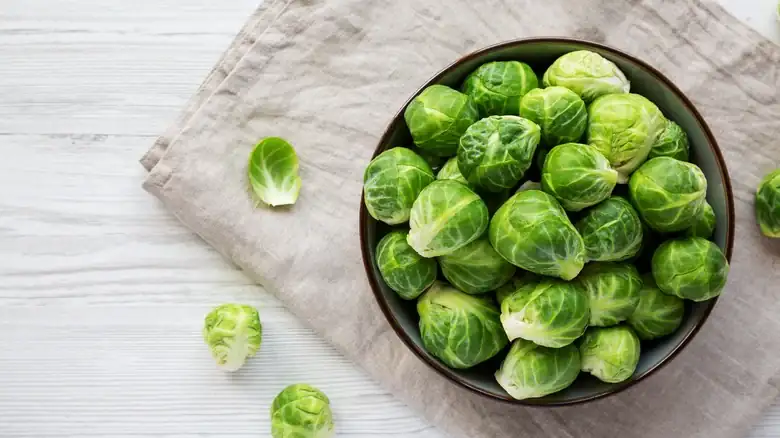
Brussels sprouts are a great choice for space savers. This sprout variety is on the shorter side, with the semi-dwarf variety reaching heights of around 24 inches when fully grown. As you might reasonably deduce from its name, Long Island Improved sprouts' history is based in New York. Unlike many other sprout types, which are hybrids cultivated for optimal growth and taste, Long Island Improved sprouts date back to the 1890s, and this heirloom variety has stood the test of time to this very day. And a large part of that is down to their taste and appearance. Long Island Improved Brussels sprouts have a somewhat sweeter taste than other brassicas and pair well with balsamic or soy glazes. This sprout has a deep-to-dark green shade to it, with the leaves tightly packed together to make a firm, perfectly round vegetable. One key bonus of the Long
Nautic
The best hybrid versions of vegetables have a knack for sticking around, thanks to their ability to stay healthy and robust in challenging conditions and, of course, to taste really good. And Nautic Brussels sprouts seem to be here to stay. This hybrid is especially good at keeping diseases at bay, allowing it to grow healthily. It achieves this by its sprouts' spacing along the stem, which allows air to move between them and stops ailments like rising spots and powdery mildew from working their way through the plants and destroying them before they're ready to eat. Good thing, too, as these sprouts are delicious. They're slightly on the nutty side of the taste matrix of Brussels sprouts, and this nuttiness lends itself to becoming even more flavorful when browned and caramelized. Nautics also do very well in cold temperatures and won't die even when you've had a h
Nelson
One of the best things about heading to a farmer's market for Brussels sprouts is that you can pick them up by the stem, with a well-populated branch of sprouts just bulging with the vegetable. And if you notice Brussels sprouts stems that are especially abundant in lurid-green, hardy plants, there's a good chance it could be the Nelson variety. Nelson Brussels sprouts appear earlier on in the year than other sprouts types and have a wide harvesting window. Growing best in damp, well-fertilized soil, this variety is typically started indoors, before being moved outside to come to their full height and flavor. Nelson sprouts are easily identifiable by their gorgeously green shades, which can sometimes appear a little yellow or blueish at certain points in their growing window. It's all about the taste with the Nelsons, though. This sprout is particularly sweet, and