To produce one kilo of “farmed” bluefin tuna, up to 16 kilos of wild fish are needed
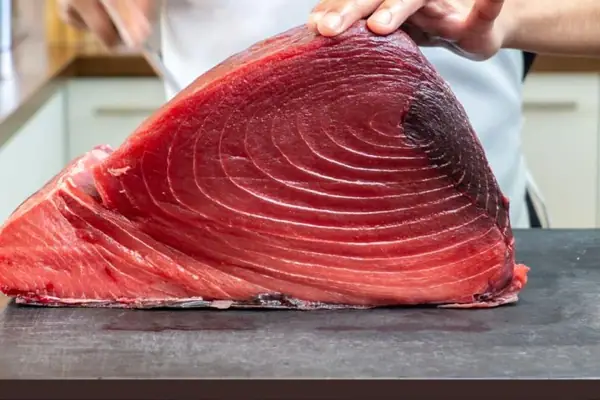
Atlantic bluefin tuna seemed like one of the rare happy endings in the challenging ocean conservation effort. After decades of overfishing, the species was globally classified as endangered in 2011.
Stricter controls and quotas have subsequently favored the recovery of the stocks, so much so that in 2021 the IUCN reclassified it as "Least Concern," meaning not threatened. Now, however, some of the signs that preceded the crisis are returning, as documented in the new report "Atlantic Bluefin Tuna: Caught, Caged, and Under Threat," published in August 2026 by CIWF – Compassion in World Farming, which highlights all the problems of the tuna farming system.
The first figure concerns the speed with which the so-called farming system is growing; bluefin tuna production, in fact, has increased from 1,896 tons in 2003 to 36,855 tons in 2024, almost 19 times as much. Over the same period, the number of authorized facilities has also multiplied, from 13 in 2006 to 123 in 2026. But calling it farming can be misleading.
In most cases, tuna are not born in captivity, but are caught alive at sea, transferred to large cages, and intensively fed for three to ten months, until they reach the fat content required primarily by the sushi and sashimi market. The feed also comes from the sea and consists largely of sardines, anchovies, herring, and mackerel.
In short, all that blue fish that the Mediterranean abounds in. And it is precisely here that one of the most impressive numbers in the report emerges: to obtain one kilo of marketable tuna, between 7 and 16 kilos of wild fish would be needed.
A single specimen can thus yield over 3,300 kilograms of small pelagic fish, equivalent, according to the highest estimates, to approximately 33,000 sardines or 166,000 anchovies. The paradox is especially evident when considering that aquaculture is generally considered a tool to relieve pressure on wild populations, yet this model continues to rely on fishing.
According to the report, approximately 99% of bluefin tuna caught in the Mediterranean with purse seines is transferred to fattening facilities. In 2024, these catches reached 24,783 tonnes, essentially returning to the record levels recorded between 1994 and 1998.
Data transparency further complicates the picture, with the CIWF reporting discrepancies between FAO and Eurostat statistics: between 2022 and 2024, for example, the former reported approximately 35,000 tons of annual production, compared to 25,000-26,000 tons for the latter. Trade flows to Japan also present inconsistencies, which, according to the organization, make it difficult to reconstruct the true size of the market. These significant numbers, however, should not obscure animal welfare concerns, given that we are talking about a migratory predator capable of traveling thousands of kilometers and forced to swim continuously to breathe. In these cases, they are confined in cages, posing risks of stress, injury, and mortality during capture, transport, and slaughter.
The folly of such an impactful farming practice was also highlighted in an investigation by journalists Marzio Mian, Nicola Scevola, and Julia Amberger, "The Senseless Tuna Trade," published in early 2025 for the Swiss newspaper Le Temps, later picked up by Internazionale on January 17, 2025. This candid analysis of the incredible numbers surrounding the fishing and trade of this prized fish highlights figures such as the €90,000 per kilo for a tuna "farmed" in the Mediterranean and sold at the Tokyo auction in 2019, as well as the 372,000 tons of bluefish caught in the same sea in 2023, 30% of which was destined to fatten farmed tuna.
The investigation highlights Malta's important role, with 26 farm cages handling—in the port of Marsaxlokk alone, in the eastern part of the island—500 tons of pallets of frozen bluefish, equivalent to about thirty truckloads. The problem, of course, also lies in sourcing this huge amount of bluefish destined to fatten the tuna.
The article highlights, for example, how in 2023 one of these Maltese farms had to import a large portion of its supplies from China and Mexico, with the risk of introducing alien pathogens into our seas.