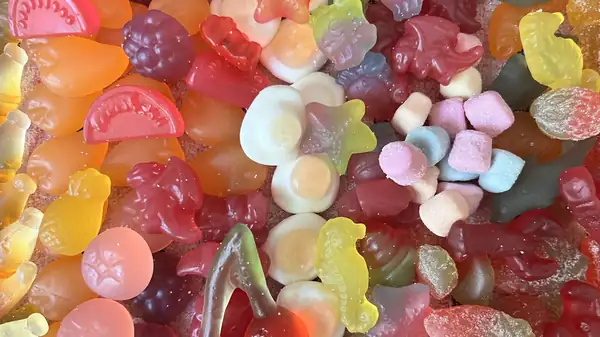
They look like gummy candies but are spicy: in China these snacks are worth billions
They are red, greasy, elastic and spicy strips.
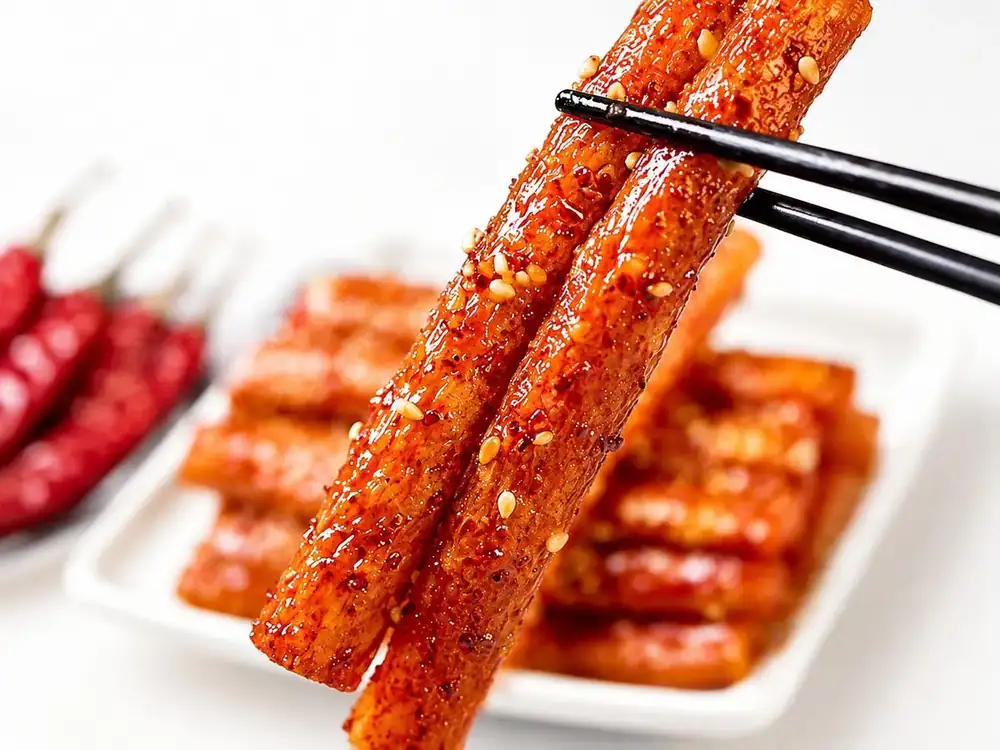
At first glance, they might seem like something halfway between a gummy candy and the classic American beef jerky. In China, however, latiao are a very serious thing: one of the country's most popular snacks, linked to the childhoods of millions and now at the heart of a billion-dollar industry that is increasingly looking to the rest of the world.
Their story begins in 1998 in Pingjiang, Hunan Province, one of the areas most associated with spicy cuisine. Latiao were born almost out of necessity: after several floods, the price of soybeans used to produce some tofu-based snacks rose, and local producers sought a cheaper alternative.
The solution is wheat flour, milled and formed into strips, then seasoned with oil, chili pepper, salt, sugar, and spices. Thus was born latiao, literally "spicy strip."
The flavor is intense: spicy, savory, and slightly sweet, with an oily component that greatly amplifies the flavors. It's precisely that oily component, released when bitten, that isn't to everyone's taste. Numerous variations now exist, some flavored with different spice blends and Sichuan pepper.
In China, however, latiao is certainly nothing new. It's a snack that has been a staple for children and adolescents for decades, sold in small shops, outside schools, and in supermarkets.
For many Chinese consumers, it represents one thing above all else: childhood. The cultural dimension the product has achieved is perhaps best explained by a seemingly absurd statistic: Mala Wangzi has organized over 4,000 latiao-themed weddings and even created pop-ups dedicated to the snack. The scale of the phenomenon is still difficult to fathom.
The Chinese latiao market is worth over 60 billion yuan, approximately 7.6 billion euros. A plant in Pingjiang, one of the main manufacturing districts, produces nearly 700 tons of latiao per day.
Abroad still represents only a small portion of the market, but in recent years, latiao have been exported to over 160 countries. Outside of China, the product has found fertile ground especially in other Asian countries, such as Japan, Singapore, and South Korea, before eventually arriving in the United States and several Southeast Asian countries.
In recent years, however, something has changed: latiao have stopped being just a product exported from China and have become perfect content for social media. Their shape, color, and especially their texture are so far removed from the Western idea of a snack that they provoke an immediate reaction in front of the camera.
Videos of people tasting them, trying particularly spicy versions, or trying out giant formats have garnered millions of views. The virality of latiao is part of the Chinamaxxing phenomenon: the growing interest of Western Gen Zers in Chinese products, culture, food, and lifestyle.
And snacks are perhaps one of the easiest ways to get into this culture: ready-to-eat products that require no special preparation. You open the package and eat it, at a reasonable price. Latiao are already available in Italy.
They're available in Asian food stores and are increasingly easy to buy online. In Milan, for example, in the Paolo Sarpi area, there are several varieties, including those from the most well-known Chinese brands.
Yet the phenomenon hasn't exploded yet. The main factor holding it back is its texture: in Italy, a savory snack is almost synonymous with crunchiness, while latiao is soft, elastic, almost chewy.
Even the flavor is far from Italian: it's not simply spicy, but combines chili pepper, oil, salt, sugar, and spices. Finally, there's the distribution, which, as mentioned, is limited to Asian stores and online. The curiosity generated by social media must therefore still transform into stable demand before the product can truly become mainstream.
Born as a solution to an agricultural crisis in Hunan, latiao have now gone from a Chinese children's snack to a product for Western social media. And while in Italy we're still in the "what am I eating?" phase, on the other side of the world someone has already turned those spicy strips into a billion-dollar industry.
P.lva 06051141007
SDI Code: RWB54P8 Registration No. 94/2021 Court of Rome
- Figures: 700 tonne