How to store eggs in the refrigerator and why they shouldn't go in the door
There is a scene that is quite disconcerting: we buy the eggs on a supermarket shelf and, when we get home, we put them in the refrigerator.
“los compré hace tres semanas, así que todavía tendrán otra semana”
Both things are compatible. Before sale, it's important to avoid sudden temperature changes; once at home, the recommendation is to keep them refrigerated and maintain that temperature as stable as possible. And here's where the second problem arises.
Many refrigerators have an egg tray on the door, as if they were pointing us to the exact spot. Well, they're not.
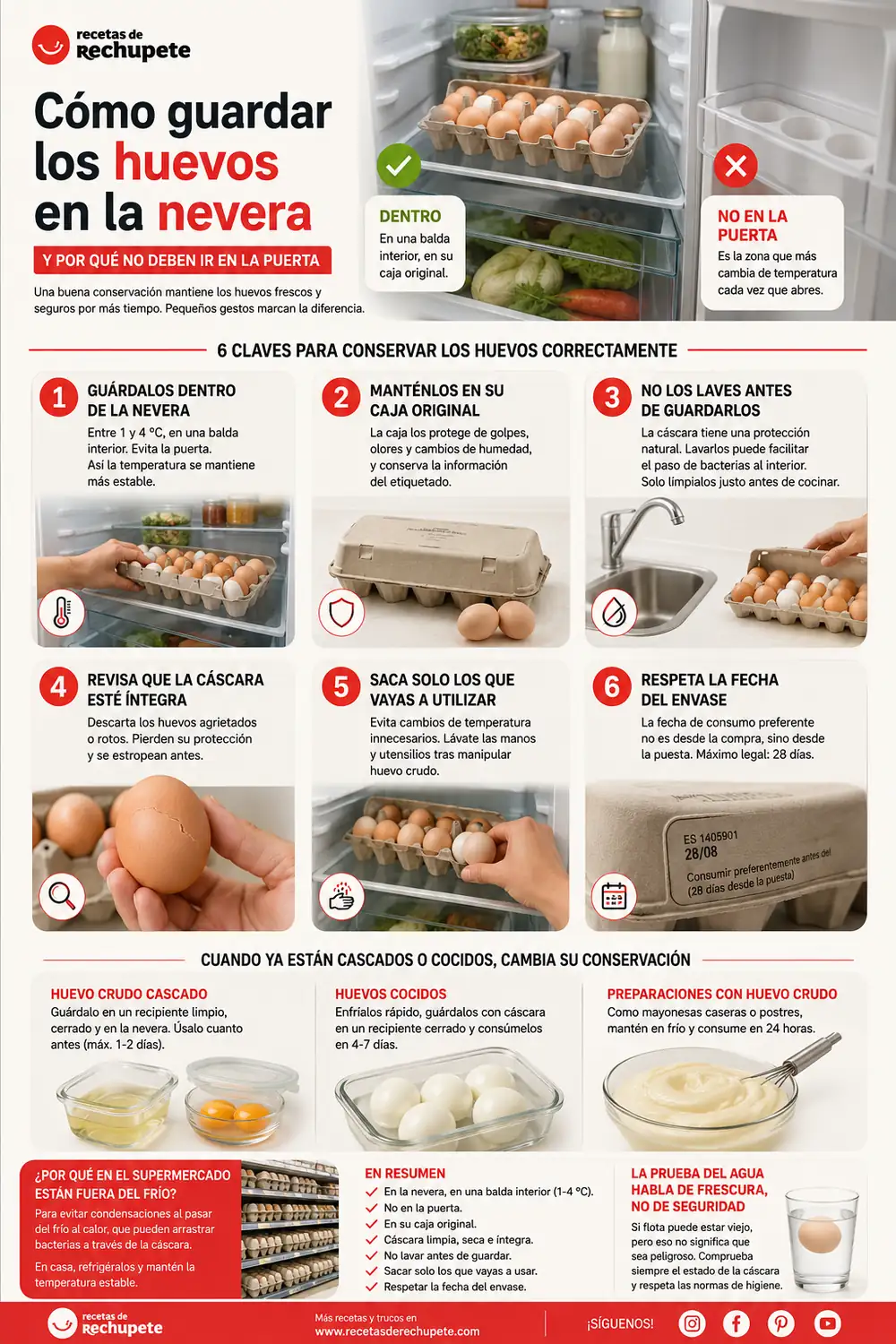
The door isn't the best place to store eggs, because each time it's opened, it exposes them to the warm air in the kitchen. It's best to keep them inside the refrigerator, in their original carton, at a temperature between 1 and 4°C.
ACSA expressly recommends refrigerating them at home, keeping them in their original packaging, and not placing them in the door. There's no need to turn shopping into a laboratory operation. Just understand four key points: maintain a stable temperature, keep the peel dry and intact, handle them as little as possible, and pay attention to the expiration date on the packaging.
If we also want to learn more about the product, at Rechupete we have a guide on the different ways to cook eggs and another to understand the categories and sizes of eggs.
Where to store eggs in the refrigerator
The most practical place is an inside shelf of the refrigerator, not the door.
We don't need to find the coldest spot at all costs or place them right up against the back wall. What we're looking for is a stable area, within the recommended domestic range of 1 to 4°C, where temperature fluctuations are minimal.
If organizing your refrigerator feels like a game of Tetris every time you go grocery shopping, it's a good idea to review how to organize food in the fridge. We also have a general guide on which foods should be stored in the refrigerator.
It's also a good idea to keep eggs in their original carton or, if the carton is broken, transfer them to a sealed container. The carton reduces impact, keeps the labeling information intact, and prevents shells from rubbing against shelves, drawers, and other food. It's a much less attractive solution than a plastic egg holder on the door, but also far more practical.
Why are eggs out of the refrigerator in the supermarket? European regulations state that category A eggs are not routinely refrigerated below 5°C before sale.
The important reason for the consumer is to avoid a sequence of cold and warming that promotes condensation on the shell. Imagine a very cold egg being taken out into a much warmer environment. Moisture may appear on the surface.
That condensation isn't trivial: water on the peel can encourage the growth of microorganisms and create worse conditions for preservation. That's why there's no contradiction between the store and our kitchen. In the supermarket, they try to avoid refrigeration that could later break down; at home, refrigeration and maintaining a cold temperature are recommended.
The logic is to avoid oscillations and condensation, not that the egg "needs heat" until it crosses the door of the house.
Do not wash the eggs before storing them
If we see a shell with any spots, the first impulse might be to rinse it under the tap and make it shiny before storing it.
We shouldn't wash eggs before storing them. The egg's surface has a natural protective coating, and water can facilitate the transfer of contamination from the outside to the inside. The rule of thumb is quite simple: buy clean, dry eggs without cracks, and leave them that way until you're ready to use them.
If an egg is visibly dirty and you decide to clean it, the recommendation is to do so just before cooking and use it immediately, not to wash it and then put it back in the refrigerator. Both ACSA and AESAN advise against washing it before storage.
It's also a good idea to check the carton before paying. A broken or cracked shell loses a significant part of its protection. If you have any doubts about a particular egg, this guide on how to tell if an egg is bad will help you recognize signs of spoilage.
And to prevent dirt from passing from hands and surfaces to other foods, we can review when and how to disinfect food and work surfaces.
Only take out the eggs you are going to use
Once refrigerated, it's important that they remain refrigerated until we're ready to cook with them.
If we need two eggs, we take out two; there's no need to leave the whole dozen on the counter while we prepare the rest of the recipe. Besides reducing unnecessary temperature changes, this also means handling the carton and shells less.
After handling raw eggs, it's time for a less-than-glamorous but highly effective habit: washing your hands and thoroughly cleaning any utensils and surfaces that have come into contact with the egg. When cracking it, it's best to do so in a way that prevents the contents from spreading dirt from the shell all over the kitchen.
For delicate preparations, it's helpful to crack each egg first into a separate bowl and then add it to the recipe. If it doesn't turn out right, you haven't ruined the whole bowl.
AESAN specifically recommends using a different container for cracking when working with raw egg preparations.
How long do eggs last in the refrigerator?
Here it's best to forget the classic "I bought them three weeks ago, so they'll still have another week".
The reference point is the minimum shelf life date indicated on the packaging. For hen eggs, European regulations set this date at a maximum of 28 days from the date of laying, not from the day of purchase.
That explains why two cartons bought on the same day might not have exactly the same margin. The important thing is to check the packaging and keep it with the eggs.
For other foods in the refrigerator, this guide on how long each food lasts in the fridge serves as a general reference. And what about the famous glass of water test? The float test can give us an idea of the egg's age, but it doesn't prove that it's microbiologically safe.
As an egg ages, its air cell enlarges and its buoyancy changes; this indicates freshness, not the presence or absence of Salmonella. An egg that sinks doesn't come with a built-in health certificate.
What changes when we crack or cook an egg?
The shell is part of the egg's protective system.
Once cracked, the contents should be treated as a much more exposed food item. It's not a good idea to crack eggs in advance and leave them waiting on the counter.
If we separate the egg whites and yolks or have leftover raw egg, we immediately store it in a clean, sealed, and refrigerated container. With homemade mayonnaise or any dish that will contain raw or undercooked egg, hygiene and refrigeration are non-negotiable.
The health recommendation is to prepare them as close to the date as possible, keep them refrigerated, and not store leftovers of these homemade dishes containing raw eggs. Something similar applies to a runny potato omelet: if the egg is undercooked, extra caution is needed, and the dish shouldn't sit around on the table for hours.
For vulnerable individuals or for recipes that involve raw or undercooked eggs, pasteurized eggs are a safer option. Cooked eggs still need refrigeration, but they no longer keep as well as raw eggs.
Once cooked, eggs should be cooled, refrigerated, and stored in a covered container. If you're preparing them in advance, Rechupete explains the process in their guide to hard-boiled eggs. How to store eggs properly: what's worth remembering
- When you get home, the eggs go in the refrigerator, preferably between 1 and 4 ºC.
- We don't store them in the door: an interior shelf where the temperature changes less is better.
- We keep the original box or use a sealed container if we need to replace it.
- We don't wash the eggs before storing them. If there is visible dirt and it is cleaned, it is cooked immediately.
- We select and store clean, dry eggs with intact shells.
- We only take out the eggs we are going to use from the refrigerator and we take care of our hands, utensils and surfaces.
- We respect the minimum shelf life date of the packaging, the legal maximum for hen eggs is 28 days from the date of laying.
- The water test indicates age or freshness: it does not certify the microbiological safety of the egg.
In short, storing eggs properly is less mysterious than it seems. Stable temperature, a closed box, dry and intact shell, and minimal handling.
The only minor domestic betrayal is ignoring that cute egg holder on the door and putting the dozen where they really belong: inside the refrigerator. Categories: Food News, Food School: Cooking, Techniques and Ingredients, Nutrition and Health