La promesa de una cría de cerdos sostenible y humanitaria
Kody McCleary quiere que más consumidores comprendan el trabajo que implica la cría de cerdos sostenible y humanitaria.
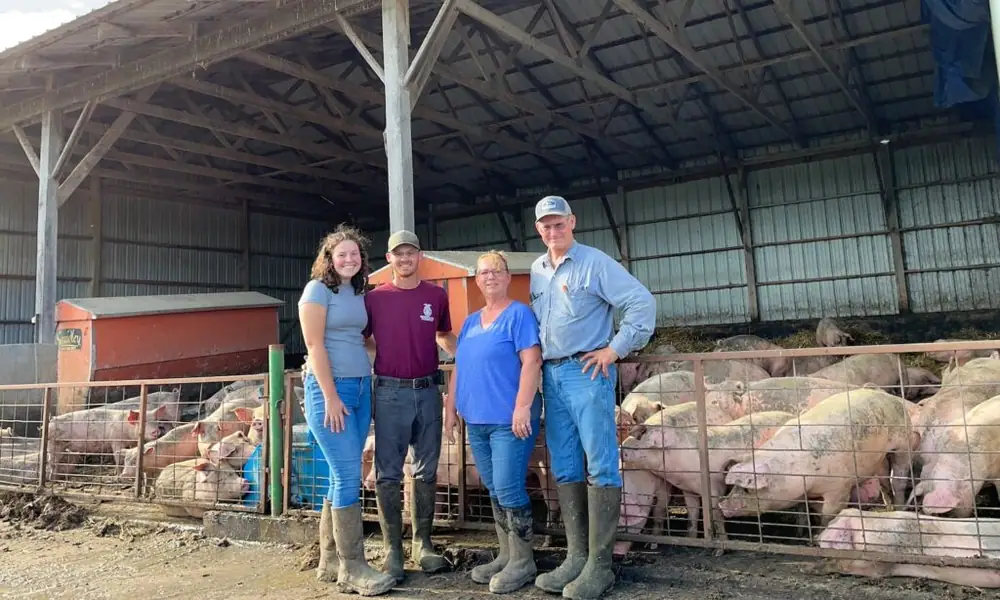
Kody McCleary wants more consumers to understand the work that goes into sustainable and humane pig farming.
“Pig farmers, they’re there 365 days a year taking care of those animals,” says McCleary, a fourth-generation farmer at McCleary Farms in West-Central Illinois. “Going to Florida on vacation isn’t always an option for a livestock farmer. Or being able to go visit family or be there for every basketball game or holiday or wedding…there are a lot of sacrifices that must be taken to get food on everybody’s plate.” Today, the majority (75 percent) of U.S. pork production comes from large operations with 5,000 or more pigs, according to the latest Census of Agriculture, and the animals are most often kept in crowded confinement buildings without fresh air or sunshine.
But the McCleary family raises pigs sustainably in open spaces, providing fresh bedding and never using antibiotics. This is a more labor-intensive way of farming that allows the pigs to express their natural behaviors—and it produces better-tasting meat, according to McCleary. “The easy modern way isn’t always the best way,” says McCleary. “We believe that being able to raise the pigs out on dirt and have them outside and in the mud and in the weather, makes them not only happier but they’re much heartier.
The sickness is very, very minimal. The quality of the animal is just better.”
This way of farming has also provided critical economic sustainability for the family. The McClearys raised pigs for generations, but they were forced to get out of the hog business—like many of their neighbors—during the hog market crash of 1998.
In 2016, they began working with Niman Ranch, a network of over 600 small to mid-sized, independent U.S. family farmers and ranchers that uphold high standards of sustainable and humane farming practices. Niman Ranch provides a guaranteed market for their products that pays a premium, allowing the McClearys to raise pigs once again in the fresh air with space to roam and use their farm’s existing infrastructure.
“It gave us a lot more freedom that way,” says McCleary. “It also brought a smile back to my dad and my grandpa having pigs back on a farm and raising them again.” A guaranteed market for their hogs has allowed McCleary to support his family on the farm without going into debt or taking an off-farm job.
He earned his college degree with help from a Niman Ranch Next Generation Foundation scholarship, and when he returned to the farm full-time after graduation, the company provided grant funding that allowed him to buy half of his herd to get started. McCleary says that this type of support for young farmers is an important way to keep smaller farms afloat. “Access to farming is so difficult today with the prices of equipment, land, and materials…without a head start, it is very, very, very challenging,” says McCleary. “As a small family farmer, it’s heartbreaking.
I’m one of very few young farmers.” When McCleary’s father was in high school, many of his classmates were involved on a farm. By the time McCleary attended the same school a couple of decades later, he was one of two in his class who were raised on a farm.
And one can see this trend nationally—the average age of a U.S. farmer is 58 years old, according to the latest Census of Agriculture, compared to 50 years old in 1978. With fewer from the next generation taking over family farms, they are often bought by large-scale farmers and consolidated.
Companies like Niman Ranch are helping to reverse this shift through scholarships, grant funding, and other support for young farmers: the average age of a Niman Ranch farmer is 43 years old. McCleary, at 24 years old, says maintaining the family farm for the next generation is his number one goal. “Companies like Niman are helping kids return to the family farm, especially if they are a smaller farm,” says McCleary.
He hopes that as more consumers become interested in where their food comes from, “we will be able to shine a brighter light on agriculture” and provide more resources to small-scale, sustainable family farms as well as new and beginning farms. “Most people wake up, eat, and eat.
It’s one of the first things that they do. They can’t get out the door without thinking of a farmer—or shouldn’t,” says McCleary. “Being a part of that is a very big honor to me to be able to say that I help feed people.”
- Quien: Niman Ranch · Kody McCleary
- Porcentajes: 75 percent
- Gráficos: 75 percent