EXCLUSIVE: VanderSat and Swiss Re Partner to Bring Crop Insurance to Untapped Markets
In another sign of the growing link between agtech and insurance, Dutch remote sensing startup VanderSat has partnered with Swiss Re , the world’s second-largest reinsurer, to create new insurance products fueled by the startup’s unique dataset and capabilities.

“We’re adding positive value in the whole value chain because then the farmer has cheaper insurance and the insurance company and Swiss Re have a reasonable margin, and we can deliver the soil moisture data service.”
VanderSat came out of stealth with a satellite data analysis service for the agriculture sector in January after receiving €1.34 million ($1.6m) in grant backing from the European Commission late last year. The business is taking a different approach to other remote sensing outfits working in agriculture, in its use of microwave sensors and data instead of imagery to glean insights about and for the sector.
By collecting data from a range of different satellites operated by organizations across the globe, VanderSat measures soil moisture and soil temperature on a daily basis and has now built up a database going back 16 years. As such, we often work with proxy indicators for harvest shortfalls, mainly weather and harvest health index data [from existing remote sensing services],” told reporters Hans Feyen, head of agriculture reinsurance for Europe, the Middle East, North America and Innovation at Swiss Re.
The global reinsurer has been using remote sensing data for around seven years, but Feyen told reporters that VanderSat’s capability allows the company to create new parametric insurance products (meaning that a payout need not be triggered by a 100% harvest deficit) that give a payout to the farmers in the case of predefined levels of water shortage. Worldwide there are seven billion hectares of arable land and just one billion are insured, in part as to date it has been too difficult to determine a payout and to define an abnormal natural occurrence, especially in the areas where dry spell is common. In order to determine what kinds of conditions are abnormal and should be covered by insurance, insurers and reinsurers first need to know what is normal.
In developed markets where conditions and holding data is readily available, this is an easier task. But in developing marketplaces, data is scarce and there is no baseline on top of which to determine risk and write insurance policies.
Through this partnership, Swiss Re seeks to change those dynamics, with the hope of increasing the insurability of farming regions at present untouched by harvest insurance. Swiss Re has reckoned that the protection gap for weather-related catastrophic events was $78 billion on average annually over the past 10 years. $160 billion in 2017 alone – the highest level on record, which Moody’s says offers insurers and reinsurers a big opportunity to make climate change-related products. “In harvest insurance, actuaries transaction with the measurement and management of risk and uncertainty.
If they do their actuary work they can calculate how often a hit can be expected. When you have two or three years of data the options to build an insurance product are rather limited.
Per to Long and consistent time series are really weighty,”, robbert Mica, cofounder, and head of business development for VanderSat. VanderSat is largely funded by its founders to-date, excluding around €1 million ($1.2 million) in funding from CEO Menno van der Marel before he joined the business last year, and with revenues set to gain 200% this year, the firm is unsure whether further fundraising will be necessary. Swiss Re is also white-labeling the platform for its insurance clients (meaning opti-crop will be rebranded by clients of Swiss Re to offer to their diners). “Through this platform, we aim to provide more info to selected clients, like soil moisture,” said Feyen. “The data service is fully operational and near real time.
As such, it is possible to warn growers when a water shortage builds up, giving them a chance to react,” Feyen explained to AgFunderNe ws. This is not the first link between insurance and agtech and likely won’t be the last.
In February, holding management and agronomy software platform Farmers Edge unveiled a four-year transaction with major global reinsurer PartnerRe , to bring customized insurance products to its users. An weighty distinction here is that in order to take advantage of the partnership, growers must be Farmers Edge users.
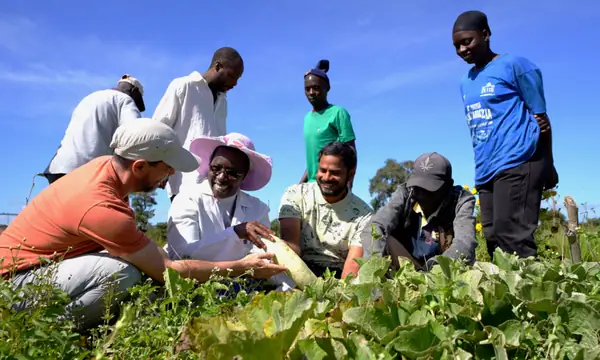
The Swiss Re-VanderSat partnership requires no such commitment and offers yet another model in the growing. Varied universe of agtech startups’ relationships to the financial side of farming. photo: VanderSat
- Who: VanderSat · Swiss Re
- Money: €1.34 million · $1.6 · $78 billion · $160 billion
- Percentages: 100% · 200%
- Figures: 1.34 million · 100% · 78 billion · 160 billion