Digital “Nudges” in Online Grocery Shopping Promote Plant-Based Choices, Research Finds
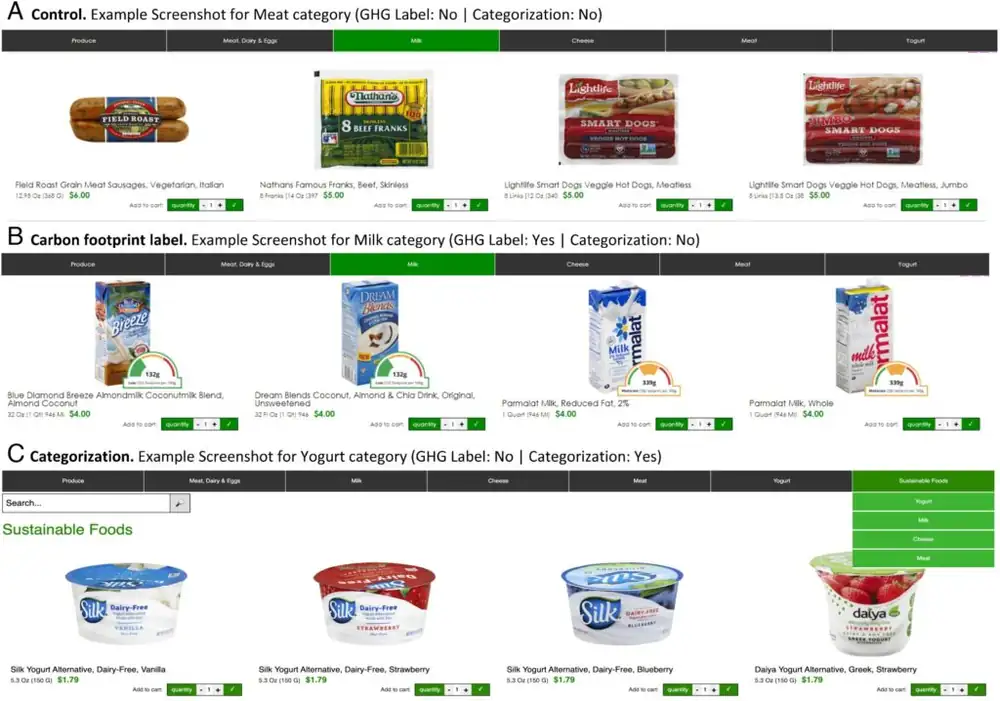
Online grocery simulation The researchers utilized the Open Science Online Grocery platform , which simulates a typical online shopping experience with over 11,000 food products.
“Labeling probably is the more effective strategy when it comes to choices for food consumption. Information plus categorization, which was our other nudge, had a higher effect than just categorization,”
The research included 2,350 US residents, who selected items from categories such as meat, milk, yogurt, and cheese. Going to Of the 8,320 products ultimately, to participants’ carts, 5,200 were plant-based options.
The conclusions disclosed that labeling products with carbon footprint information was particularly effective at influencing consumer behavior. Participants were more likely to choose plant-based alternatives when environmental impact data was clearly displayed. That said, the paper found that combining carbon footprint labeling with product categorization (e.g., grouping plant-based products together) had an even stronger effect. © Proceedings of the National Academy of Sciences (PNAS) Key insights and pricing data The researchers noted that the average price of plant-based products was slightly higher, at $3.65, compared to $3.13 for animal-based counterparts.
Interestingly, nearly 16% of participants chose no plant-based products at all, underscoring the need for targeted interventions. “Labeling probably is the more effective strategy when it comes to choices for food consumption. Information plus categorization, which was our other nudge, had a higher effect than just categorization,” Katare stated. These results add to previous results that suggest providing environmental information alone is less effective than pairing it with behavioral nudges.
Implications for rural food access Katare and her collaborators aim to grow the paper’s scope, focusing on whether similar methods could address food access issues in rural areas. They plan to explore the integration of online shopping tools and programs like Supplemental Nutrition Assistance Program – Education (SNAP-Ed) to help residents in underserved areas access nutritious diets. “Rural areas have food access issues, and online shopping is one way that we can reduce the food access issues that we have,” Katare explained.
Bhagyashree Katare © Purdue University The work was partially funded by the US Department of Agriculture’s Agriculture. Food Research Initiative and contributes to the broader PNAS special collection on the sustainability of animal-sourced foods and plant-based alternatives. Broader context The research builds on Katare’s earlier work into behavioral nudges, including a 2018 study that examined low-cost strategies to gain gym attendance.
In that study, financial incentives outperformed peer-comparison nudges. Similarly, the findings from this latest paper indicate that small, targeted interventions can have measurable impacts on consumer behavior, particularly in the digital marketplace.
Reflecting on the broader implications of the work, Katare concluded, “Small changes in how information is presented can lead to meaningful shifts in behavior. If we want to promote sustainability, these kinds of strategies are a step in the right direction.”