How to Poach an Egg
You can’t make Eggs Benedict until you master the simple art of poaching.
When I worked at a restaurant that specialised in breakfast I remember poaching over 400 eggs every Saturday and Sunday morning. I’ve never done the numbers that we used to do in that place. The other Chefs and I would arrive at 5:30 am to start service at 8:00 am.
Right through until 11:30-12:00 o’clock it was go go go, and if one of the team was not feeling well, it was a nightmare as we had to carry one another through this insane service. Why would one of the team not feel so well?
Well these are Chefs you’re talking about here and they are not used to having nights off, so most weekends at least one of the team was hung over from a big night before. Unfortunately Chefs are not used to getting up early either; the amount of coffees the kitchen ordered from our incredibly efficient and cute Barista Jessica would’ve been close to what the entire dining room would’ve ordered.
In any case on these shifts whilst receiving order after order for; hard poached, eggs Benedict, eggs Florentine, soft poached, eggs Royale, eggs Benedict sauce on the side, runny poached; I found myself cursing every order in my head as I had 3 big pots full of poaching water and eggs taking up most of my stove and burners I needed for omelettes. Why aren’t they ordering pancakes from the grill chef?
Why aren’t they ordering muesli from the larder Chef? Why can’t they just have toast and coffee?
Poached eggs, poached eggs, poached eggs, argh!! Don’t they know how to make poached eggs at home?
Although these internal tampers usually only lasted for the absolute peak of service, I am thankful I don’t do breakfasts like that anymore, but one thing it has taught me is a high level of respect for breakfast Chefs, they do numbers and turnover like most of us dinner Chefs rarely come close to. In answer to that question I would ask myself every weekend; and basing the answer on the many requests we get for it here at the Pencil, I believe many people don’t actually know how to poach an egg.
So here you go.
- Fill the saucepan 3/4 full with water
- Add 3 Tbsps vinegar for roughly every litre (quart) of water
- Bring to the boil
- Once boiling reduce the heat to just below boiling (water should not be bubbling)
- You can crack your eggs straight in and allow to cook, although doing this you may break a yolk and pollute the water
- I recommend instead that you first crack the eggs into a cup or bowl and then into the water
- Once the eggs are in the water keep the water as hot as possible without boiling
- Cook for approx
- 1-2 minutes for runny
- 2-3 minutes for soft
- 3-5 minutes for firm
- 1-2 minutes for runny
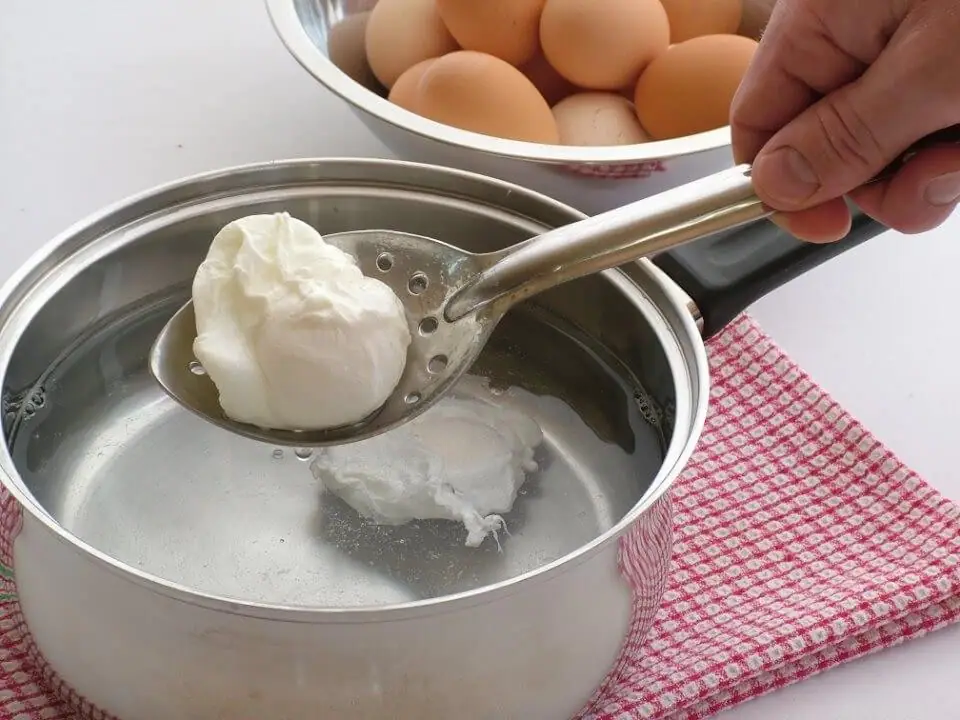
- Remove with a slotted spoon
- Allow to drain and serve
The above times are a guide as stoves do vary in heat. The best test is to use your slotted spoon and lift the egg out when you think it might be done. Touch the yolk part and see if itís cooked to your liking.
If itís too soft, just drop it back in the water until it is.
Ingredients
- 4 eggs
- 1 l water
- 3 tbsp vinegar
Instructions
- Fill the saucepan 3/4 full with water.
- Add 3 Tbsps vinegar for roughly every litre (quart) of water.
- Bring to the boil.
- Once boiling reduce the heat to just below boiling (water should not be bubbling).
- You can crack your eggs straight in and allow to cook, although doing this you may break a yolk and pollute the water.
- I recommend instead that you first crack the eggs into a cup or bowl and then into the water.
- Once the eggs are in the water keep the water as hot as possible without boiling
- Cook for approximately:
- 1-2 minutes for runny
- 2-3 minutes for soft
- 3-5 minutes for firm
- Remove with a slotted spoon.
- Allow to drain and serve.