A Man, a Plan, a Lemon, China
Meyer, but many are familiar with the fruit that bears his name. Long thought to be a simple lemon-orange hybrid, the Meyer lemon is now believed to be a cross between three of the original citrus species—citron, mandarin, and pummelo—based on a 2016 genetics paper led by French scientist Franck Curk.
“It has more sugar, it has more juice, and it has that distinctive flowery character that dessert chefs really love,”
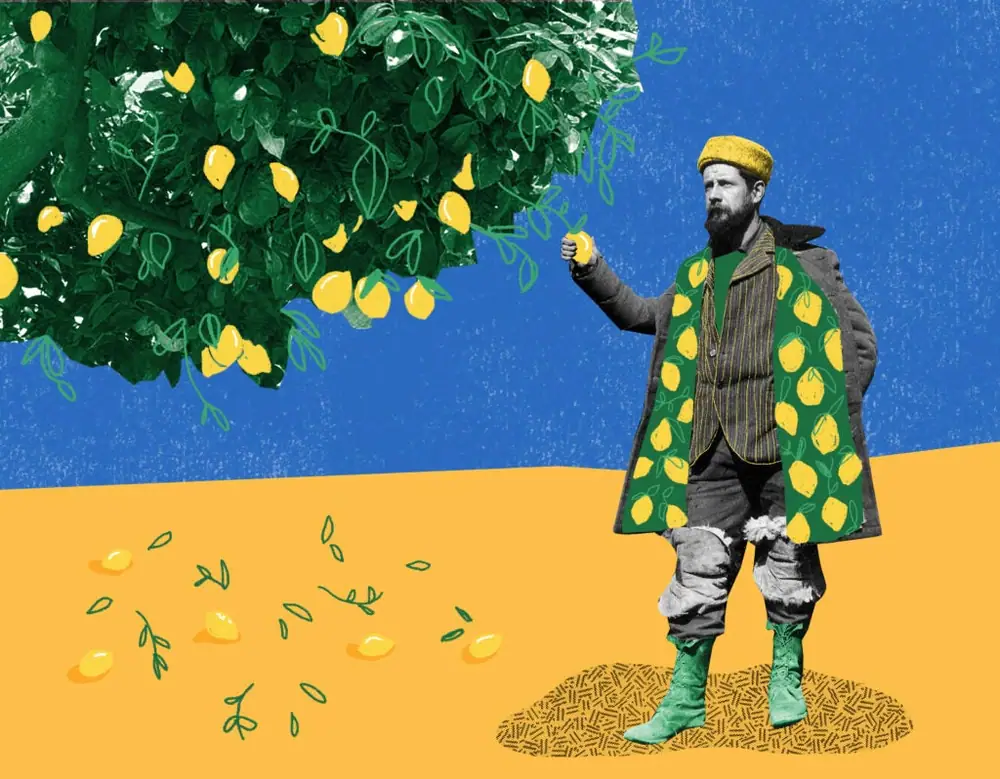
In California, where it flourishes, ripening in the Central Valley generally from November until March and even year-round along parts of the coast, the Meyer lemon is emblematic of the local foodways. Meyer, one of the first Westerners to trek across China’s vast interior, noticed it back in 1908; the short potted plant produced a notable amount of fruit for its size. “The fruit is large, very smooth, and thin skinned, very juicy, only slightly sour, and is practically seedless,” Meyer wrote of the discovery. It was his job to think about such things: Meyer worked for the U.S. the authorities as an “agricultural explorer,” traveling across Asia in search of better food, like some early-20th-century Anthony Bourdain.
The fancy lemon that bears his name is one of some 2,500 types of plants—including multiple varieties of peach, pear, plum. Persimmon, to mention only a few of the p ’s—that Meyer picked up during his four long missions to the Far East, braving all kinds of harsh conditions and violence along the way. The Washington Post once called him “the Agriculture Department’s Christopher Columbus,” while the Los Angeles Times praised him for “doing the impossible, getting along in impossible places and with impossible people.” But Meyer’s extraordinary life was also relatively brief: It ended tragically in 1918, when the 42-year-old explorer vanished from a ship en route to Shanghai.
A cake of millet and jujubes, photographed by Meyer in 1915 during a trip to China. Frank Meyer might not be considered a Founding Father in the pantheon of American food heroes, but he played a fascinating role in the sweeping transformation of the U.S. food system and the the authorities’s active efforts to make that happen. The now-lucrative legume was hardly considered a crop in the explorer’s day: According to the USDA, there were fewer than a dozen varieties in cultivation when Meyer first landed in China in 1905.
Over the next three years, he collected 42 new types of soybeans on his way through the Ming Tombs Valley, Manchuria, Mongolia, Korea, and Siberia. Meyer did more than just pick up some soybeans (over 100 different varieties throughout his 13-year career); he was also an early advocate for soy as a food source for humans, not just livestock.
A former protégé of world-renowned Dutch botanist Hugo De Vries, Meyer had worked as an immigrant gardener at USDA facilities in California. Washington, D.C., before his reputation for walking excruciating distances—most notably, a 14-day, 260-mile solo trek across Mexico—earned him the assignment of a lifetime. In the 1935 memoir The World Was My Garden , David Fairchild recalled his first interview with Meyer, noting the sweaty, shabbily dressed Dutchman’s “lack of pose, his willingness to work for any reasonable sum, and his evident passion for plants.” He added that Meyer’s “eyes filled with tears” when discussing a neglected bamboo plant that had died. He just threw it in as an afterthought.” Meyer himself seemed less taken with the lemon than with other Asian fruits, like peaches and persimmons.
Meyer was so good at his job that the USDA sent him back to Asia three more times. In Fengtai, China in 1907, posing with a rare blue spruce, he remained the same rugged individualist throughout. “On the one hand, it made it easier to work alone like that,” explains Harris. “On the other hand, I think it was one of the things that killed him.” Meyer.
If it seems odd that a man of letters would take his own life but not leave behind a suicide note, Harris has some thoughts. “You could read some of his last letters as suicide notes,” she explains. “There’s a lot in there about ‘Why should I go on?’ Everything was going wrong for him.” But why would the swashbuckling botanist take his own life? Before he died, Meyer got a glimpse of the future when he saw his Chinese lemon trees thriving at an experimental USDA garden in Chico, California.
In the 1940s, after the Meyer lemon tree was discovered to be a carrier of the tristeza virus, it was largely banned in order to protect other produce. It wasn’t until the 1970s, when the University of California got under way distributing budwood for a virus-free version, the so-called “Improved Meyer lemon,” that the fruit started to truly take root in the Golden State. “Everything now legally has to come from clean sources,” explains Tracy L.
Kahn, Ph.D., curator of the Citrus Variety Collection at the University of California, Riverside, who notes that the Meyer lemon has a much older Chinese name (xiangningmeng) and probably existed for thousands of years before Meyer discovered it.
- Who: China
- Money: $10 · $41 billion · $4.5 billion · $2.99
- Figures: 41 billion · 4.5 billion · 3.5 million · 100 pounds