Geay Oysters: From oyster beds to sneakers, an evolving expertise
I wasn't necessarily expecting to be talking about oysters at Domaine des Claires. I had come to discover Charentais wines, Pineau and Cognac and, as often happens on this kind of day, the program happily overflowed.
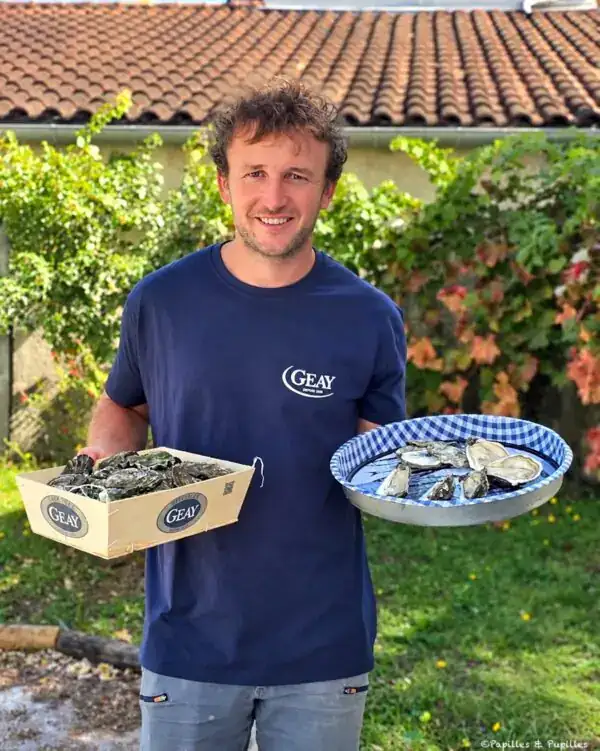
That's where I met Adrien Geay, an oyster farmer in La Tremblade. He represents the fifth generation of a family that has been working with oysters since 1874.
The oysters of Marennes-Oléron—the claires, the fines, the spéciales, the famous green color—were all, of course, familiar to me. But Adrien allowed me to delve deeper into the nuances. Because behind the words we've always seen on oyster baskets lie farming choices, growth periods, densities in the oyster beds, and above all, very different tasting profiles.
What the clear ones really change
The distinctive feature of Marennes-Oléron oysters lies in their passage through claires, these shallow former salt marshes that shape the landscape around Marennes, La Tremblade and the island of Oléron.
I knew, of course, that the oysters were refined there. What Adrien explained to me most of all was how much the time spent in the oyster beds and the density of oysters in the tanks contribute to the final result. Depending on the desired grade, they stay there for varying lengths of time and have more or less space.
And this is where the terms "fine de claire" or "spéciale" become truly meaningful. The difference isn't simply based on the size of the oyster. A fine de claire is less meaty, lighter on the palate. A spéciale has a higher meat content: it's more generous, offers more texture, and generally has a longer finish.
Growth time is also important. Some oysters can be marketed after two and a half to three years, while others continue to develop for longer. Throughout this period, they are observed, sorted, and moved according to their growth. It's not something one necessarily imagines, but oysters travel a great deal during their lives. They don't all develop at the same rate, and this selection process is an integral part of the profession.
To each their own oyster
That's probably what interested me most about his approach: Adrien isn't trying to produce an ideal oyster that would please everyone. Because when it comes to oysters, as with many things, we don't all like the same thing.
Some prefer a delicate, briny, and lively oyster. Others seek more meat, something you really chew and whose flavor lingers longer. Between these two extremes, Adrien created the Généreuse, meatier than a Fine de Claire but less imposing than a Spéciale. The company has thus developed different ranges over the years. La Môme, for example, was created to celebrate the 150th anniversary of the family business. And when I asked him which one he preferred, he didn't hesitate for long: La Sublime, a green Spéciale.
This famous green color is natural. It comes from the blue navicula, a microalga found in certain oyster beds, which colors the oyster's gills and gives it this characteristic tint without, on its own, imparting a particular taste.
We then moved on to the tasting, from the smallest to the largest oysters. And it's obviously when they're side by side that the differences become most interesting: texture, chewiness, length on the palate, marine intensity… The profiles stand out very clearly.
It's a bit like with wine: you can know the theory, but direct comparison tells you much more.
And then Adrien takes out… sneakers
And that's when the encounter took a turn I truly hadn't anticipated. Because Adrien's work doesn't end once the oyster is out of the water, or even once it's been eaten. He also considers what can become of its shell, a heavy, bulky waste product generated in considerable quantities.
At Geay, the shells are collected and then sent to Ovive, near La Rochelle, a company specializing in their processing. They can be cleaned, crushed, and transformed into powder or granules for new uses. Adrien first showed me glasses whose frames incorporate processed oyster shells. Then he brought out a pair of sneakers whose soles also contain them.
I admit I wasn't expecting that .
But beyond the unusual aspect, there is a real reflection on what to do with these tons of shells after consumption. They can be used in the manufacture of materials, for certain uses related to soil or filtration, and thus become a raw material rather than a simple waste product.
And that's ultimately what surprised me most about this encounter. Not the oyster beds themselves, but this way of thinking about the oyster right down to what remains of it once it has been eaten.
We finished the tasting with a Colombard from Domaine des Claires, fresh and lively, which worked very well with the oysters.
I left thinking that this encounter ultimately told two stories at once: that of oyster farming expertise passed down since 1874, and that of a company seeking to invent what it will do with its oysters in the future. Shells included. Even in the form of sneakers, apparently .
Practical information
Geay Oysters, Rue des Brunettes, 17390 La Tremblade – Tel.: 05 46 36 28 29.
It is possible to visit the oyster farm from February to the end of November, with a tasting of different types of oysters at the end of the tour. Please check the opening days and times beforehand.