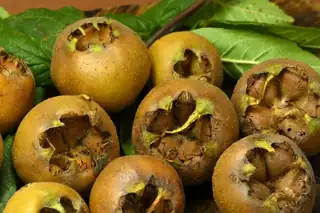
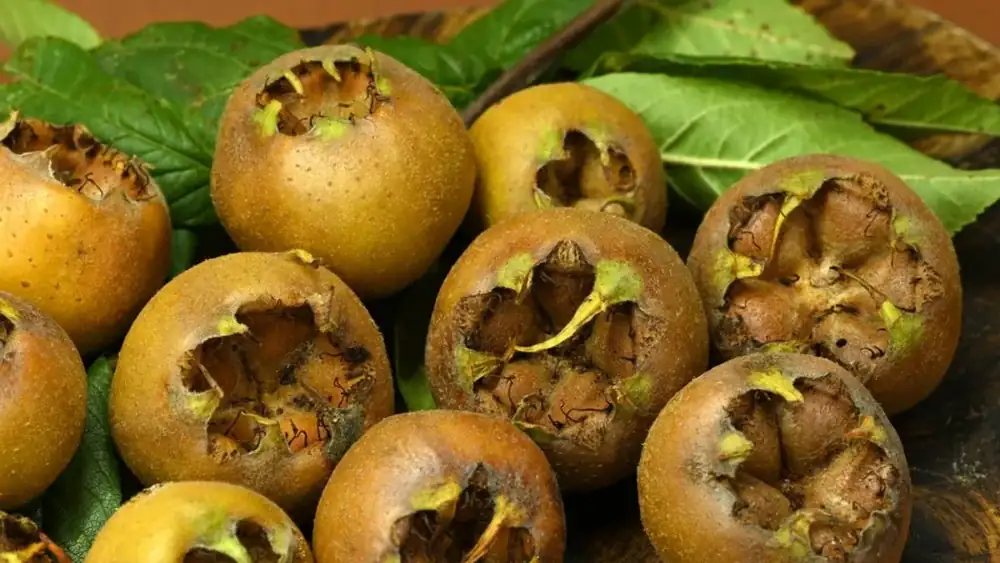
Ugly, but very delicious: this is why we love medlar
The medlar (Mespilus germanica) is a deciduous fruit tree in the Rosaceae family, related to the apple and pear, among others. It has long been cultivated in Europe and Western Asia, and although it is less common today, it was once a popular fruit tree in rural and larger gardens.
Medlar is not delicious when picked.
One of the most interesting features of the medlar is that it is not really suitable for consumption when picked fresh. The flesh of the hard, unripe fruit is tart and tough, so it is not like when you pick a ripe pear or apple and bite into it right away.
Medlar is traditionally eaten after a period of so-called post-ripening, also known as bletting. The fruit is picked in late autumn, usually around or before frost, and then left to ripen in a cool place. During this time, the hard flesh gradually softens, turns brown, and the flavor becomes sweeter and more complex.
This may not sound very appetizing at first, but that's when it becomes truly delicious. The flesh of a fully ripe medlar is creamy and soft, and its taste can be reminiscent of a strange mixture of apple, pear, date, and a slightly vinous, spicy aroma. However, the texture of the fruit does not make it worth comparing it to crunchy fruits: a good medlar is more suitable for spooning than biting.
This is how medlar ripens
The post-ripening of medlar is actually a natural biochemical process. As the fruit softens, the structure of the cell walls changes, the starch and other components are transformed, while the characteristic taste and aroma of the fruit are also developed. During the process, the appearance of the fruit also changes: from a hard, lighter fruit, it gradually becomes a soft, brownish fruit. To a layman, this can easily seem as if the medlar has spoiled, although this is precisely the desired state of a properly post-ripened fruit.
Of course, it's important to distinguish between ripe and spoiled fruit. If it has an unpleasant, putrid smell, is moldy, slimy, or is otherwise clearly spoiling, don't eat it.
This is why you eat medlar
Medlar is interesting not only for its unique taste. The fruit also contains carbohydrates, organic acids, minerals, carotenoids, and various polyphenols. According to research, medlar also contains several plant compounds with antioxidant properties, including flavonoids and phenolic acids. The nutritional content and composition of medlar also changes during ripening. The latest research is also investigating how bioactive compounds develop during the post-ripening, or softening, of the fruit. However, this does not mean that medlar is some kind of medicine. Although several interesting biological properties have been observed in laboratory studies, it cannot be directly concluded from these that the fruit prevents or treats a specific disease. It is therefore worth considering it simply as a delicious fruit that can be included in a varied diet.
Versatile material
Although medlar is most often eaten on its own, it has many more uses than that. The fully ripe, soft flesh can be simply scraped from the peel and spooned, but it can also be used as an ingredient in jams, jellies, syrups, sauces, and various desserts. According to the literature, medlar is also used to make juice, cheese-like fruit preparations, and fruit leather, while the unripe fruit can also be used to make pickles or vinegar.
It works particularly well in desserts: the soft fruit pulp can be used to make cake fillings, fruit creams, or even a special chutney. Its flavor pairs well with apples, pears, cinnamon, vanilla, nuts, and citrus.
What should we look for when buying or picking medlar?
Medlar is less common on store shelves, so it is most often purchased from home gardens or farmers at the market. Here are some things to look out for:
- If the fruit is still hard, don't expect it to have the same flavor as a fully ripe medlar.
- For post-ripening, it is worth choosing a cool, well-ventilated place. Do not crowd the fruits on top of each other, and check them from time to time to remove any that have started to deteriorate.
- It's also important not to judge by appearance. One of the special things about medlars is that they're at their best when they're soft and brown—just when you'd think it's time to throw away another fruit.
Ingredients for about 4 small jars:
- 2 kg fully ripe, soft medlars
- 30–40 dkg of sugar
- Juice of 1 lemon
- 1 vanilla pod or 1 tsp vanilla extract
- 1 dl water
Preparation:
- Wash the soft, ripe medlars and place them in a saucepan. Pour in the water and cook over medium heat until the fruit is completely soft and mushy. This will take about 15–20 minutes.
- Pass the cooked fruit through a fine sieve or colander to prevent the peel and seeds from getting into the jam.
- Return the fruit pulp to the saucepan, add the sugar, lemon juice and vanilla.
- Continue cooking over low heat, stirring frequently, until it thickens sufficiently. This should take about 15–25 minutes, depending on the water content of the fruit.
- Pour the hot jam into clean, scalded jars, seal immediately, and turn upside down for a few minutes. Then let it cool.
Tip: Medlars thicken nicely due to their natural pectin content, so you don't necessarily need a gelling agent. The lemon juice also nicely offsets the sweet, slightly spicy flavor of the medlar. This medlar jam recipe uses a similar, traditional method: the cooked fruit is broken open and then cooked further with sugar.