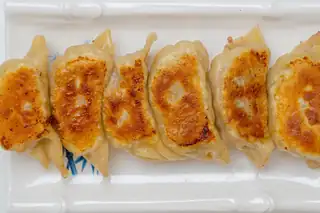
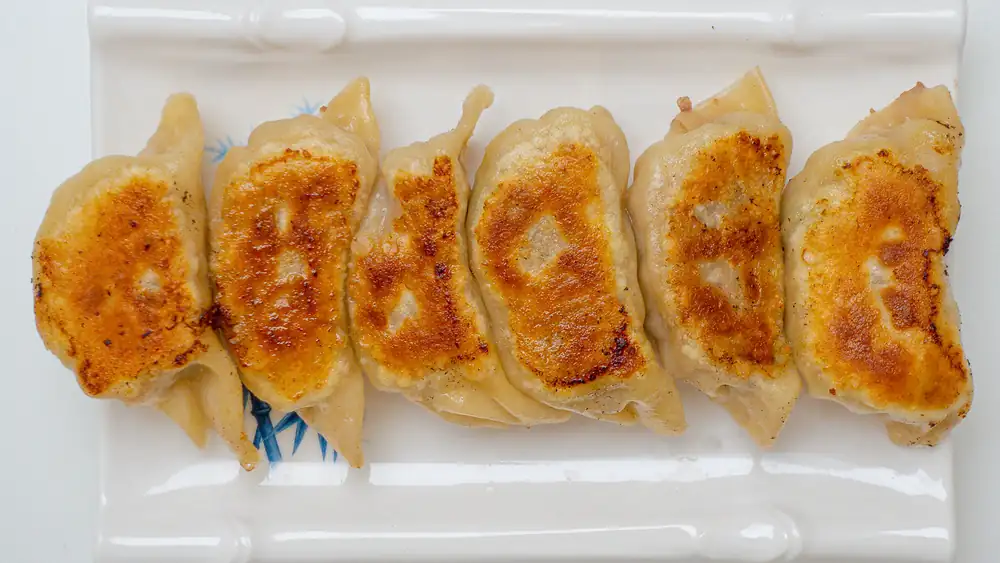
Guiosa
Gyoza gyōza) are small dumplings filled with ground pork and vegetables, wrapped in a thin dough. They originated in China, where they are known as jiaozi, but have become very popular in Japan. The classic gyoza filling includes ground pork, scallions, chives, cabbage, ginger, garlic, soy sauce, and sesame oil.
- 500 grams of pork (neck, shoulder, etc. - cuts with tender fat)
- 250 grams of green cabbage/white cabbage or Savoy cabbage
- 15 grams of soy sauce / shoyu ((1 tablespoon))
- 14 grams of sesame oil ((1 tablespoon))
- 50 grams of scallions (or chives; about 1 stalk)
- 30 grams of ginger (about 2 tablespoons)
- 10 grams of garlic (2 medium cloves)
- 6 grams of salt ((1 teaspoon))
- 1 gram of black pepper (½ teaspoon)
- 240 grams of wheat flour ((2 cups))
- 120 ml of water ((½ cup))
- 5 grams of salt
- 15 grams of soy sauce / shoyu ((1 teaspoon))
- 15 grams of rice vinegar ((1 teaspoon))
- 5 drops of la-yu (Japanese hot sauce) ((optional, adjust to your spiciness preference))
- 120 ml of water (half a cup)
- 14 grams of neutral vegetable oil (canola, sunflower, corn, etc.) ((1 tablespoon))
- Mincing garlic: Mince the garlic into very small pieces.
- Peeling ginger: using a spoon or small vegetable knife, peel the piece of ginger.
- Grate ginger: grate the ginger using a fine grater.
- Removing the core of the cabbage: remove the hard part from the center of the cabbage and discard it.
- Slice the cabbage: slice the cabbage into very thin slices.
- To chop cabbage: chop the cabbage into very small pieces.
- To slice scallions: cut the scallions (or chives) into very small slices.
- Cutting pork: if the pork is not already ground, cut it into small strips.
- Grinding pork: Grind the pork. In this recipe we use pork neck meat, also called neck or pork shoulder. It's a fairly fatty cut, which will make the gyoza more flavorful. Other cuts of pork can be used, but we recommend using pieces with very tender fat.
- Grind twice: Grind the pork a second time until it is almost a paste.
- Place ingredients in a bowl: put all the filling ingredients in the bowl.
- Mix well: Mix the ingredients thoroughly using your hands.
- Cover and refrigerate: Cover and refrigerate. We recommend refrigerating for at least 30 minutes, but ideally overnight so the flavors penetrate the meat and cabbage well.
- To heat water and salt: add the salt to the water and microwave until boiling (about 2 minutes).
- Adding water to flour: place the flour in a bowl and add the hot water.
- Mixing water and flour: Mix water and flour with a spatula. Use a spatula while the water is still hot and finish mixing with your hands.
- Kneading 01: once the dough has cooled slightly, knead it for about 5 minutes, until it is smooth.
- Resting the dough: cover the dough with plastic wrap or a towel and let it rest for 30 minutes.
- Kneading 02: Knead the dough again for another 5 minutes.
- Smooth dough: after the second kneading, the dough will be very smooth.
- Cutting dough: cut the dough into 3 or 4 pieces to roll it out.
- Sprinkle flour: Sprinkle flour over the dough and the work surface. Sprinkle whenever the dough starts to stick to the work surface or the rolling pin.
- Roll out the dough: using a rolling pin, roll out the dough until it is very thin (1 to 2 mm thick). This dough is quite stiff and difficult to roll out with a rolling pin. We recommend using a pasta machine (like Mercatto) to roll out this dough. If using a machine, roll it out to setting 6 or 7.
- Thin dough: the dough should be very thin.
- Cut into circles: cut the dough into 8-9 cm circles. Use a glass or pastry cutter to make the cuts. Any leftover dough can be kneaded again and reused to make more circles.
- Adding the filling: Place 10 to 15 grams of filling in the dough (about 1 tablespoon). We recommend using less filling for your first attempts, as this will make it easier to close the dough into the gyoza shape.
- Spread the filling: Spread the filling with a spoon, without reaching the edge of the dough. The moisture from the filling will help seal the dough.
- Close the dough: join the opposite sides of the dough.
- Making folds: With your left index finger, push the top of the dough to the right. Your left thumb makes a movement in the opposite direction, creating a small fold in the dough. Pinch the fold with your right index finger and thumb to seal the dough. Repeat the movement until the gyoza is completely closed.
- Closed gyoza: when the folds are finished, the gyoza will be tightly closed and will have a half-moon shape.
There are three main types of gyoza:
- Yaki-gyoza: the most common type of gyoza. They are placed in a frying pan and partially fried, then water is added to the pan and a lid is placed on so that the gyoza steam. When all the water evaporates, the gyoza are fried again to create a crispy crust on one side.
- Age-gyoza: In this method, the gyoza are deep-fried in hot oil, creating a crispy crust, similar to Brazilian street fair pastries.
Gyoza Recipe | Gyoza
Our gyoza recipe follows the traditional Japanese recipe for yaki-gyoza. The result is a very flavorful, moist gyoza with a partially crispy crust. The gyoza are first cooked in a small amount of water. When the water evaporates, one side of the dough is fried/grilled until golden brown and crispy.
Meat: In this recipe we use pork neck, also called shoulder or neck. It's a tender cut of meat with fat that's excellent for grinding. Other cuts of pork can be used, but we always recommend using cuts with fat, as the fat enhances the flavor of the gyoza. We grind the meat twice so that it becomes slightly paste-like.
Cabbage: We use raw white or green cabbage. Some chefs partially cook the cabbage to soften it, or even sprinkle salt on it so that it wilts, loses moisture, and also becomes softer. We don't find this step necessary; the cabbage will cook during the preparation of the gyoza, and we want it to add a firmer texture to the filling.
Chives: the traditional gyoza recipe calls for nira (Chinese chives), a vegetable similar to chives, with a strong garlic flavor. While this herb can be found in some supermarkets in Brazil, we prefer to substitute it with a combination of chives and garlic.
Dough: The dough for gyoza is very similar to the dough for Brazilian street fair pastries. It's a firm dough because it has a small proportion of water to flour. It's possible to roll it out with a rolling pin, but we recommend using a pasta machine (like Mercatto or similar) to achieve a very thin dough.
- Rolling pin
- Medium bowl
- Small bowl
FILLING
MASS
SAUCE (PER PERSON)
FOR COOKING (FOR EACH PAN WITH 12 GYOZA)
FILLING
MASS
FILL
- Use immediately or freeze: Gyoza can be prepared immediately or frozen for later use.