Don’t Overlook the Georgia Oyster
Matthew Raiford’s new cookbook tells the story of the Gullah Geechee legacy that lives within the rich soil and abundant waters along the coast of Georgia. Plenty of cookbooks touch on the topic of family history, or preparation rituals that have been passed down from generation to generation.
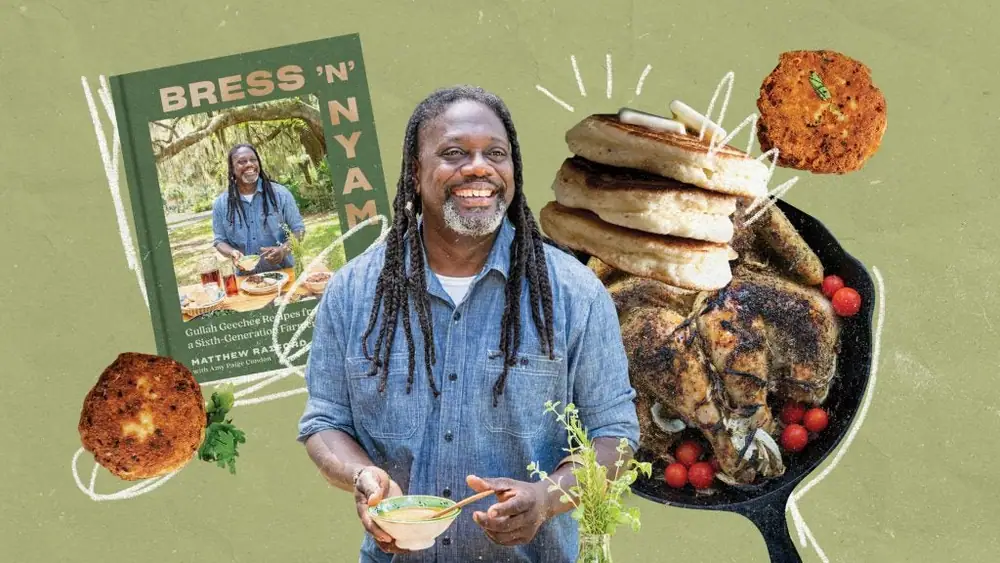
“I grow cucumbers, somebody else grows tomatoes, we give them back and forth. We have a farm, and you might not have a farm, but you grow peas.”
The James Beard Foundation Award–nominated chef lives and works on the farm in Brunswick, Georgia, that was originally established by his great-great-great-grandfather Jupiter Gilliard in 1874, just a few years after emancipation from slavery. Living on the estate for the past decade has meant stumbling upon family recipes, records of harvests past, 19th-century cookbooks, and even grocery ledgers from the early years of the estate. The book is an ode to the dishes and components that define this part of the Georgia coast, from the griddle cakes with muscadine jelly to the “Hot Tin Oysters” that are cooked by the bushel on a big sheet of metal over an open fire.
How is everything going at Gilliard Farm, and how has this year been for you? It actually just poured down rainfall two minutes ago, which was awesome, since I have a little bit of everything planted right now, and I needed the soil to get soaked anyway, since I’m getting ready to put rice in the ground right now. I think I’m the first person in 90 years to grow rice like this on the coast of Georgia.
I enjoyed reading about rice in the book, and a lot of the history of Brunswick and of Georgia, and your family history, too—your great-great-great-grandfather Jupiter and all of the following generations. How much of the book was about recording that history and having it in written, printed form?
The reason I started my podcast, Jupiter’s Almanac , is that I had all of these letters that were written between my great-grandparents. My grandparents about what was being sold at marketplace, what was being harvested. So I had those records in letter form already, and then there had been some documents, because someone did their master’s thesis on and wrote about Jupiter Gilliard, so that was how I was able to amass a lot of that information and fact-check it.
You write about unearthing all of these incredible records on the holding, like the grocery ledger from Jupiter’s lifetime. The magic cobbler method is actually a method that I began doing in the ’70s, because it was a little thing on the back of a Pillsbury box of self-rising flour.
Can you walk me through how you do it?” I think the pandemic has indicated us how unprepared we are for any food system collapse. We have a farm, and you might not have a farm, but you grow peas.” It was always about the best elements, even growing up. And I think, by the time I went to culinary school, and I was hearing chefs talk about getting the best components, knowing your grower, I was already like, “Oh, boom, I know that.” That was already part of my DNA, part of my life.
One of the things you write about is how people in the Brunswick area have become a little less self-sufficient over time about growing or catching their own food—because of environmental factors, and new developments being built. I think it’s key for us all to take a pause for a moment and realize that Mother Nature has a lot to give us, and we have to be kind to the earth if we expect to continue. If food is that weighty to our survival, we have to ensure that we’re able to continue to eat.
Oysters are such a big part of the book—diving into the history of the oyster industry in Georgia, but as well lots of exciting ways to cook them. Especially for folks who are along a coastal line, who can get that all the time—it has to be part of what you do.
- Who: Georgia · Jupiter Gilliard