What are the crunchy crystals that appear on some aged cheeses?
The crystals in some aged cheeses are sometimes mistaken for mold, but they are calcium lactate or tyrosine, and are edible.
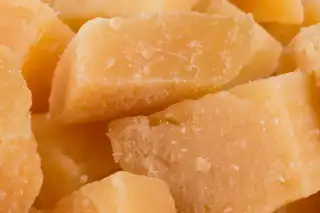
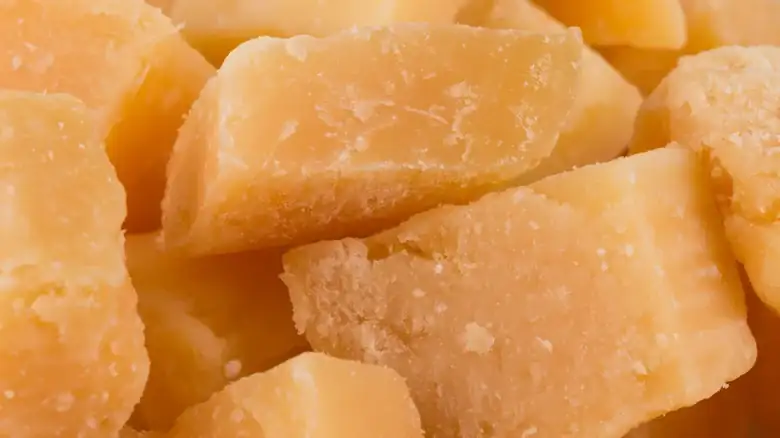
Some aged cheeses have small crystals that contribute to their crisp texture. These form during ripening, when some proteins separate and create the particles you feel when you bite into a piece of aged cheddar. Like some wines, these cheeses improve with age, and the crystals indicate that they have matured properly.
There are two types of crystals. Calcium lactate appears both on the surface and inside, as small, soft, white spots, and is common in cheddar and Colby. Tyrosine appears only inside, as shiny white flecks, and is found in Swiss, Pecorino Romano, and Gruyère cheeses.
In Parmesan or aged Gouda, both types can appear at the same time.
To distinguish the crystals from the mold, simply look at the surface. Calcium lactate appears smooth, while mold is soft and raised. The mold fragments can be carefully removed, and the rest of the cheese, with its crystals, remains edible.







