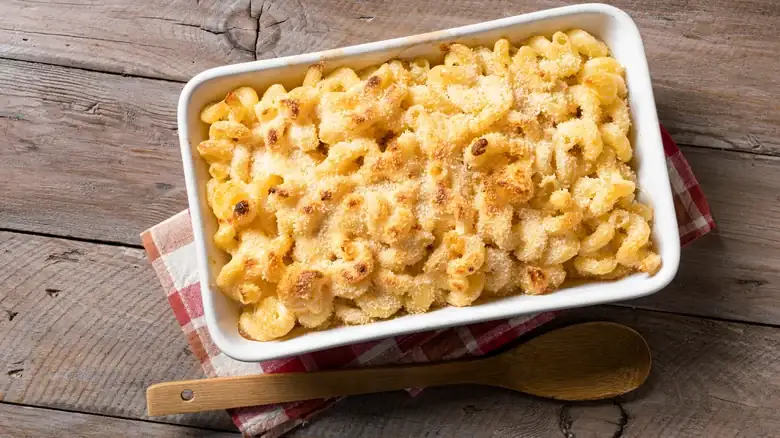
A poorly made roux and excessive heat make macaroni and cheese greasy.
The roux and the choice of cheese determine whether the macaroni and cheese turns out creamy or greasy.
Creamy and cheesy, macaroni and cheese is the ultimate comfort food. Aside from quick two-ingredient sauces with cream cheese and shredded cheddar, most recipes start with béchamel, one of the five French mother sauces. Making it begins with a roux, a mixture of equal parts butter and flour, and that's where the first problem arises. If the ratio isn't exactly 1:1, the roux either tastes like flour or is too greasy.
The roux must be cooked to its first stage, known as a white roux, but not overcooked. If it darkens too much, it has fewer thickening properties and absorbs less liquid, so it won't combine well with the milk, the next ingredient in béchamel sauce.
Cheese is the second factor. Ideally, you want a cheese that melts well and has a strong flavor. A medium-to-mild cheddar melts best, and adding Gruyère, fontina, or Monterey Jack adds a lot of depth.
The most important thing is to grate the cheese into the béchamel sauce, remove it from the heat, and let the residual heat do the rest. If the sauce gets too hot, the fat separates from the cheese proteins, and the macaroni becomes greasy. With this technique mastered, the béchamel sauce becomes ultra-creamy and can easily incorporate other ingredients.







