How does Yorkshire pudding differ from popovers?
Americans and Britons often have a friendly rivalry over their respective cuisines. But those culinary traditions, though neither country readily admits it, are more similar than many realize. Take, for example, a fluffy pastry made from dough, baked in hot fat, and served as an iconic side dish.
Americans and Britons often have a friendly rivalry over their respective cuisines. But those culinary traditions, though neither country readily admits it, are more similar than many realize. Take, for example, a fluffy pastry made from dough, baked in hot fat, and served as an iconic side dish. We're referring, of course, to Yorkshire puddings. Or perhaps popovers?
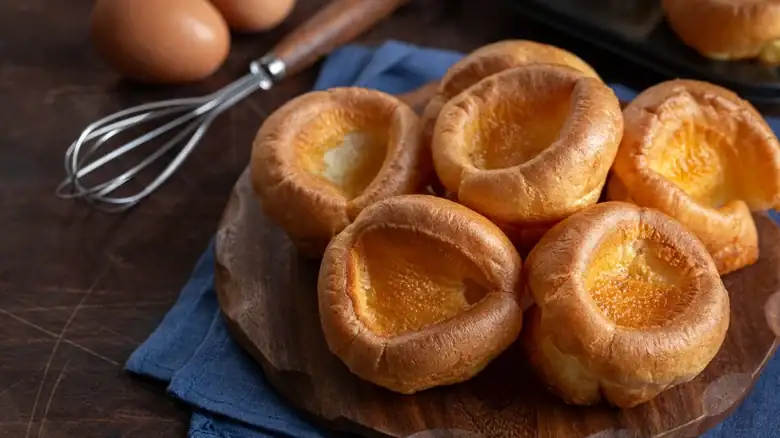
Although at first glance these two pastry-based desserts look very similar, to those with a discerning eye, they are quite different. So, what exactly is a Yorkshire pudding? Supposedly originating from, you guessed it, Yorkshire, in the north of England, it's not as sweet as you might expect. In fact, the word "pudding" originally referred to a savory dish, primarily made with meat. However, by the mid-18th century, meat began to gradually disappear. Around the same time, in 1747, a cookbook called "The Art of Cooking Made Easy and Plain" first mentioned the newly christened "Yorkshire pudding."
The recipe hasn't changed much to this day: a simple batter of flour, milk, and eggs, cooked in fat. Originally, that fat was beef fat, as Yorkshire puddings were baked beneath a beef roast, thus collecting the excess fat. The popover, on the other hand, emerged roughly a century later, likely as a modification of the original Yorkshire recipe by English settlers in colonial America. Although similar, the traditional popover recipe uses butter, not beef fat, giving it a slight sweetness and a softer, fluffier texture.
Preparing Yorkshire puddings and popovers
As for the preparation of Yorkshire puddings and popovers, there aren't too many differences. Both consist of a batter similar to pancake batter, made with eggs, milk, wheat flour, and salt, whisked until smooth and runny. However, popovers have melted butter added, which gives them their moist and fluffy texture. Neither uses yeast; their characteristic fluffiness comes from intensely heating the fat in the base of their special molds before adding the batter.
For Yorkshire puddings, it's common nowadays for home cooks to use a neutral, high-smoke-point oil, such as vegetable or sunflower oil. However, to achieve that classic Yorkshire pudding flavor, beef fat is the best choice. It imparts a delicious taste that pairs perfectly with a traditional Sunday roast. The puddings are baked in a special tray, which is essentially a shallow muffin tin. Originally (though it's now rare), Yorkshire puddings were baked in a larger tray, rising slightly above the rim, unlike the more pronounced rise of popovers.
Popovers, on the other hand, require butter instead of fat or oil, giving them a rich, slightly sweet flavor, unlike the saltier profile of Yorkshire puddings. They are also baked in a special type of tin, similar to a muffin tin, but instead of being shallow like those used for Yorkshire puddings, these are deeper and narrower, which gives them their characteristic shape as the batter rises and overflows the tin.
How to serve Yorkshire puddings and popovers
Yorkshire puddings were originally served as an appetizer. In times when meat was very expensive, they played an important role in staving off the hunger of working Britons before the main course: the Sunday roast. Today, however, they are a legendary side dish and look wonderful on a platter piled high with meat, potatoes, roast vegetables, and plenty of gravy. Their savory flavor, thanks to the rendered fat, makes them the perfect accompaniment to the rich flavors of roast meat. In the case of the legendary British classic, toad-in-the-hole, the batter is poured over sausages in a baking dish, encased in puff pastry, resulting in a fluffy meat pie, crispy on the outside and tender on the inside, that begs to be smothered in a traditional onion gravy.
Popovers, on the other hand, are a bit more versatile. The butter in their batter gives them a subtly sweet flavor, making them ideal both as a savory side dish and on their own. Why not experiment by adding different flavors to the batter? Havarti and dill popovers, for example, offer a delicious cheesy and herby touch, though they're also lovely spread with berry jam for a sweet dessert. In fact, popovers can even make a delicious and easy weeknight breakfast. While they may have their differences, Yorkshire puddings and popovers share at least one thing: they're both delicious!