Apples Gone Wild: An Exhibition of Feral Fruits
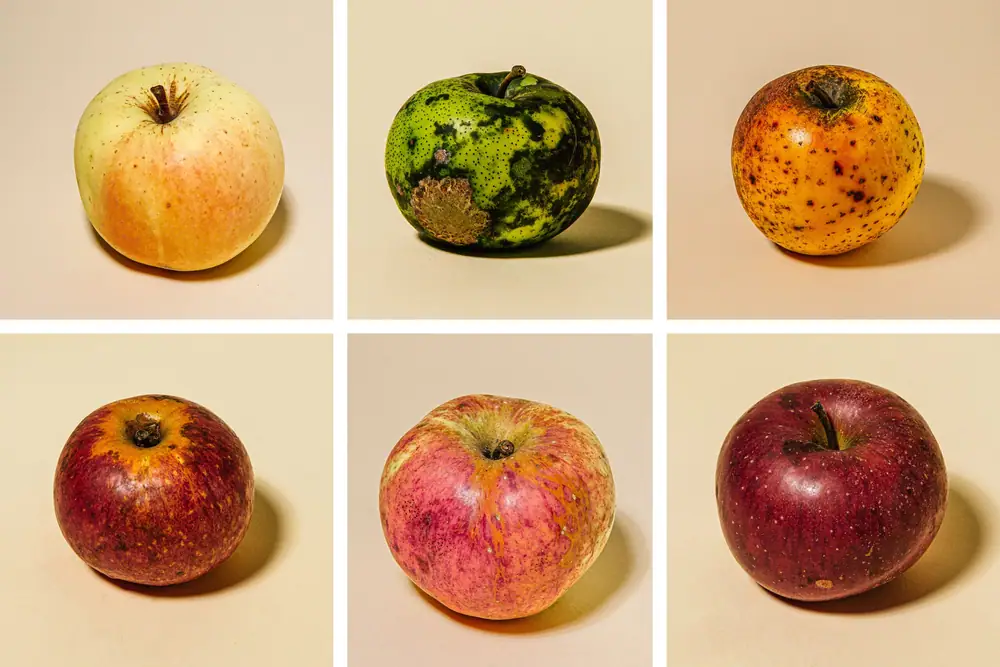
The skin of the first specimen—dubbed “Lemongrab,” from Warren, Vermont—is electric yellow with a hazy glow, almost as if lit from within.
“but when you’re cloning that original tree, exact copies of the same organism are occupying dozens or hundreds or even thousands of acres of land.”
Pomologists, scientists who study the cultivation of fruit, call this irregularity scarf skin: The apple’s epidermis has separated slightly from its flesh, allowing light to refract in the spaces between. The effect is otherworldly; the fruit resembles a tiny planet, its whorls and flecks shifting like atmospheric storms.
“Denbow Etoile,” “Bowdler Bitter,” and “Tonguelasher” are next on the table, three of the 160 wild apple varieties on display at Matt Kaminsky’s annual Pomological Exhibition in Williamsburg, Massachusetts. Each entry is diced and displayed on a paper plate alongside toothpicks for sampling.
Pens and paper are provided for visitors to jot down their tasting notes. Observations run the gamut from the conventional (“musky,” “acidic,” “honeysuckle”) to the bizarre (“ashtray,” “hairspray”) to the downright confrontational (“why are you picking these???”).
The exhibition debuted in 2019 as a way for Kaminsky, an orchardist and arborist, to share the strange varieties he had encountered in his studies. “But it kind of overtook my life and became my passion project,” he says. Apple seeds, it turns out, carry a tremendous amount of genetic diversity. Commercial apple varieties are produced by grafting; every Granny Smith apple tree, for example, is a direct clone of another. “Apples aren’t the first thing people think of when they think of a monoculture,” Kaminsky says, “but when you’re cloning that original tree,
exact copies of the same organism are occupying dozens or hundreds or even thousands of acres of land.” The lack of biodiversity can have adverse effects on the environment. A tree grown from seed, however, will produce completely novel fruit and adapt naturally to its terrain; Kaminsky is constantly seeking out resilient varieties that offer great flavor for eating—or applications in cider—that require little maintenance to grow. Countless undocumented varieties are growing in backyards, on roadsides, and in untended fields, all waiting to be discovered and cataloged in the latest volume of Kaminsky’s Pomological Series, an annual book he produces with photographer William Mullan.
With the exhibition entering its fifth year, Kaminsky now receives hundreds of submissions each fall, and every apple is tasted and judged. The apple voted “Best Quality Eating” in 2023 was called “Scout” and hailed from an orchard in Palermo, Maine; In 2022, it was “Lady Marmalade” from Alvadore, Oregon.
Lately, he is sourcing dormant twigs, or scion wood, from the most compelling and flavorful varieties, which he uses to graft and propagate young trees in his home nursery. By making the saplings available for purchase, growers of all levels are able to access and cultivate more of these noteworthy fruits. “That’s what’s great about wild apples,” he says. “They belong to everyone.” For more information and to submit your own wild apples to the fifth annual Wild and Seedling Pomological Exhibition in November 2024, visit gnarlypippins.com.
- Who: William Mullan The