What does the AOP/AOC label on French food and wine mean
The French take their food very seriously - a country has to when its gastronomy and baguettes are both listed on Unesco’s intangible cultural heritage lists. Yes, France is a fast food fountain with an insatiable appetite for junk food - but it is also justifiably proud of its own traditional cuisine, from boeuf bourg…
“result of a unique combination of human and environmental factors that are characteristic of a given territory”
That pride extends to food production, with farmers and artisan manufacturers fearlessly defending their techniques - taking their disputes to court in many cases. READ ALSO French court rules on the appearance of striped cheese
The French developed a labelling system that meant consumers could buy certain agricultural products - from vegetables to cheeses and wines - safe in the knowledge that its production and processing have been carried out in a particular geographical area (the terroir) and using recognised and traditional know-how. This is the Appellation d’Origine Contrôlée (AOC).
The designation can indicate a particular geographical area, or that the producer has followed the traditional technique or both. Under French law, it is illegal to manufacture and sell a product under one of the AOC-controlled indications if it does not comply with the criteria of that AOC. And these requirements can be very specific - for example several AOC cheese marks specify that not only must the cheese be made in a certain area and following the traditional recipe, but it must be made from the milk of animals living under certain conditions - eg grass-fed cows.
Following the brutal heatwaves and drought of the summer of 2026, grass has become so scare that many cows are being fed supplementary feed - in fact the situation is so serious that cheese-makers have been given temporary permission to use milk from cows that are no longer fully grass-fed. In order to make them recognisable, all AOC products carry a seal, with a number as well as the name of the certifying body.
The colour of the seal indicates the product classification: green for field products and red for dairy products. The origins of AOC labelling date to 1411, when the production of blue Roquefort cheese was regulated by parliamentary decree. On August 1st, 1905, AOC rules were introduced for wine - and, in 1919, the Law for the Protection of the Place of Origin was passed which specified the region, right down in some cases to the commune in which a given product had to be manufactured to bear its name.
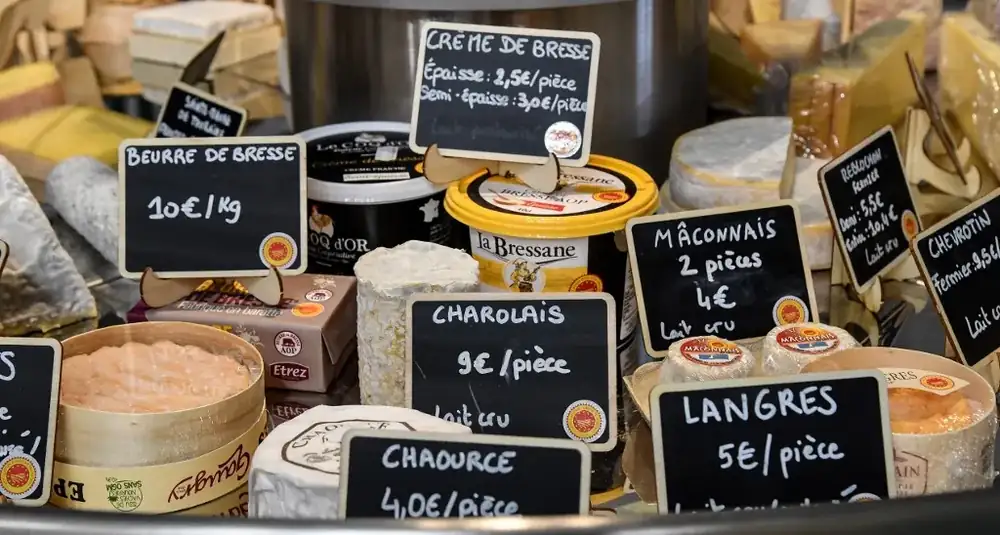
As well as wines and cheeses, AOC status has been awarded to Poulet de Bresse, and salt marsh lamb raised in the Baie de Somme; Haute-Provence Lavender Essential Oil; lentils from Le Puy-en-Velay; Corsican honey; butter from Charente, Charente-Maritime, Vienne, Deux-Sèvres and Vendée; and certain spirits. The European Union operates a similar geographical protection system that recognises products that are the “result of a unique combination of human and environmental factors that are characteristic of a given territory”. This is the more common Appellation d'Origine Protégée (AOP).
The difference? Scale.
The two labels are fundamentally the same. Just the former is French and older, while the latter European.
Most products with AOC designation also have AOP protection under EU law, so they use AOP. However, certain wines with AOP status can still use the French AOC designation, and many use both.
So are AOP/AOC products better than non-AOP ones? Neither of these labels are a quality mark, they refer only to how and where the product is made or grown, so there is nothing intrinsically better about an AOC/AOP cheese, lentil or wine.
However, the marks tend to go to the smaller, artisan producers who take great pride in their products, so in reality many of the AOC/AOP products are the better ones. Producers of Camembert have fought a decade-long battle over labelling that pitted the AOP camembert producers (whose product must be made with unpasturised milk, at least 50 percent of which is produced by cows that have been grazing on Normandy grass) against the big factory producers who have no such constraints.
While both are camembert, the AOP producers will tell you (at some length, if you let them) that theirs is an infinitely superior product.
- Who: Origine Contrôlée
- Percentages: 50 percent
- Figures: 50 percent