Coffee under the experts' scrutiny
How many sensory notes can be found in a cup of coffee? Before you take your first sip and make your notes, trained professionals have (probably) already analyzed your coffee.
How many sensory notes can be found in a cup of coffee? Before you take your first sip and make your notes, trained professionals have (probably) already analyzed your coffee. Learn about the role of the Q-Grader in purchasing and evaluating batches and their importance for the continuous improvement of the quality of Brazilian coffee beans.
When we buy specialty coffee, it's common to find sensory descriptions of the beverage on the packaging, such as red berries, brown sugar, and caramel. In the cup, we primarily seek these references through aroma and flavor, accessing our memory to identify new notes that may appear between sips. For us consumers, this is an unpretentious exercise, a ritual with each cup of coffee. But behind the sensory pleasure lie complex characteristics, deeply analyzed by professionals who dedicate themselves daily to identifying, describing, and analyzing the best (or worst) qualities of each bean.
Who is a Q-Grader and what do they do?
The so-called Q-Graders, you've probably heard of them, are responsible for evaluating and issuing quality reports on coffee. In English, Q is short for "quality," while Grader means classifier or evaluator. However, unlike a coffee classifier, a Q-Grader is an international certification that qualifies professionals through a specific methodology, enabling them to physically and sensorially evaluate a bean and categorize it as "special" or "non-special" depending on the positive attributes and defects found. A classifier, however, does not necessarily need to be a Q-Grader certified professional.
“Both professionals are extremely important in the coffee market, both specialty and commercial,” says Donieverson dos Santos, a Q-Grader for four years. “These professions are complementary, and they ensure that coffee evaluation is conducted with seriousness and professionalism, valuing the product and allocating it commercially in the correct way,” he adds.
How to become a Q-Grader
It is necessary to complete the training course offered by the Coffee Quality Institute (CQI). During the course, which also takes place in Brazil, in locations validated by the CQI, the professional is trained and evaluated in different aspects related to sensory analysis, to deepen their knowledge in specific certifications: Q-Grader, for Arabica coffees, or Q-Robusta Grader, for Canephora coffees.
KJ Yeung, a Q-Grader for three years, says the evaluation takes a week, but don't be fooled: despite the short time, it's an intense learning experience. "The candidate's resilience to the training is key to passing," explains KJ Yeung. According to him, in addition to physical and mental stamina during classes and tests, participants need in-depth knowledge of sensory evaluation, gained from daily experience with tests, or at least a good understanding of the method. Furthermore, the professional states that soft skills acquired outside the workplace are essential: "Having curiosity, not just sensory curiosity, is the basis for being a good evaluator. The greater the experience, the broader the perception of quality, which can be quite flexible and subjective depending on the context," he teaches. Another important characteristic, according to the Q-Grader, is having a critical sense. "Which doesn't mean being harsh, but truly recognizing the characteristics of a coffee, both positive and negative," he emphasizes.
No special skills are needed to be a good professional. Over time, however, some measures can be taken to ensure that professional performance is not compromised and that they become a benchmark. These include avoiding excessive alcohol and tobacco consumption, maintaining a balanced diet, always seeking to expand one's sensory range and maintaining continuous learning, as well as continuing to have focus and curiosity.
Coffee review
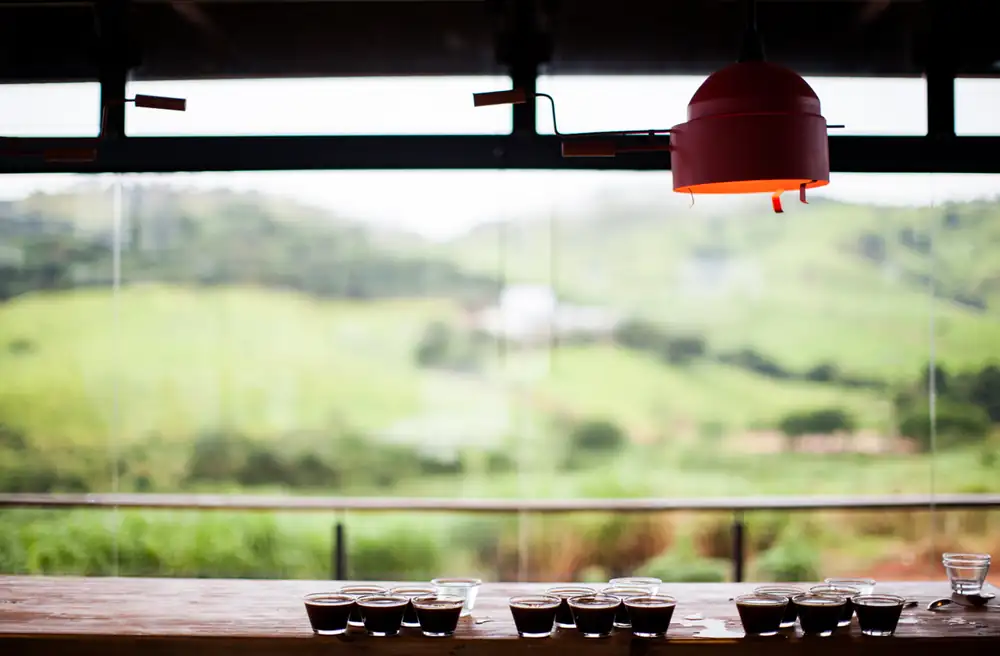
Coffee is evaluated and classified in two stages: physical classification and sensory analysis. In the case of specialty coffees, sampling is done first. "It must be representative of the batch. If the sampling is not done well, the analysis and purchase of the beans can be compromised," points out Q-Grader Camila Arcanjo, who has worked in the field for ten years.
In the physical classification stage, the raw bean (green coffee) is evaluated on a series of factors, such as product definition (Arabica or Canephora), moisture percentage, presence of foreign material, extrinsic and intrinsic defects, odor, color, size (sieves), and percentage of defects (breakage or picking).
Then, part of this sample is roasted for the sensory evaluation process. “Here, we take the opportunity to evaluate the number of quacker beans per 100 grams of roasted coffee,” explains Camila. Quacker beans are the 'pale beans' defined in the Official Brazilian Classification (COB). “This sample will be evaluated at a medium roast level, and the particle size should allow 70 to 75% of the coffee powder to pass through a 20 mesh sieve (the higher the mesh number, the finer the powder), between 8 and, at most, 24 hours after roasting,” details the specialist.
During sensory analysis, if the product is commercial, it will be evaluated in different beverage groups: strictly mild, mild, just mild, hard, riado, rio, or riozona. If the coffee is specialty coffee, the parameters evaluated will define a specific score, which generally ranges from 60 to 100 points. Coffees considered specialty should score above 80. Aroma/fragrance, flavor, finish, acidity, balance, uniformity, cleanliness (absence of defects), sweetness, and personal evaluation are analyzed in this stage.
Discrepancies between assessments
Do a Q-Grader working for a producer and a Q-Grader from competitions evaluate the same coffee differently? For Donieverson, this depends on the conditions under which the product is analyzed. "The protocol standardizes the evaluation and provides support so that the coffee is evaluated under the same conditions, regardless of location," he says. However, other factors can contribute to the divergence in evaluations: the calibration, experience, and sensory range of each taster.
“Calibration can be one of the factors contributing to the discrepancy. Uncalibrated professionals tend to evaluate coffees incorrectly,” he believes. Experience and sensory range are also contributing factors. Donieverson also points out that more experienced tasters, whose sensory library is well-developed and who have had the opportunity to evaluate coffees from different regions and farms, are more consistent. “Ideally, if there is a difference, it should not be greater than 1.5 points. If this happens, it is recommended that the coffee be re-evaluated and, if possible, with more professionals involved.”
The Q-Grader in industry and in the field.
This professional can work in different segments of the sector, such as industries, trading companies, quality control laboratories, farms, cooperatives, associations, and also independently, issuing quality reports and providing consulting services. In the industry, they work in various stages, but mainly in receiving and checking the quality of raw materials. "Through physical and sensory evaluation, they can approve or reject a batch of coffee that has been purchased, verifying if the quality is in accordance with the parameters pre-established in the contract," explains Donieverson. Another important point is product definition. "Through sensory evaluation and quality checking, the professional can draw attention to points at some stage of the industrial process, for improvement and also to select a line of profiles that will be used by the brand, directing the points according to the target audience and the consumer market," he adds.
In the field, the Q-Grader plays a fundamental role. They evaluate all batches of coffee produced on the property, using international methodology and adhering to different standardized sensory analysis parameters, so that the same product can be evaluated by different professionals under the same conditions, or as close as possible to them. "Without a doubt, properties with the resources and infrastructure for a laboratory where it's possible to perform sensory analysis of all cultivated batches have a competitive advantage," points out Donieverson. He believes it's essential to have a certified professional to assist in the evaluation.
It is also important that this professional is calibrated with professionals from the same region but from different areas, who deal with different profiles and processing methods of coffee, so that "sensory bias" is minimized. Furthermore, it is important that there is no restriction on access to different terroirs. "Professionals who are always tasting coffees from the same region or property tend to standardize the evaluation and incorrectly assess different qualities of coffees of varying quality," warns the professional. "It is essential, whenever possible, to calibrate and evaluate different beans and regions," he suggests. Finally, it is beneficial to have at least two professionals on the property for sensory analysis of the coffee, so that convergent and divergent points regarding the analyzed sample can be discussed.
The work of a Q-Grader is also relevant in coffee sales. “With the classification and report, an estimated commercial value for the product is reached,” explains Donieverson. “With this analysis in hand, it’s possible to search for and apply the coffee in different markets and buying and selling companies, to obtain an attractive profitability for the product,” he explains. The classification, however, is a guarantee of quality, not a mandatory certificate for trading companies. In other words, the negotiation should take place in a way that satisfies both parties.