Carnitas Ramirez Opens in the East Village
When Giovanni Cervantes and Tania Apolinar opened Taqueria Ramirez in 2021, their jobs almost instantly became about more than making tacos.
When Giovanni Cervantes and Tania Apolinar opened Taqueria Ramirez in 2021, their jobs almost instantly became about more than making tacos. Along with blowtorching tripe and shaving al pastor from the spit, they spent a good deal of time answering questions from English-speaking customers, who were trying meats like suadero and longaniza for the first time. “We didn’t expect that” Apolinar says. “The educational aspect.”
Then, she smiles: “We’re about to do it all over again.”
On Friday, Cervantes and Apolinar opened their second restaurant Carnitas Ramirez with new partners Yvon de Tassigny and Kari Boden (210 E. Third Street, near Avenue B).
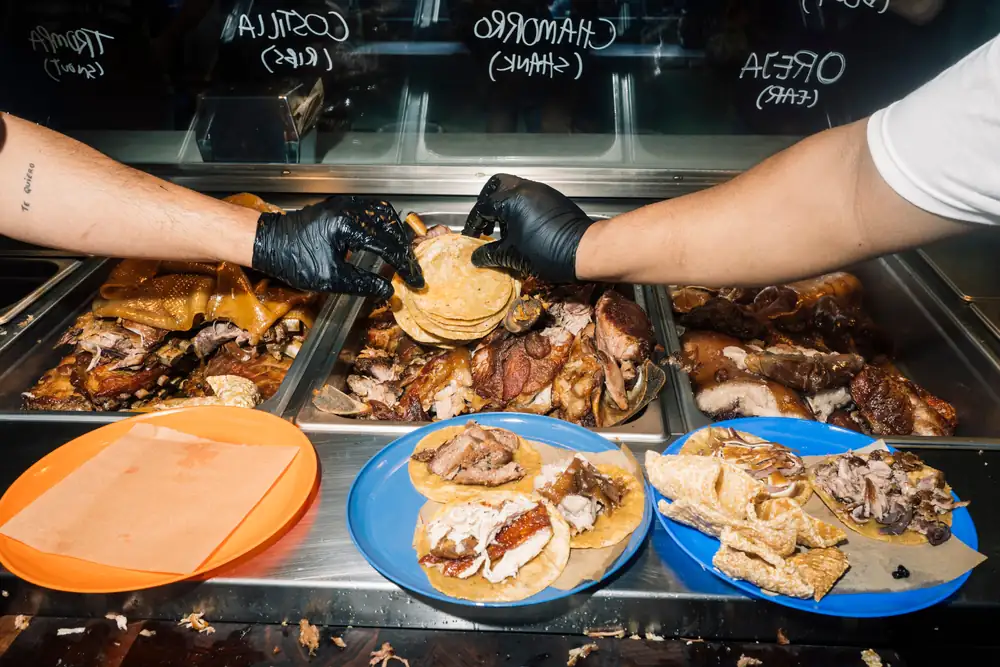
The taqueria is another language lesson. The names of different cuts of meat are listed above the register, but unless you’re fluent in Spanish, the diagram of a pig on the far wall will probably be more useful. It has the names of different pork parts, oreja (ear), buche (stomach), and matriz (uterus), along with their English translations. Not that you’ll get to use them.
“You can try and ask for pork butt” Cervantes says. “We’re going to make you say maciza.”
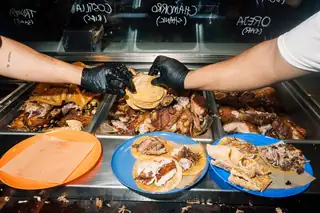
On opening weekend, there were close to a dozen types of carnitas on the menu ($5 each). When you have several of them on the same plate, you start to appreciate their differences: The cabeza is rich with collagen, and the chamorro has crunchy, fried skin. The brain meat known as seso is ground into a ricotta cheese-like paste, and the surtida has it all: cartilage, fat, and skin.
Seeing so many carnitas in one place is unusual in Manhattan. Across Mexico, carnitas come in a range of styles, cooked with Coca-Cola, beer, tomato, and orange, and utilize more parts of the pig. With a few exceptions, carnitas here have been made with just one cut of meat: pork shoulder.
As recently as a year ago, none of the owners at Carnitas Ramirez had made carnitas. (Maybe that won’t surprise you: After all, Cervantes and Apolinar say they learned to cook the menu for Taqueria Ramirez on YouTube.) Last year, Cervantes traveled to Michoácan, Mexico, where carnitas are said to originate. He developed a recipe, salt, garlic, and lard, and more importantly, he learned the ropes.
The process starts each morning around 7 a.m. when Cervantes and de Tassigny drop ears, ribs, and more into a stainless steel cauldron known as a cazo. After frying in lard for a few minutes, they’re moved to a second pot, where they simmer at lower temperatures for hours. Cooking carnitas like that takes a close eye: Each piece of meat has a different cooking time, and the temperatures in the crowded pot can change.
“It relies on mastery” Cervantes says. “These are perfectionist carnitas.”
Carnitas Ramirez is open Friday and Saturday, from noon to 10 p.m. and Sunday from 11 a.m. to 9 p.m.