
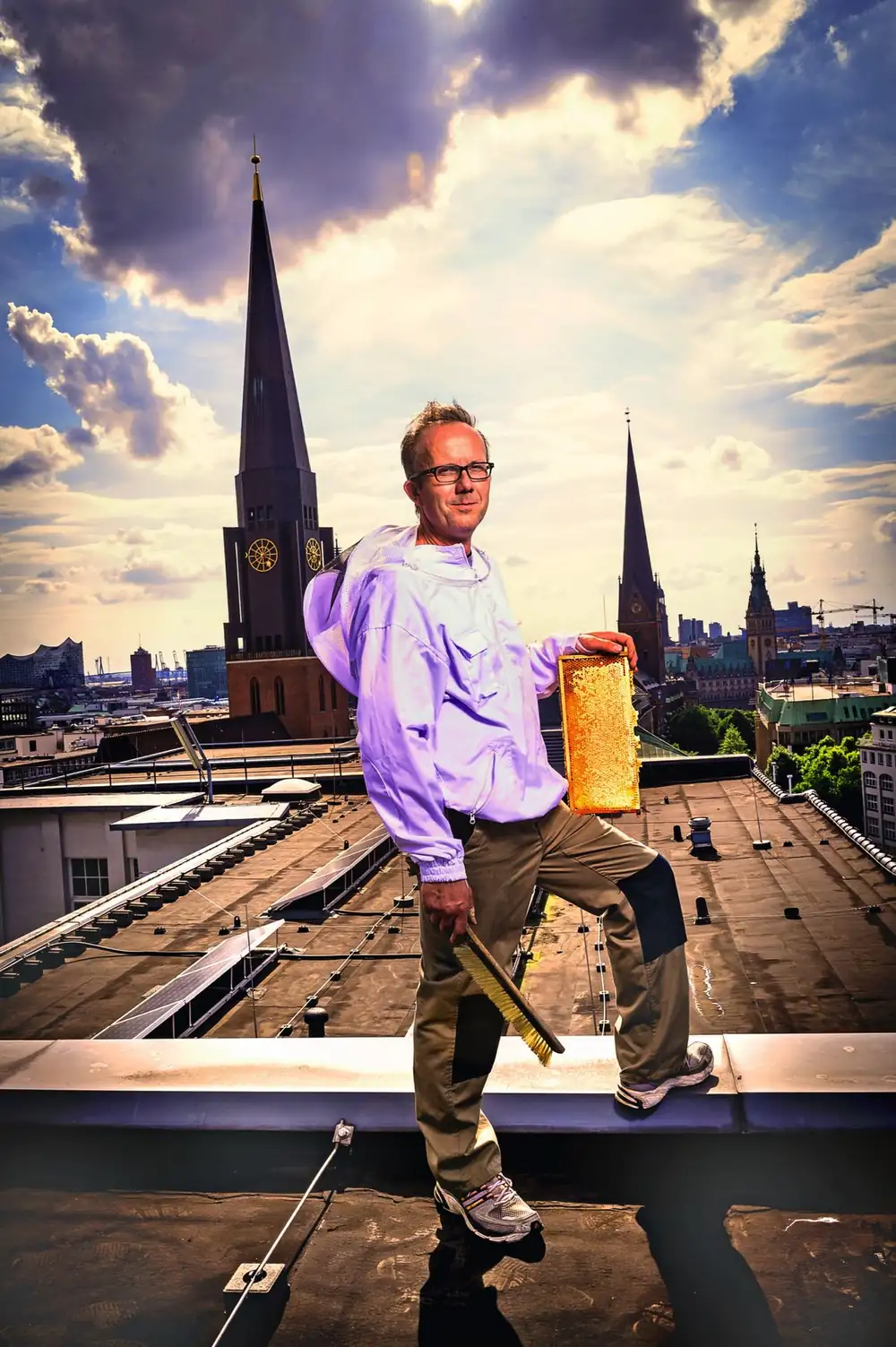
TREND CHECK CITY BEES
Beehives on the roof. This helps preserve the species, and the guests also benefit: they get honey for breakfast, and it gives the hosts a good image.
Beehives on the roof. This helps preserve the species, and the guests also benefit: they get honey for breakfast, and it gives the hosts a good image.
TEXT STÉPHANIE SOURON
Summer is bee season, and not least since the worldwide success of the novel "The History of Bees" by Norwegian author Maja Lunde, keeping bee colonies and beekeeping has become a real trend. Honeybees are now among the endangered species; diseases, pesticides, and monocultures make their lives difficult. Anyone who keeps a bee colony in their garden or on their roof is therefore doing them a favor and may even be contributing to the preservation of their species.
Many hotels now keep bees on their roofs. The insects enhance the green image of the buildings almost effortlessly. This resonates well in times of "vertical greening," green walls and facades, and Fridays for Future. Guests also benefit from the industrious insects high above: every morning at breakfast, they receive a local spread that not only sticks to their fingers but also leaves a lasting impression. Whether the beehives are located on the Park Hyatt or the East in Hamburg, the Big Mama or the Ellington in Berlin, the Bilderberg Bellevue in Dresden, the Pullman in Munich, or one of the numerous other hotels in Germany with rooftop bees, regional, artisanal honey always tastes better than the golden syrup from a plastic bottle. And the quality of these homegrown products is surprisingly good. "Urban honey has an incredibly broad spectrum of flavors," says beekeeper Wolfgang Zell. "It often tastes much better than a single-variety honey from the countryside." Because, as strange as it may sound, conditions between asphalt and concrete are almost paradisiacal for bees. Due to the milder temperatures, the growing season in the city is longer and the plant diversity is greater. In addition, for several years now, many city dwellers have been passionately practicing "urban farming," or urban gardening. They establish garden communities, sow flowers in their front gardens and on traffic islands, and plant in public parks. This makes it easier for the bees to find food and has a positive effect on the quality of the honey. "Unlike in the countryside, there is no mass flowering in the city, such as with rapeseed. Everything blooms in the city one after the other, from the willow in March to the ivy in October," says Zell. This way, the bees always find enough food and can take their time to produce their honey. "You can taste the difference in the end," says Zell.
Beekeeper Dietmar Niessner inspects the honeycombs at the Hotel Daniel in Vienna.
Beekeeper Wolfgang Zell lives in Brandenburg and is one of Germany's experts on honey from hotel rooftops. Three years ago, while searching for new habitats for his bee colonies, he stumbled upon a spot on the Hotel Ellington in the heart of Berlin. Since then, he has placed three beehives there every spring, tended to the bees, and then supplied the hotel with honey from the roof. The success of this unusual "Be2bee" concept has spread far and wide. Zell and his wife now supply around 80 hotels in Berlin, Hamburg, and Dresden with beehives, beekeeping expertise, support, and honey from their "Salubria" honey manufactory in Calau. And Wolfgang Zell has the great fortune of being able to sample each hotel's honey. He raves about blends of linden blossom, honeydew, blackberry, and mint. "Every city tastes different," he says with a laugh.
If you go by that logic, the honey from the roof of Frankfurt's Jumeirah Hotel is definitely worth a trip. The beehives are located 96 meters high, that's how high the tower of the luxury hotel chain from Dubai spirals into the sky. The hotel specializes in guests from the Middle East. For example, the "El Rayyan" restaurant serves the finest Lebanese cuisine. And the honeycomb at the breakfast buffet isn't your average regional honey either: because Frankfurt's Palmengarten (botanical garden) isn't far from the hotel, the bees also collect nectar from the exotic plants there. At the Jumeirah, they know how to showcase the rooftop honey effectively: the bar uses it in cocktails, and the hotel's spa offers a special "Skyline Honey" treatment.
Daniel's honey is also available to take away.
The Viennese are also embracing the bee trend. Hotel Daniel is a smart, urban hotel located between the main train station and the Belvedere Palace. On the hotel roof sits a stranded sailboat, designed by the artist Erwin Wurm. The vessel is joined by four bee colonies, which diligently produce honey up here. When it's ready for harvest, a beekeeper arrives with all his equipment and extracts the honey in the "Daniel Bakery" in front of the hotel guests, creating a spectacular display.