Austrian cuisine: Pub culture & coffee house
Pub, coffee house, beef trolley: The dignity of Austrian cuisine
The word "Jause" evokes wonderful memories for me. "Maxl, would you like to have a Jause?" my Tyrolean grandmother would ask when I spent my holidays with her. I always did. What she would then prepare in an antique stove didn't have a name in my childhood world; it was simply a Jause: two almost burnt slices of toast with ham and cheese melted between them. She would put a dollop of ketchup on the plate and encourage me to dip a corner of the toast in it. It tasted fantastic. Only many years later did I discover that this ham and cheese toast is served in coffeehouses all over Austria, as a transition from morning to lunch, or from afternoon to evening.
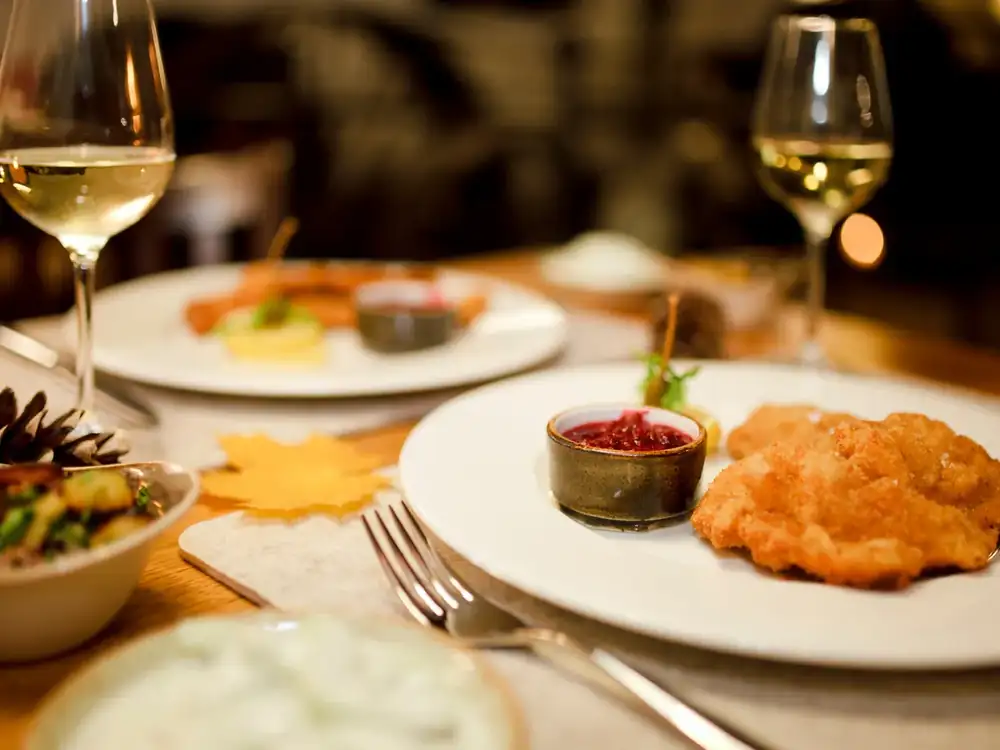
Austria, as is well known, suffers from no longer being an imperial and royal world power. But when it comes to cuisine, the schnitzel-shaped Alpine country is definitely a force to be reckoned with – in New York, for example, the best restaurants are currently serving Grüner Veltliner, such as that from Mathias Hirtzberger in the Wachau region. Alongside French and Italian cuisine, Austrian cuisine has decisively influenced European food culture. All the dumplings and strudels that are now served so naturally as Bavarian fare between Passau and Garmisch, the schnitzel, Kaiserschmarrn, and Gugelhupf – they all first became popular in Austria. For over the centuries, the great Habsburg Empire collected and refined the specialties of its many peoples. The result is a cuisine that embraces rusticity and Alpine simplicity, yet always carries a touch of courtly refinement. Just think of the glorious beef cuisine, which is still celebrated today at the “Plachutta” in Vienna in the same classic style as in the time of Emperor Franz Joseph: with a meticulous liturgy consisting of soup, boneless marrow on black bread – and then the various cuts of boiled beef along with chive sauce, spinach and apple horseradish.
"In culinary terms, the schnitzel-shaped Alpine country of Austria is definitely a force to be reckoned with."
A beef trolley laden with copper pots, wheeled to the table by a stern waiter, is both operetta and living gastronomic heritage. For Austrian cuisine is above all a cuisine of hospitality, celebrated in traditional pubs and restaurants, in wine taverns and coffee houses. When food critics speak of "upscale pub cuisine," the term perfectly captures the place where it can truly shine. For Austrian culinary culture is about chanterelle mushrooms and veal goulash in cream sauce, about Grammeln, as the deliciously crispy rendered bacon is called – and, of course, about a well-crafted glass of house wine. It's about happiness and melancholy at the table, not so much about stars or toques. In Austria, they still cherish the appreciation for the value of a ripe apricot or a good veal. This attitude is also evident in the solemn earnestness with which a veteran Viennese coffeehouse waiter, say at "Café Sperl" or "Café Korb," serves even in the midst of dense tourist activity a simple, impeccable chive bread and two eggs in a glass – in a tailcoat, on a tarnished silver tray, along with a glass of water, and with a touch of haughtiness. This gastronomic dignity is a cherished characteristic and a valuable export. Because the chefs in Vienna, Graz, or the Salzkammergut often still know, or at least sense, that every spoonful of clarified butter in the schnitzel pan and every glass of Gemischter Satz (a traditional Viennese field blend) represents a cultural act, making one part of something greater. This nostalgic commitment always benefits the guests. Some might think of Emperor Franz Joseph, others of Grandma's afternoon snack.