The gourmet tavern in Biscay that cooks with produce from the local garden
It's becoming a recurring pattern among a new generation of chefs. Seasoned professionals from big cities, with impressive resumes, are seeking refuge in the tranquility of a village bar. They're fleeing the rigors of the demanding urban scene to rediscover what made them fall in love with the profession.
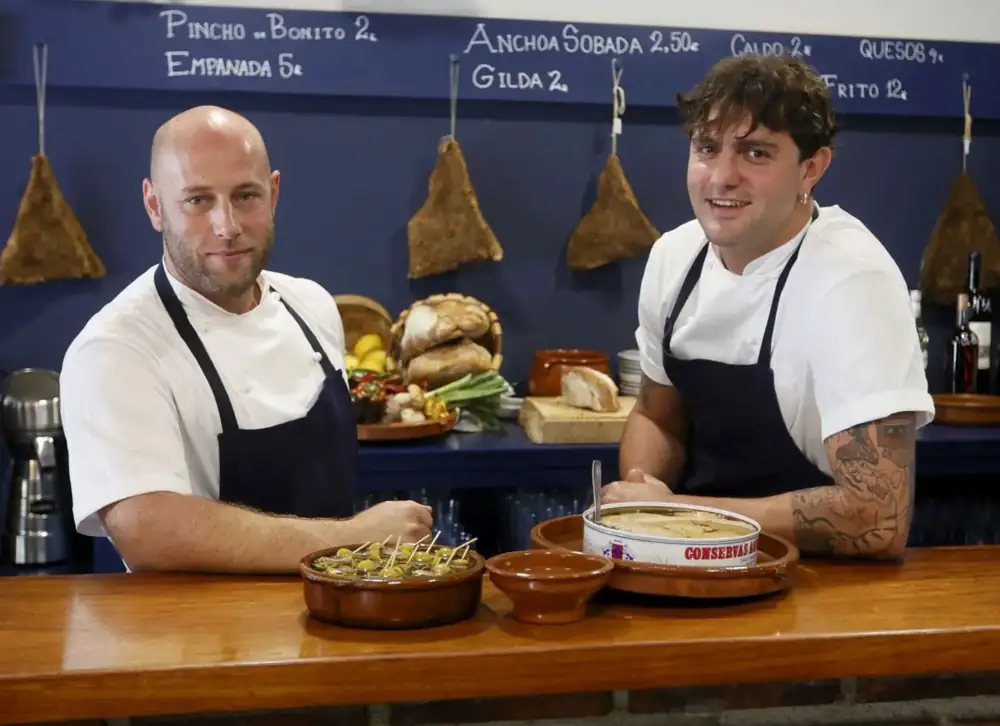
Carlos had been running the kitchen at Señor Martín for years, and Jero was part of the team at Chispa Bistró, two gems of Madrid's new wave of gastronomy, both in the heart of Malasaña's most exclusive district. They saw each other daily between shifts, while fantasizing about moving to the countryside.
“One day a friend told me that Txinbo was retiring and that Ana Mari, the owner, who lived right upstairs, was looking for someone to take over the bar.” Carlos knew the place from his high school days in Mungia, when he used to drop by with his friends for a plate of beans or pork loin with peppers. Things were getting difficult in Madrid, so they started planning the move together.
A fresh coat of paint, white tablecloths, earthenware dishes, some family furniture rescued from storage, and a strong desire to cook. "With what we've invested here, in Madrid we wouldn't even have enough to put down a deposit." In the village, they've been incredibly accommodating, as long as the bar, founded 80 years ago, didn't close its doors. This has allowed them to escape the complications of an urban project and focus on what's essential.
Their connection to the landscape—both natural and human—has never been stronger, and their improvisational skills in the kitchen are on full display. Trained for years by repeating scores written by others, they now embrace jazz. One only needs to glance at today's menu, filled with scribbled notes in the margins, to get a sense of the immediacy of their cuisine.
Sustainable out of necessity
The vegetable stew will include leek, carrot, pumpkin, and fennel, because that's what grows in Iker Villasana and Gorane's garden, less than four kilometers away, at the Biortzatxu farmhouse in Arrieta. The mushrooms for the dish that precedes the pochas (a type of white bean stew)—which will have already disappeared by the time you read this—were picked by Gorka, nicknamed 'Mazeto,' a renowned mycologist in Fruiz. The meat and eggs come from Unai Beitia, from Itturbaltza, who raises animals in a regenerative system less than a kilometer away, or from Gaizka, the son of Rafa, a butcher from Mungia, whose animals graze nearby.
They buy the apples from Rosa in Gatika, who sets up a stall every Friday at the market. The dairy products—unpasteurized—come from Carles and Leire at the Bizkaigane cooperative in Errigoiti. The only things that come from beyond a ten-kilometer radius are the fish—today a magnificent squid caught by seine net in Galician waters—the wild boar—"which comes from a farm in Navarre because the Health Department requires it, although we could hunt them right outside the restaurant"—and the bread, which Aida Iza brings from Orozko.
This commitment to local sourcing isn't a conceptual decision, nor a gesture of sustainable pretension. While restaurants proudly proclaim their "zero-kilometer" approach while delivery vans pull in through the back door, they rely on their neighbors out of sheer necessity: "The big distributors don't even have a route assigned to them that passes through here," Carlos jokes.
It's by making the most of what arrives—rather than waiting for orders—that they build their culinary offering. A menu of half a dozen dishes that diners can order à la carte or try as part of a tasting menu. The price, 60 euros, is a feat here, but in Madrid it would be considered science fiction. Defining Urruti's style is complicated: there's a preference for short cooking times and al dente textures, a respect for traditional flavors but also fresh ideas that, starting with classic ingredients and combinations, manage to sound distinct.
From the garden to the table
There's not much point in detailing a menu that changes almost daily, but let me mention a few highlights to give you an idea. A zucchini blossom stuffed with brandade and garum made from anchovy and sardine heads, served on a grilled tomato gazpacho with a few drops of Laphroaig whisky. It suggests a fresh and clean elegance, like the Álvarez Gómez cologne I find in the bathroom.
The vegetable stew isn't for everyone, be warned. You need to know how to appreciate the textures of freshly picked vegetables, to nibble and slurp them with relish, between spoonfuls of a delicate razor clam broth. The hake loin rests on a bed of light zurrukutuna sauce; it surprises with notes of pickled onion and the intense spiciness of Espelette pepper. At first glance, it seems like a classic, but it disarms you once you take a bite. There's more: the tripe, legendary, the wild boar with Apurtuarte sauce, the corn and coffee dessert…
Judging by the quality of the food and the wine selection, anyone might think they were in a fancy restaurant in the capital. Until, at four in the afternoon, Iker and Gorane arrive: they've come straight from the orchard and sit at the next table. Suddenly, Urruti proudly transforms back into a village tavern.