Three New Himalayan Spots That Go Beyond Momos
Three new Queens restaurants are going beyond momos when it comes to Himalayan food, pushing to the forefront lesser-known facets of the cuisine.
“I love to cook with lots of spice to people who also love spice,”
Three new Queens restaurants are going beyond momos when it comes to Himalayan food, pushing to the forefront lesser-known facets of the cuisine. Their chefs are homing in on dishes from Nepal, Tibet, and India demonstrating personal styles at each of these spots: Timur House in Woodside (39-04 64th Street at the corner of 39th Avenue); and Darjeeling Kitchen and Cafe in Astoria (31-12 36th Avenue between 31st and 32nd Streets); and Tandoori Tibet in Elmhurst (81-09 41st Avenue on a curved 81st Street).
Timur House
Timur House is a bright, casual corner spot with floor-to-ceiling windows. There, chef and co-owner Vivek Lama is going hard on Nepalese spices with a spotlight on the namesake timur. It’s a black peppercorn that gives off a numbing, tingling sensation most commonly attributed to its cousin, the Sichuan peppercorn. The timur grows in Nepal’s section of the Himalayan mountains, and Lama has it directly shipped. Just a handful of the peppercorns hits the nose with an intense, earthy, floral bouquet from a foot away.
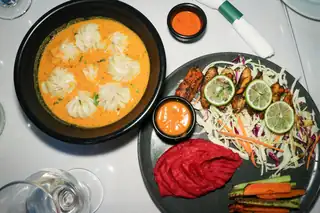
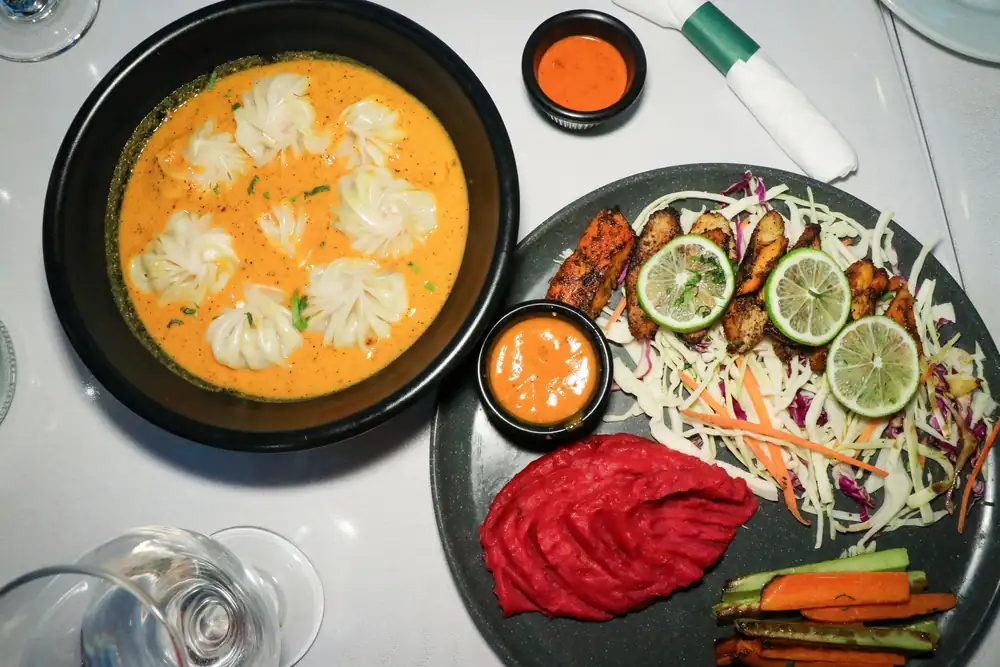
Timur is also a big reason that Lama, originally from Kathmandu, left his last chef job in Santiago, Chile for New York City. “I love to cook with lots of spice to people who also love spice” he said. He’s formed the base of the broth in his jhol momos with it. Cooked with tomato, peanuts, and a Nepali masala of cumin, coriander, garlic, dried red chiles, and ginger, his jhol momos are delightfully juicy, and robustly flavored with citrusy, tingly notes from the timur.
It also appears in a chutney, and a grilled chicken rubbed with the spice and served with pink beetroot mashed potato chutney. His bold masala without timur powers several items that don’t often show up at Nepali restaurants in NYC, such as the smoked duck choila, flame-grilled pork ribs, and three chile momos slathered in a fiery red chile sauce that you can’t miss. (Appetizers: $8-$11; momos: $11-$15; entrees: $13-$27.)
Darjeeling Kitchen and Cafe
While Timur House caters to those who like spicy dishes, the charming Darjeeling Kitchen and Cafe conveys a lighter approach. Chef and co-owner Pupu Chhangi has made it her mission to represent Tibetan food from Darjeeling, India, where many Tibetan immigrants like her family have settled. She also layers in a healthy cooking style following a doctor’s recommendation: As a devout Buddhist, she’s sharing that with her customers, serving a collection of dishes lighter on spices, oils and meats.
That plays out in her momos, too (although Tibetan momos already typically forego masala). She has two versions of vegetable momos, which are typically offered with a potato or cheese filling. She, instead, cooks a mixed vegetable version with kale, tofu, cabbage, and carrots, and another with oyster mushrooms. She has also concocted a shrimp momo that’s more buoyant than the beef or chicken counterparts.
She delicately seasons her other regional Darjeeling specials, too: like the thukpa (noodle soup); aloo dum (saucier than its Nepali version, and topped with crunchy chickpea flour); and rildok, a soup usually eaten by Sherpas on the way up to Everest. Due to the inaccessibility of certain ingredients here, Chhangi has subbed in Nigerian fufu for smashed potato dough, and blue cheese for a funky Tibetan cheese but uses so little of it that it doesn’t overpower the flavor. (Appetizers: $4-$8; momos: $9-$10; entrees: $10-18.)
Tandoori Tibet
While Timur House and Darjeeling Kitchen have narrowed in on their respective culture, Tandoori Tibet shepherds both Indian and Tibetan cuisines, made even more apparent with the constant broadcast of romantic Bollywood music videos inside the no-frills space. Owner Liam Tashi represents both cuisines in separate menus and fusion dishes, partly due to heritage, he’s a Tibetan born and raised in India, and partly to appeal to the multicultural community in Elmhurst.
Tashi’s chile momos, for instance, features a sauce made with Indian-style masala, which has many spices (“many more than a Nepali masala”). His spicy momos, which he used to eat in India, feature chile oil, soy sauce, peanuts, and dried red chile peppers.
That fusion approach also appears in his thali, a Nepali concept where he adds an Indian twist. Unlike traditional Nepali thalis, the main components of his are saucier curries. Indian-style masala and produce appear in the sautéed potato cauliflower and the achar (pickled vegetables) made of carrots, cucumber, mango, cumin seeds, sesame oil, and mustard oil.
Altogether, the three restaurants make the case that there’s so much more nuance to the Himalayan food narrative that goes way beyond momos, as delectable as they are. (Appetizers: $4-$8; momos: $9-$10; entrees: $10-18.)