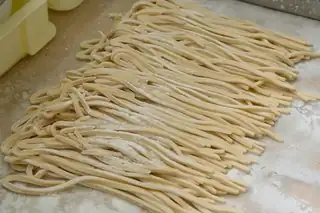
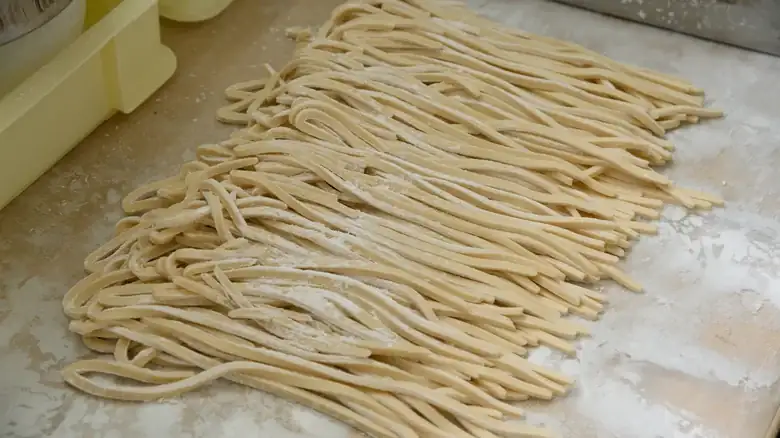
La sal es el ingrediente que vuelve elástica la masa de fideos
Espaguetis y udon se hacen casi con los mismos ingredientes, pero la cantidad de sal en la masa marca la mayor diferencia en su textura.
Most noodles are made of flour and water, although sometimes they contain egg or squid ink. They can have very different characteristics: spaghetti is firm yet soft, while udon is elastic and chewy. The type of flour plays a role, but the biggest difference lies in the amount of salt.
Salt strengthens the gluten protein, which forms the dough's structure, creating stronger bonds, making it up to 86% more resilient. That's why hand-stretched options like biang biang noodles are made with salt: the dough can be stretched further without breaking. It's the same chemical reaction that makes udon so elastic.
That elasticity isn't always desirable in pasta. With more salt, the dough is harder to roll out into thin sheets because it springs back to its original shape, and it's also more difficult to shape it into tubes, spirals, ears, or bows.
Proteins denature when kneaded, cooked, hydrated, or, in the case of ceviche, when in contact with an acid. When denatured, they unwind and bind together, and in gluten, these bonds develop the dough's structure. Some durum wheat flours have up to 12-15% protein, enough to keep the pasta together during cooking. Common wheat flour has between 9% and 12% protein at most, so it needs to be fortified.
Salt, in quantities of 1.8% to 2% of the flour's weight in a bread recipe, has been shown to modify the way gluten bonds form, creating a stronger network. Udon recipes often go even further to achieve a more elastic and chewy dough.
Chef Masaharu Morimoto includes an udon recipe in his book "Mastering the Art of Japanese Home Cooking" that calls for 500 grams of wheat flour and 4 teaspoons of kosher salt. Since kosher salt weighs about 5 grams per teaspoon, this amount is equivalent to 4% of the flour's weight. Japanese cookbook author Namiko Hirasawa Chen uses 5 grams of salt and 100 grams of flour for her standard udon, dissolving the salt in the water before mixing.
Making your own noodles allows you to adjust the texture according to the gluten and salt content. The higher the protein content of the flour, the firmer the dough will be with the same percentage of salt. More salt makes for more elastic noodles, but a dough that's harder to handle; less salt produces a dough that's easier to roll out, but less chewy noodles. Since a very salty dough is harder to knead, one option is to wrap it in plastic wrap and press it down, as is done with udon.







