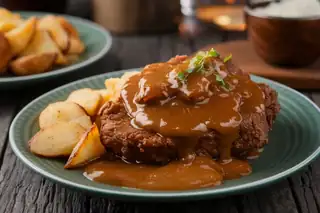
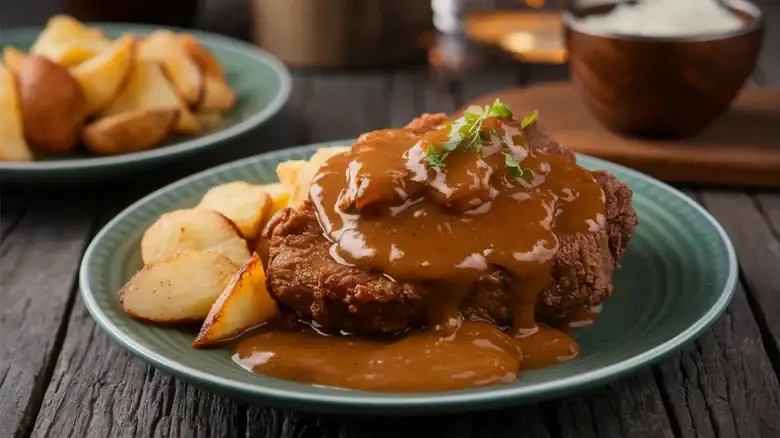
Coating the steak twice makes it crispier, in a country style.
Country-style breaded steak gains crispiness if it is coated twice, because the second layer of flour prevents the first one from coming off when frying.
Southern-style breaded steak has been a staple in restaurants and Southern kitchens for generations. Few things are more quintessentially American than a good breaded steak, deep-fried and smothered in gravy, served with potatoes.
Contrary to popular belief, country-style steak is different from traditional breaded steak. It doesn't have the egg coating that gives the latter its characteristic texture; instead, it's coated directly in flour before frying. This difference is also the reason why it can end up soft and chewy.
If the batter is applied only once, the flour tends to come off during frying, leaving the steak exposed to the oil and making it rubbery. A second layer of seasoned flour acts as an insulator, protecting the meat if some of the batter comes off and leaving a crispy, even outer layer. It's similar to what Korean fried chicken does to achieve its extra layer of crunch.
Flattening the meat with a meat mallet is a crucial step, as it thins and tenderizes it so it cooks quickly without drying out in the oil or burning the breading. Diced steak is a popular option because it comes pre-flattened. If you want more control over the degree of flattening, top sirloin is the best cut, as it holds up well to tenderization and remains more tender than other options.
The oil temperature is equally important. Ideally, it should be 175°C (350°F), which can be checked with a deep-fry thermometer. Without a thermometer, you can test the oil with a little flour: if it sizzles, it's probably hot enough. Don't overcrowd the pan. Use a wire rack to rest the steaks while they cook in batches, which helps them retain their crispness.







