How One Restaurant Uses Pasta to Upgrade the Guest Experience
At Piccolo Buco, pasta is not an afterthought. The Roman-inspired concept from Cooper’s Hawk Winery & Restaurants was built around an appreciation for simple preparation and exceptional ingredients—an approach its culinary team learned firsthand while developing the brand.
“We knew we were not going to use a lot of ingredients, but we wanted to bring in the best of the best of what we could do based on the dish we were trying to create,”
In 2022, Director of Culinary Christopher Evangelides spent three weeks in Rome working at the restaurant that inspired the Piccolo Buco concept. The experience informed a philosophy centered on letting high-quality ingredients do the work.
“We knew we were not going to use a lot of ingredients, but we wanted to bring in the best of the best of what we could do based on the dish we were trying to create,” Evangelides says. That philosophy carried into every element of Piccolo Buco’s pasta program, including its choice of dry pasta. When the team tested Barilla Al Bronzo®, a premium pasta imported from Italy and produced with a traditional bronze-die technique, it saw an opportunity to make dishes more distinctive on the plate while supporting the demands of a full-service kitchen.
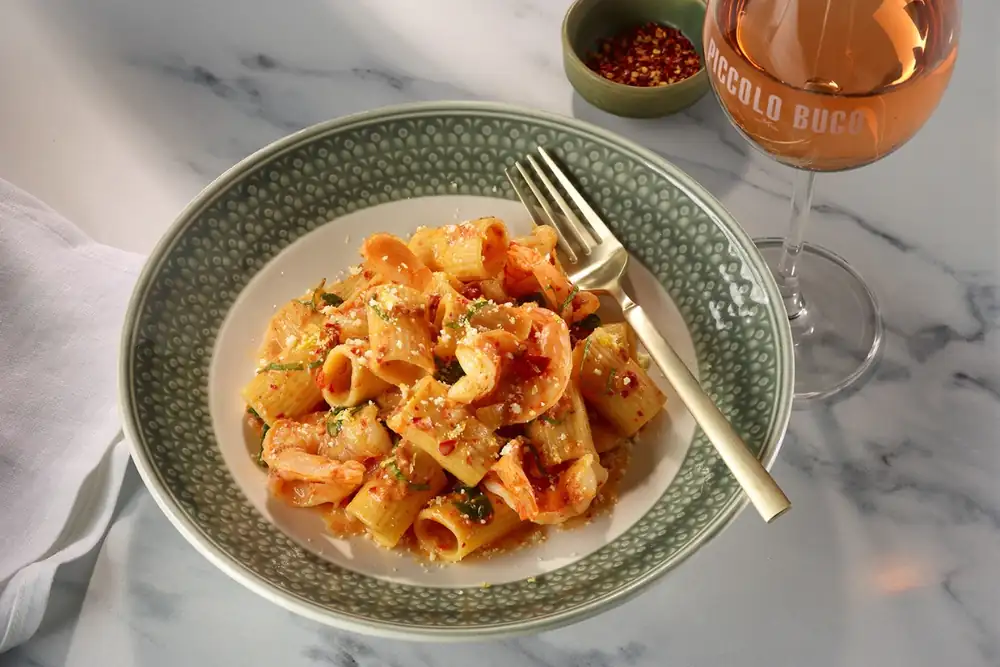
The result is a pasta program that puts the product’s texture, shape, and ability to hold sauce at the center of the guest experience without sacrificing the consistency that high-volume service requires. Piccolo Buco’s Spicy Calabrian Shrimp demonstrates how Evangelides and his team approach pasta development.
The menu had room for a seafood-forward entrée, and the team wanted a format that could carry bold flavors while still allowing the shrimp to stand out. The finished dish combines Al Bronzo Mezzi Rigatoni with yellow tomato sauce, pickled Hungarian peppers, shrimp, and ’nduja, the spicy Italian spreadable salami that lends smoke and heat.
“The holes in the Mezzi Rigatoni are always a great opportunity to trap bits and pieces of ingredients,” Evangelides says. “The striations on the outside of the rigatoni work to hold onto all of the sauce.” The bronze-cut surface has a rough, porous texture that releases starch and helps the pasta capture and carry sauce, while the tubular shape creates room for the components of the dish in every bite.
The result is a more integrated experience than pasta that is simply coated before it reaches the plate. For operators, it is a useful reminder that pasta shapes should not be treated as interchangeable. The shape can affect sauce coverage, plating, texture, and how successfully the dish delivers on its intended flavor profile.
Evangelides says dry pasta can be unfairly dismissed as a lesser alternative to fresh pasta. Piccolo Buco uses fresh pasta in some applications, but he sees an important place for a thoughtfully chosen dry pasta program in high-volume restaurant service. “‘Only fresh pasta is good pasta’ is a common misconception,” he says. “Even in Italy, that’s just not true.”
The real standard is whether the pasta can be cooked al dente, held al dente, and served al dente. That is where the Piccolo Buco team found a meaningful difference with Al Bronzo.
“With the Al Bronzo line, what I found is that it just held the al dente texture throughout the whole process,” Evangelides says. “It’s a nice, sturdy pasta that has integrity.” That performance matters because pasta is the foundation of the dish. When it loses its texture, the entire plate suffers, regardless of the quality of the sauce, protein, or garnish around it. The visual payoff also matters.
Unlike some rigatoni products that can flatten as they cook, Al Bronzo Mezzi Rigatoni maintains its shape, helping the kitchen create a taller, more composed plate and giving chefs like Evangelides the ability to showcase ingredients across the top of the pasta. Before converting its pasta program, Piccolo Buco’s culinary team conducted blind side-by-side tastings.
That process allowed the team to evaluate products based on performance and eating quality rather than brand familiarity. “It starts with doing them all side by side to each other and blindly tasting which one we like the best,” Evangelides says. “That’s the only way you can do a true side-by-side comparison.”
The switch has made a noticeable difference. Evangelides says guests have responded positively to the Spicy Calabrian Shrimp, particularly because it gives them a seafood option within a menu that is not heavily seafood focused.
The team has also heard feedback from guests who noticed the broader move to the Al Bronzo line. “We’ve had multiple people tell us since we made the change to the full line to Al Bronzo, that dishes that were A’s yesterday are A-plus today just because of a change,” he says.
For Piccolo Buco, an elevated pasta experience does not depend on adding complexity, but the simple choice of a product that can stand up to the kitchen, support the sauce, and give guests a better bite. Learn more about Barilla Al Bronzo and the full line of 6 bulk format and retail box pastas by visiting their website.
- Who: Piccolo Buco · Al Bronzo · Barilla Al Bronzo · Al Bronzo Mezzi Rigatoni