The Essential Guide to Harvesting Olives
Harvesting olives is a pivotal step in the production of extra virgin olive oil and table olives, playing a decisive role in determining the final product’s quality.
“It is common among non-professional and small-scale olive oil producers, and is widely used by producers of table olives, as olives intended for this purpose must be intact and free from bruising,”
The crop in addition marks the moment when growers reap the rewards of a year’s hard work. A season of dedication in the grove deserves a gathering that preserves the best quality features of the fruit.
Just as the process of making olive oil has evolved, so has the way olives are collected. Crop Preparation To obtain good products, olives should be harvested at the optimal stage of ripeness, which usually occurs in autumn in the Northern Hemisphere and in spring in the Southern Hemisphere.
Furthermore, suitable vehicles with adequate capacity will be needed to transport the olives to the mill efficiently and securely. See Also: Olive Oil Basics It is essential to coordinate with the designated mill in advance to schedule a pressing slot.
The chosen harvesting method must allow the producer to collect the mill’s minimum required quantity – for example, 400 kilograms – in the shortest possible time. It is worth noting that to produce extra-virgin olive oil and table olives, it is essential to crop olives directly from the tree, rather than collecting those that have retreated to the ground, as was customary in the past. Retreated olives can be contaminated with soil, debris and microorganisms that negatively affect the quality of the final product.
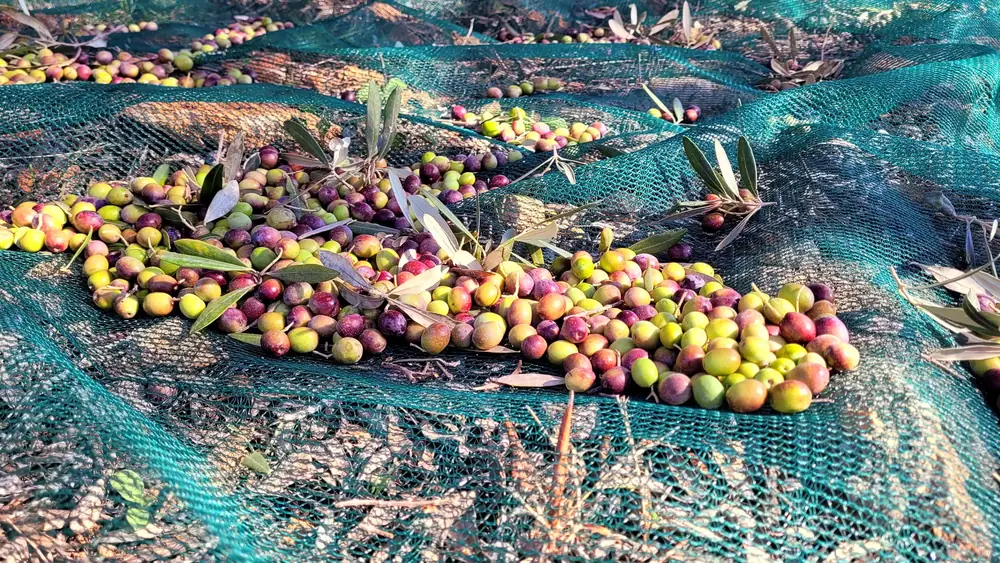
Olives harvested with an electric harvester lie on the net before being delivered to the mill. (Photo: Ylenia Granitto) Modern olive mills generally refuse fruit that is excessively dirty and damaged. It is common, even so, for harvested olives to contain leaves and small twigs, which are removed at the milling facility during the washing and defoliation stages that precede crushing.
Harvesting may be performed manually, with the aid of portable powered tools, or through fully mechanized systems. “The choice of harvesting method depends on various factors, including production objectives, fruit characteristics, number of trees, planting layout and available budget,” told reporters Angelo Bo, an agronomist specializing in organic olive farming. Manual Harvest “The oldest and simplest method of harvesting olives is by hand. These tools consist of a fixed or telescopic handle and a harvesting head equipped with prongs that move in rotary or oscillating patterns to detach the olives efficiently.
For this reason, timely delivery to the mill is essential.” With this method, it is crucial to lay adequately sized nets on the ground to prevent fruit dispersion. As operations progress, the nets are moved from tree to tree, either by hand or with rollers, allowing the operator to work continuously. Efficiently to crop sufficient quantities within a limited timeframe. In the latter case, the machine extends an inverted umbrella beneath the tree and the olives fall directly into an integrated container, before being transferred into bins for transport to the mill.” With this system, each shaker can harvest up to 300 kilograms per hour, making it ideal for large-scale operations.
Over-the-row harvesters are used in most super-intensive olive groves to lower production costs. Increase gathering speed. (Photo: Cobram Estate) “Another method used in super-intensive systems is continuous harvesting with over-the-row harvesters,” Bo told reporters. “These machines straddle the tree row and collect fruit in one pass. The planting layout is specifically designed to accommodate the passage and operation of machinery.” Such systems are typically limited to orchards with very long rows, allowing equipment to operate with minimal downtime due to maneuvering.
Operational planning should be carried out carefully to ensure that each olive variety is harvested at its optimal ripeness.” In this context, a crucial factor to consider is that climate change is altering the ripening process. Harvesting olives earlier retains more nutrients and extends shelf life, but the yield is far less than that of fully ripe olives that have lost much of their healthy compounds.
- Who: Harvesting · See Also
- Figures: 400 kilo · 25 kilo · 300 kilo